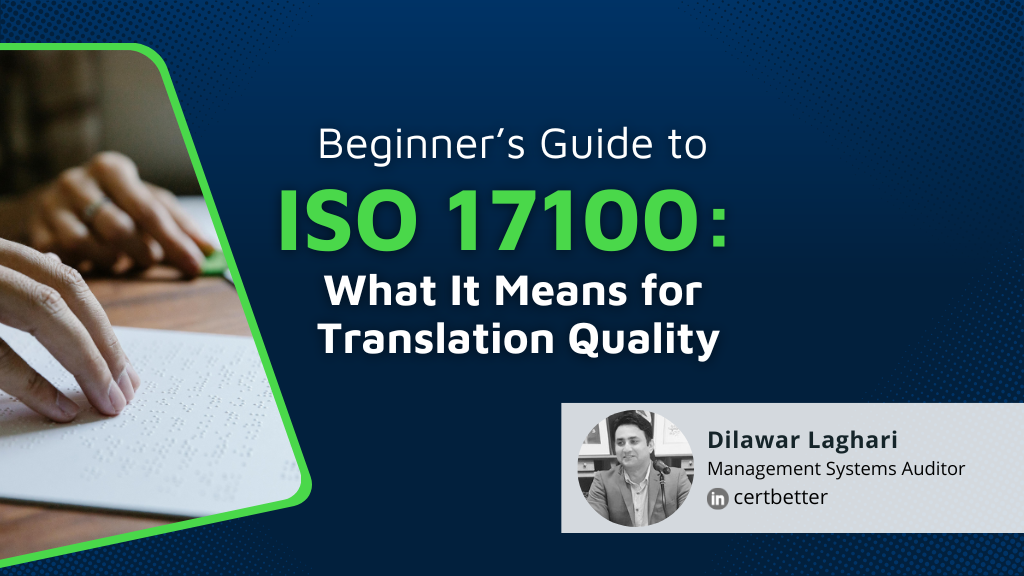
Have you ever tried to read something that was translated into another language, but it just didn’t make sense? Maybe an instruction manual, or a website? That’s where ISO 17100 comes in!
On this page
It’s a set of guidelines that helps translators create translations that are clear, accurate and professional. ISO 17100 defines the requirements for high-quality translation services. It ensures that translations are not just understandable, but also reliable and fit for their intended purpose.
“From healthcare and law to international business and government, ISO 17100 helps organizations deliver professional, accurate, and culturally appropriate translations every time.”
With ISO 17100, companies can make sure their translations are top-notch every time. Whether you're reading instructions, signing contracts, or using a website, you’ll know that the translation is done well!
Recommended Read: ISO 10006: A Practical Guide to Quality Management in Projects
Why ISO 17100 Is Crucial for Your Translation Business
If you operate a translation agency or work as a language service provider, delivering consistent, high-quality work is non-negotiable. Clients expect accuracy, reliability, and professionalism with every project and ISO 17100 gives you the framework to deliver exactly what they expect. .
1. Ensuring Consistent Quality Across Projects
Think of ISO 17100 as your internal quality compass. It defines standardized processes for translation, revision, and quality assurance so that no matter who’s working on a project, the end result meets the same high standard.
This consistency is what sets professional agencies apart from freelancers or unverified providers. With ISO 17100, your team can scale without sacrificing quality, giving clients confidence in your work no matter the scope or subject.
2. Building Long-Term Client Trust
Trust is everything in the language services industry. When clients see that your processes are ISO 17100 certified, it tells that you follow global best practices and take quality seriously. This trust becomes a competitive edge. ISO Certified agencies are more likely to retain clients, win large contracts, and be included in RFPs (especially with enterprise and government buyers).
3. Raising the Bar for Translator Competence
Translation is more than just bilingual fluency, it requires subject-matter expertise, cultural understanding, and editorial precision. ISO 17100 outlines clear criteria for translator qualifications, including formal education and relevant experience. This ensures that every linguist on your team meets a defined professional standard, improving the overall quality and credibility of your services.
4. Protecting Client Data with Secure Practices
Translation often involves sensitive information such as legal documents, medical records, business strategies, and more. ISO 17100 includes requirements for data security, confidentiality, and secure file handling, which demonstrates to clients that their information is protected. This is especially critical for regulated industries like healthcare, finance, or government.
5. Driving Continuous Improvement
One of the strengths of ISO 17100 is that it’s not a static checklist, it encourages ongoing learning and optimization. By building regular reviews, client feedback loops, and performance monitoring into your operations, your team can continuously improve workflows and client satisfaction. Over time, this leads to better results, stronger teams, and more efficient project delivery.





Practical Checklist for Implementing ISO 17100
If you want to improve your translation business with ISO 17100, here's a simple checklist to help you get started. It will guide you through important steps to make sure everything is up to standard.
1. Do You Offer Translation Services?
First things first, do you offer translation services? If you do, then ISO 17100 can help you. It makes sure you have a clear, standard way of doing your work. This way, your clients know exactly what to expect from you every time. By following this standard, you can improve the way you work and make sure your translations are always top-quality.
2. Are You Meeting the Required Qualifications for Your Translators?
Your translators need to be experts, right? ISO 17100 sets the rules for what kind of skills and certifications translators should have. This helps make sure that the people working on your translations know what they're doing. By checking that your translators meet these standards, you can guarantee that their work will always be accurate and professional.
3. Is Your Translation Process Well-Documented?
Having a clear plan is very important. When you document your translation process, it helps you stay organized and work smoothly. ISO 17100 encourages businesses to write down how they do everything, from the first draft to the final review. This way, you can follow the same steps each time and make sure nothing is missed.
4. Do You Prioritize Quality Assurance and Review Procedures?
To make sure your translations are perfect, you need to double-check them. ISO 17100 stresses the importance of reviewing your work. It’s not enough to just translate—someone else should look over the translation to make sure it’s correct. This step helps catch any mistakes and makes sure your clients get the best possible result. So, always make quality control a priority!
5. Are You Committed to Confidentiality and Data Protection?
When you’re working with private documents or sensitive information, keeping everything safe is a must. ISO 17100 includes strict rules for protecting client data. It’s like locking up important documents. By following these guidelines, your clients will feel confident that their information is secure and treated with respect.
Key Components of ISO 17100: Ensuring High-Quality Translation Services
Let’s break down the key parts of ISO 17100 that help to make sure your translations are top-quality every time. These parts are like the building blocks of a great translation service.
I. Translator Qualifications and Competence
To get the best translations, your translators need to be really good at what they do. ISO 17100 sets clear rules about what skills and experience translators should have. They need to know more than just the language, they should also understand the subject matter they’re translating. For example, a translator working on medical documents should know medical terms well. By following these standards, you make sure your translators can deliver high-quality work.
II. Process Requirements
ISO 17100 explains how to set up a clear process for every translation project. This includes managing the project, reviewing the work, and delivering the final result to the client. It’s like following a recipe, if you know the steps to take, you won’t miss anything important. When your process is defined, everything runs smoothly, and you can provide better translations on time.
III. Technology and Tools
Using the right tools can make your translation work faster and better. ISO 17100 encourages businesses to use good translation software and tools that help improve accuracy and efficiency. These tools can help translate faster, check for mistakes, and keep everything organized. Think of them like helpers that make your job easier. When you use the best technology, you can focus on what really matters, getting the translation just right.
IV. Quality Assurance and Review
It’s never a bad idea to double-check your work. ISO 17100 says that every translation should go through a review process to make sure it’s accurate and high-quality. This means having someone else read over the translation to catch any errors or improve the wording. By reviewing your work carefully, you make sure your clients always get the best results.
V. Client Interaction and Communication
It’s important to talk clearly with your clients. ISO 17100 has guidelines for managing feedback from clients. This includes listening carefully to what they want, setting clear expectations, and making sure they’re happy with the result. Sometimes clients might have changes or questions, and you need to address them. Good communication helps build trust with your clients and makes them feel comfortable working with you.
Reommended Read: ISO 10002 Simplified – A Practical Guide to Effective Customer Satisfaction & Complaints Handling
Steps to Align with ISO 17100
Aligning your translation services with ISO 17100 is a step-by-step journey that ensures your work is always at the highest quality. Let’s break it down into simple, easy-to-follow steps.
Step 1. Understanding the Standard
The first thing you need to do is learn all about ISO 17100. Think of this as reading a guidebook. ISO 17100 tells you exactly what’s needed to run a quality translation service. Take the time to read and understand what it requires so you can follow it correctly.
For example, imagine you work for a translation company that translates documents for legal firms. ISO 17100 will guide you on the specific skills and qualifications your translators need, such as knowledge of legal terminology and certification. This way, you can ensure your translators meet the necessary standards for high-quality legal translation.
Step 2. Gap Analysis
Next, you’ll need to look at your current process and see where you might be missing the mark. This is called a gap analysis. Ask yourself: Are you following all the rules for translator qualifications? Are you using the right tools? Is your process clear and well-organized? Finding where you’re not quite meeting the ISO 17100 standard will show you what needs to be improved.
For example, if you run a translation agency for businesses, you might find that some of your translators don’t have the right experience in specific industries, like technology or marketing. This is where the gap analysis helps. Once you spot this, you can make changes, like hiring translators with more specialized skills or offering additional training.
Step 3. Developing a Quality Translation Policy
Now it’s time to write down your plan. This is where you create policies that explain how you’ll follow ISO 17100. These policies should cover things like making sure translators have the right skills and how you’ll manage translation projects from start to finish. A clear policy will guide everyone on your team to ensure they know what’s expected and how to meet the standard.
For example, if you’re managing a team that works with medical translation, your policy might include a requirement that all translators must have experience in medical fields. This will ensure that everyone understands the specific requirements for translating things like patient records or clinical trial reports.
Step 4. Training and Development
For your team to meet ISO 17100, they need to be trained. This includes giving your translators and project managers the skills and knowledge they need to follow the standard. You might set up workshops or online courses. The more your team knows, the better they can perform.
For example: Think about an e-commerce company that needs product descriptions translated into different languages. Training your translators in e-commerce jargon and understanding how to adapt content for different cultures will improve the quality of your translations. If your translators aren’t familiar with the cultural differences in marketing, a product description could end up sounding awkward or offensive in another language.
Step 5. Implementing the Standard
Now it’s time to put everything into action. Start setting up systems and processes that match ISO 17100. This includes adding quality control steps, using the right technology, and making sure communication is clear and consistent. Having these things in place makes sure that every translation project runs smoothly and follows the best practices. In this way, you can avoid repeating the same mistakes and make sure your translations stay consistent across different projects.
For instance, let’s say you run a translation service for marketing materials. You might start using translation memory tools that store phrases or words previously translated, allowing you to keep your translations consistent across projects. This is part of the process to implement the standard and keep the quality high.
Step 6. Monitoring and Continuous Improvement
Finally, keep track of how everything is going. ISO 17100 encourages you to regularly check how well your processes are working. Are your translations getting better? Are your clients happy? Use feedback to adjust your processes and keep improving. This step helps you stay on track and ensures that you’re always getting better.
For example, if you provide translation services for a global tech company, you might regularly ask for feedback from your clients about the clarity and accuracy of your translations. If you hear that a particular area, like technical documentation, needs improvement, you can adjust your processes and offer extra training to your translators to ensure better results next time.
Challenges in Implementing ISO 17100
When you decide to implement ISO 17100 in your translation business, there are several challenges that might come up. These challenges can be managed with the right approach and mindset. Let's look at some of the main hurdles you might face.
1. Resistance to Change
One of the first challenges you’ll face is resistance to change. People tend to feel comfortable with the way things have always been done. When you introduce new processes, some team members may be hesitant or unsure about adopting them. Overcoming this resistance involves clearly explaining the benefits of the changes, such as better-quality translations and improved client satisfaction.
2. Resource Allocation
Implementing ISO 17100 might require significant investment in resources. This could involve purchasing new tools, training your team, or bringing in experts. Balancing the cost of these improvements with the need to maintain high-quality translation services is a challenge. While the upfront costs may seem high, the long-term benefits, such as increased efficiency and client satisfaction, usually outweigh the initial investment.
3. Managing Translators’ Continuous Development
ISO 17100 requires that translators keep their skills up to date. This means they must maintain certain qualifications and continue their professional development. The translation industry is always evolving, and keeping translators trained on the latest tools, trends, and techniques is essential. It’s important to provide ongoing training and development opportunities to ensure that translators remain competent and capable of meeting the high standards required by the standard.
4. Consistency Across Projects
Achieving consistency across different projects can be challenging, especially when multiple translators are involved. Each translator may have their own approach or style, and making sure the final product feels unified can be difficult. However, maintaining consistency is crucial for ensuring the translation meets the client’s expectations and aligns with the original content.
5. Meeting Client Expectations
Clients often have high expectations when it comes to translation quality. They expect accurate, timely, and professional translations. At times, clients might request shortcuts or tight deadlines, but it’s important to stick to the processes outlined in ISO 17100. This ensures that the quality of the translation is never compromised and that the final product meets the client’s requirements.
Additional Considerations
When you’re working to implement ISO 17100, there are a few other important factors to keep in mind. These considerations help ensure that your translation services are always improving and staying up to the highest standards.
Leadership Commitment
To successfully implement ISO 17100, it’s important to have strong support from leadership. This means that the leaders in your business need to fully invest in quality translation practices and continuous improvement. When leadership commits to these changes, it sets the tone for the entire team, encouraging them to take the process seriously and work toward achieving the best results.
Technology Integration
The right technology can make a huge difference in how efficiently your translation processes run. From translation memory tools to automated quality checks, integrating the latest technologies can streamline workflows, reduce errors, and speed up delivery times. By using modern tools, your team can focus on more complex tasks while the technology handles repetitive ones, allowing you to deliver better quality translations faster.
Client Relations and Confidentiality
A key element of ISO 17100 is maintaining strong relationships with clients and safeguarding their data. Clients trust you with sensitive information, so it’s crucial to ensure that you meet the highest standards of confidentiality and security. This can involve setting up clear processes for handling client data, ensuring that all team members understand their responsibilities, and using secure systems to store and transmit information. By doing so, you’ll build trust and loyalty with your clients, which is essential for long-term business success.
Ongoing Evaluation and Refinement
ISO 17100 isn’t something you just implement once and forget about. It’s important to regularly review and refine your translation processes. This ensures that your services stay top-notch and continue to meet the evolving needs of your clients. Regular feedback, both from clients and within your team, can help you identify areas for improvement and implement changes that enhance your service delivery.
Conclusion: The Value of ISO 17100 for Translation Services
ISO 17100 is essential for ensuring high-quality, consistent, and reliable translation services. By following the standard, translation businesses can streamline their processes, ensuring that every project meets the highest standards of accuracy and professionalism.
Aligning with ISO 17100 not only improves the quality of the work but also enhances your business's reputation. Clients are more likely to trust and return to companies that demonstrate their commitment to quality. This leads to greater client satisfaction and long-term business success.
We encourage every translation business to adopt ISO 17100 practices. It provides a solid foundation for continuous improvement and offers a competitive edge that helps businesses stand out in the ever-growing translation market.