ISO 13485 certification cost is unlike any other ISO standard. Medical device audits are longer, more technically demanding, and more tightly regulated than quality or environmental management audits — because the consequences of a non-conforming medical device are not a dissatisfied customer but a patient outcome. That regulatory weight is visible in both the audit day requirements and the certification fees.
On this page
Device Risk Class: The Primary Cost Driver
Medical devices are classified by risk under the IMDRF Global Medical Device Nomenclature framework — the same system used by the TGA in Australia, the MHRA in the UK, the FDA in the US, and Health Canada. Your device's risk classification determines the depth of audit required, the intensity of design control review, and in Australia, the specific TGA regulatory pathway you must follow alongside ISO 13485 certification.
The IAF MD5 mandatory document sets base audit days by employee count, but ISO 13485 audits routinely exceed these minimums. Class IIb and Class III device manufacturers face additional audit time for design history file review, post-market surveillance data, complaints handling records, and sterility or biocompatibility evidence as applicable.





ISO 13485 Certification Cost by Device Risk Class
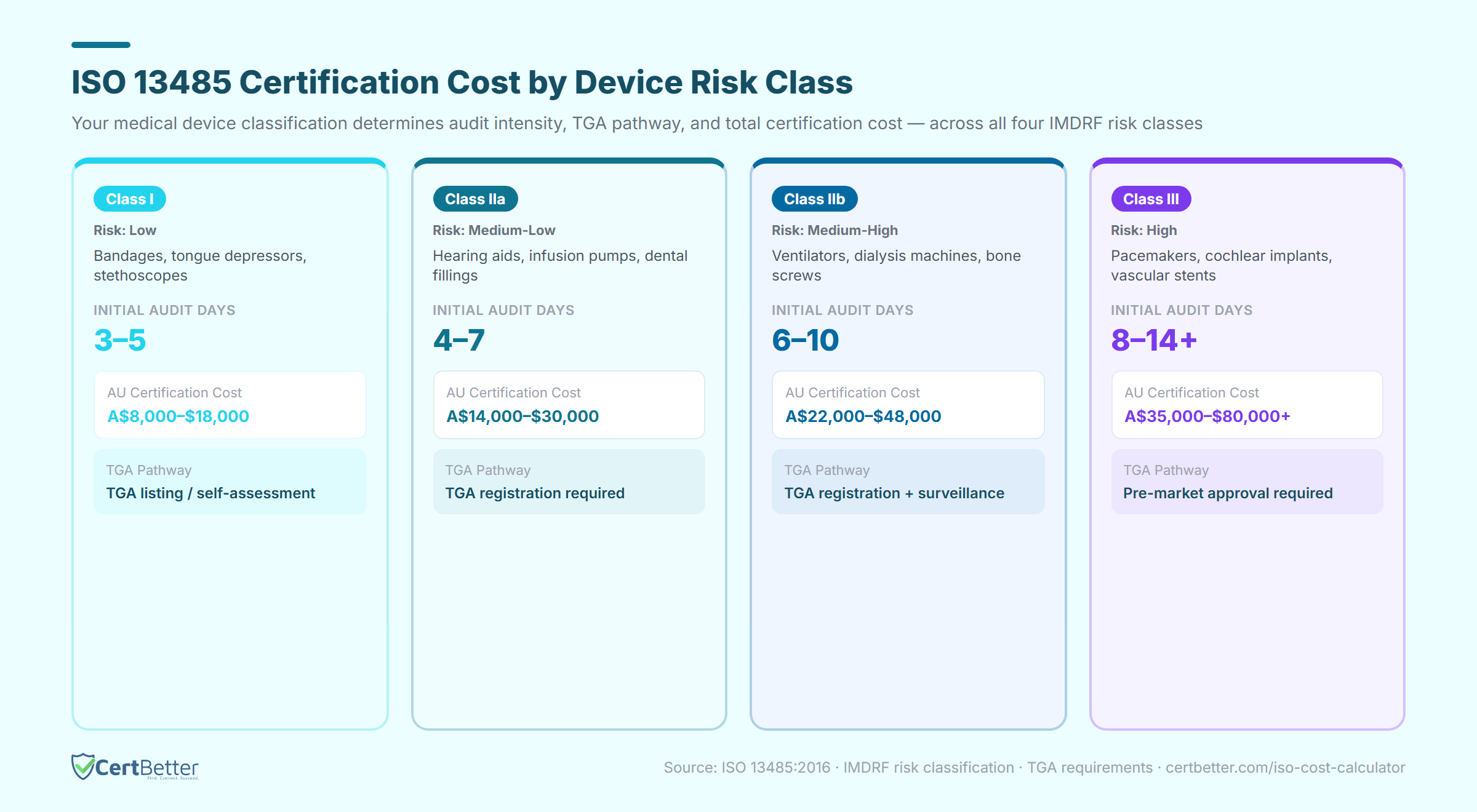
Initial certification estimates. Excludes TGA registration fees, product testing, biocompatibility studies, and consulting. Source: IAF MD5, IMDRF classification, TGA requirements, and CertBetter provider data.
Design Controls: What Class II and III Auditors Are Looking For
Clause 7.3 of ISO 13485 covers design and development — and for Class II and III device manufacturers, this is often the most intensive part of the audit. Auditors review your design input and output records, design verification and validation studies, design transfer documentation, and design change records. A manufacturer that has been modifying its device design without maintaining corresponding DHF (Design History File) records will typically receive multiple major nonconformances, requiring significant remediation before certification can proceed.
For manufacturers producing sterile devices or devices that contact the body, biocompatibility evaluation under ISO 10993 is expected as evidence. Our comprehensive guide to biological evaluation of medical devices under ISO 10993 explains what this requires in practice.
TGA Registration and ISO 13485: How They Interact
In Australia, ISO 13485 certification is a prerequisite for most TGA medical device registration pathways. The TGA does not directly recognise ISO 13485 certificates — it has its own conformity assessment framework — but a current ISO 13485 certificate from a TGA-approved auditing body can substitute for a TGA conformity assessment certificate in certain registration pathways.
This creates a practical consideration: not all ISO 13485 certification bodies are TGA-approved auditing bodies. If you need both ISO 13485 certification and TGA regulatory compliance, selecting a certification body that holds both accreditations saves you from running parallel audits with two separate bodies. The ISO 13485 cost calculator helps you identify providers with the right regulatory scope for your device class and market.
Get Your ISO 13485 Cost Estimate
The free CertBetter ISO 13485 cost calculator generates a personalised estimate based on your device risk class, employee count, number of product lines, and target markets. It covers Australia, UK, US, and Canadian certification requirements and flags where TGA, MHRA, or FDA-specific considerations affect your cost profile.
How long does ISO 13485 certification take for a medical device startup?
Most startups take nine to eighteen months from QMS design to receiving their certificate. Class I devices with limited design controls can move faster. Class III devices with full design history files, clinical data, and sterility validation routinely take longer. The audit itself is typically two to five days depending on device complexity — the timeline is dominated by QMS documentation and product evidence preparation.
Do I need ISO 13485 for software-only medical devices (SaMD)?
Yes, if your software is classified as a medical device under TGA or equivalent regulatory frameworks. Software as a Medical Device is subject to IMDRF SaMD risk classification — many SaMD products fall into Class IIa or IIb based on their intended use and information provided by the software. ISO 13485 certification requirements apply the same way as for physical devices, with Clause 7.3 design controls particularly relevant to software development lifecycle documentation.
What is the difference between ISO 13485 certification and CE marking?
CE marking is a regulatory authorisation required to sell medical devices in the European Economic Area. ISO 13485 certification is a management system certification. In the EU MDR (Medical Device Regulation) framework, a certified ISO 13485 QMS is a component of the technical documentation a Notified Body reviews when issuing a CE mark — but they are separate processes conducted by separate bodies. ISO 13485 alone does not grant CE marking or market access in any jurisdiction.
Can ISO 13485 audits be conducted remotely?
Document review, management interviews, and procedure walkthroughs can be conducted remotely. However, physical site activities — sterility controls observation, manufacturing process verification, incoming inspection review, and calibration record checks — typically require an on-site visit, particularly for Class IIb and III devices. Hybrid audits covering documentation remotely and site observation on-site are common and reduce overall cost compared to fully on-site engagements.
Are there ISO 13485 requirements specific to packaging?
Yes — Clause 7.5.11 covers requirements for sterile device packaging, and ISO 11607 provides the detailed technical requirements for sterile barrier systems. For device manufacturers producing sterile or near-sterile products, packaging validation is a specific audit focus. Our guide to ISO 11607 and medical device packaging compliance covers the validation requirements in detail.