ISO 14001:2026 is coming. The Final Draft International Standard (FDIS) was published on 5 January 2026, the last formal step before the standard is released. Publication is expected in April 2026. After that, every organisation certified to ISO 14001:2015 will have until May 2029 to transition to the new edition.
On this page
This is not a rewrite. The revision is deliberately evolutionary. The core structure and requirements of ISO 14001 remain intact. But seven specific clauses have changed in ways that will require documented action, and one brand new clause has been added. If your organisation holds ISO 14001 certification, understanding what changed now is the right move, not waiting until your certification body raises it at your next surveillance audit.
Why ISO 14001 Is Being Revised Now
ISO 14001:2015 was published over a decade ago. In the years since, the environmental management landscape has shifted significantly. Climate risk has moved from a background consideration to a front-page business concern. Biodiversity loss has become a formal regulatory and reporting category across major economies. Supply chain environmental accountability has become a procurement and legal requirement in many sectors, not just a voluntary aspiration.
The 2024 climate change amendment (Amd 1:2024) already made climate considerations mandatory for organisations certified to ISO 14001:2015. The 2026 revision builds on that and goes further. It integrates biodiversity, ecosystem health, and resource availability into the core requirements of the standard. It extends environmental accountability further into supply chains. And it introduces a formal change management clause that was missing from the 2015 version.
The revision also brings ISO 14001 into closer alignment with ISO 9001, ISO 45001, ISO 50001, and ISO 27001, making integrated management systems easier to implement and audit consistently across all standards.





The Transition Timeline
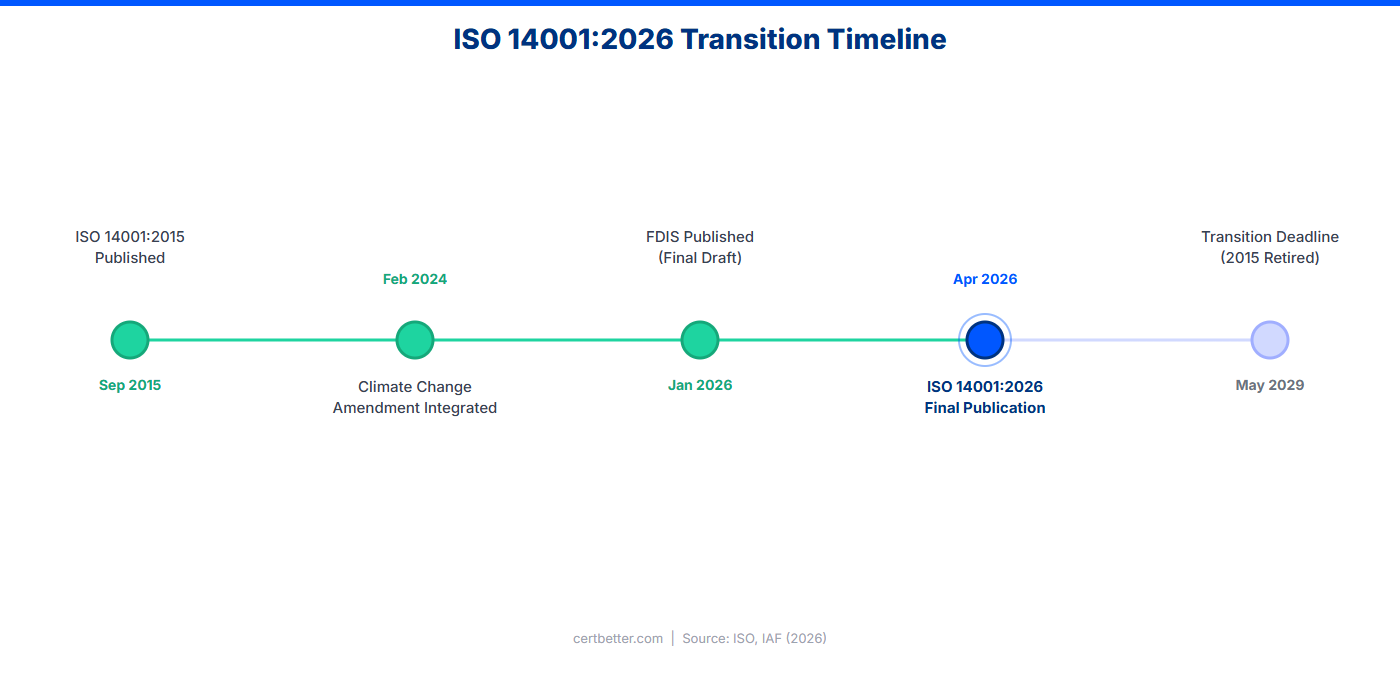
Three years sounds comfortable. In practice, certification bodies typically begin offering transition audits within several months of the final standard being published. Early movers can combine their transition with a scheduled surveillance or recertification audit, avoiding additional audit costs. Organisations that wait until 2028 or 2029 will be competing for auditor availability alongside a rush of late transitioning businesses.
The IAF has proposed a mandatory three-year transition window based on a draft document circulated for national member body input. This aligns with the transition periods used for ISO 9001:2015 and ISO 45001:2018. Once confirmed, certificates issued to the 2015 edition will no longer be recognised after the transition deadline. Your certification body will communicate the exact process for your certificate.
What Changed: Clause by Clause

Clause 4.1: Broader Environmental Context
The 2015 edition required organisations to consider external and internal issues relevant to their environmental management system. The 2026 revision adds illustrative examples to this clause: biodiversity, ecosystem health, pollution levels, and natural resource availability. These join climate change, which was already added as a mandatory consideration via the 2024 amendment.
This change is significant in practice. An organisation that previously reviewed its context by looking at energy use and waste generation now needs to consider whether biodiversity loss, local pollution levels, or water scarcity are material issues in its operating environment. If they are, those factors need to flow into objectives, risk registers, and operational controls. If they are not material, the organisation must be able to demonstrate that assessment was made.
Clause 5.1: Leadership Accountability Extended
Top management responsibilities have been extended to cover support for leadership across all relevant roles in the organisation, not just formal management positions. The practical meaning is that environmental accountability can no longer be treated as the preserve of a dedicated EMS manager. It needs to be embedded in how the organisation operates across functions.
This also shifts how auditors will evaluate leadership commitment. Evidence of top management engagement will need to go beyond signed policies and attendance at management reviews. Auditors will look for demonstration that environmental responsibility is genuinely understood and owned at the senior level.
Clause 6.1: Risks and Opportunities Restructured
The planning clauses have been reorganised for clarity. Most of the content previously in Clause 6.1.1 has moved into a new dedicated Clause 6.1.4, titled Risks and Opportunities. This new clause makes an important clarification explicit: the issues and requirements identified in Clause 4 do not automatically represent business risks or opportunities. Some environmental conditions may be material to the environment without having a direct business impact, and the standard now formally acknowledges that distinction.
Clause 6.1.2 has been updated to give clearer guidance on applying a life cycle perspective when identifying environmental aspects. Previously, life cycle thinking was expected but the guidance on how to apply it was limited. The 2026 version sets out more explicitly how this approach should work, covering normal and abnormal operating conditions as well as potential emergency situations.
Clause 6.3: Change Management (New)
This is the only genuinely new clause in the revision. ISO 14001:2015 had no formal requirement for managing planned changes to the EMS. The 2026 revision adds Clause 6.3, requiring organisations to determine, plan, and manage changes that affect or could affect the intended outcomes of the environmental management system. Emergency situations are distinguished from planned operational changes.
ISO 9001:2015 has carried a similar change management clause for over a decade. Organisations with an integrated management system will recognise this requirement. For those with a standalone ISO 14001 system, this is new. It means adding a documented process for evaluating EMS-relevant changes before they are implemented: operational changes, new products, infrastructure works, supplier switches, or significant process modifications.
Clause 8.1: Supply Chain Scope Expanded
The terminology change in this clause has real practical weight. The previous reference to “outsourced processes” has been replaced with “externally provided processes, products and services.” This broader framing mirrors the approach taken in ISO 9001:2015 and expands the organisation's environmental accountability further into its value chain.
Organisations that previously limited their operational controls to direct operations and outsourced manufacturing processes now need to consider the environmental impacts of a wider range of external providers. Procurement criteria, supplier assessments, and contractual environmental requirements may all need revisiting. The revision reinforces that the supply chain is part of the environmental management system, not separate from it. This aligns directly with how ISO 14001 connects to ESG reporting obligations, where Scope 3 supply chain emissions and impacts are increasingly required.
Clause 9.2.2: Internal Audits Must Have Defined Objectives
Internal audits in the 2015 edition required a defined scope and criteria. The 2026 revision adds a third requirement: defined objectives. This is a meaningful change. An audit conducted to verify compliance with a specific legal requirement has a different objective than one conducted to assess the effectiveness of a new operational control. The standard is now explicit that organisations must know what they are trying to achieve before an audit begins, not just what they are auditing against.
For organisations with mature internal audit programmes, this will be a documentation update. For those running informal internal audits, this is a prompt to build more deliberate audit planning into the programme.
Clause 9.3: Management Review Restructured
The management review clause has been reorganised into three subclauses: 9.3.1 (General), 9.3.2 (Inputs), and 9.3.3 (Results). The content itself has not changed significantly, but the structure makes the connection between inputs and results clearer and easier to audit. Organisations should update their management review templates to reflect the new structure ahead of their transition audit.
Clause 10: Continual Improvement Simplified
Former Clauses 10.1 and 10.3 have been consolidated into a single revised clause. This simplifies the improvement section without changing the underlying intent. Most organisations will need only minor documentation adjustments here.
What Your Certification Body Will Check During Transition
When you transition from ISO 14001:2015 to ISO 14001:2026, your certification body will conduct a transition audit. The audit will focus on the gaps between your current system and the new requirements. Based on the changes above, auditors will specifically look for:
- Evidence that biodiversity, ecosystem health, pollution levels, and resource availability have been assessed in the context analysis (Clause 4.1). A statement that they were considered and found not material is sufficient if justified. No consideration at all is a nonconformity.
- Demonstration that top management engagement goes beyond a signed policy and annual management review attendance.
- A documented change management process (Clause 6.3) covering how the organisation identifies, evaluates, and controls EMS-relevant changes.
- Updated internal audit records showing defined objectives for each audit in addition to scope and criteria.
- Procurement and supplier controls that reflect the broader “externally provided processes, products and services” scope.
- Updated management review documentation structured to the new 9.3.1/9.3.2/9.3.3 format.
The extent of work required depends on how rigorously your current system is documented and how proactively you engaged with the 2024 climate change amendment. Organisations that treated the 2024 amendment seriously will have a shorter gap to close. Those that did the minimum will have more to do.
What to Do Now
The FDIS is published and the final standard is weeks away. The right time to start is now, not after publication.
Start with a gap analysis against the FDIS. Go through each changed clause and document what your current system covers and what it does not. This does not need to be a large project. For most certified organisations, the gaps will be in three or four specific areas: the broadened context analysis, the new change management clause, audit objective documentation, and supplier environmental controls.
Update your context analysis to explicitly address biodiversity, pollution, and resource availability alongside climate change. If these are not material issues in your operating environment, document why. That assessment is what the auditor needs to see, not a detailed biodiversity impact study.
Create a simple change management procedure for Clause 6.3. It does not need to be complex. A documented process for how the organisation evaluates EMS-relevant changes before implementation is sufficient. Build it around changes you already manage: operational modifications, new equipment, significant supplier changes, and facility expansions.
Review your internal audit templates to include an “audit objective” field alongside scope and criteria. Update your management review template to the new three-part structure.
Then talk to your certification body about scheduling. Many will offer combined transition and surveillance audits. ISO 14001 certification is increasingly connected to sustainability reporting requirements across Australian and UK businesses. Getting ahead of the transition protects the value your certification delivers in tender responses, investor reporting, and supply chain qualification.
CertBetter helps Australian and UK businesses compare ISO 14001-accredited certification bodies side by side. If you are planning your transition or want to compare quotes for ISO 14001 certification, submit your requirements once and receive responses from multiple accredited bodies. Visit certbetter.com to get started.