ISO 14001 certification costs are shaped by a different set of factors than most other ISO standards. Because auditors must physically observe your environmental aspects in operation — the machinery, the waste streams, the stormwater drainage — there are limits to how much cost can be removed through remote auditing. That said, the price range is still wide, and knowing what drives it puts you in a much stronger position when comparing quotes.
On this page
How Environmental Management Audits Are Priced
Like all ISO certification audits, ISO 14001 pricing begins with the IAF MD5 mandatory document — the international framework that specifies minimum audit days based on employee count and complexity. But ISO 14001 adds a layer that ISO 9001 does not: your organisation's environmental aspects.
An environmental aspect is any activity, product, or service that can interact with the environment — fuel combustion, chemical storage, effluent discharge, energy use, waste generation. The more significant aspects your organisation has, the more audit time is required to verify controls. A 30-person logistics company with a large vehicle fleet and fuel usage will require more audit days than a 30-person software consultancy with a minimal environmental footprint.
The CertBetter ISO 14001 cost calculator accounts for both your employee count and your industry's environmental risk profile when generating your estimate.





What Drives ISO 14001 Certification Cost
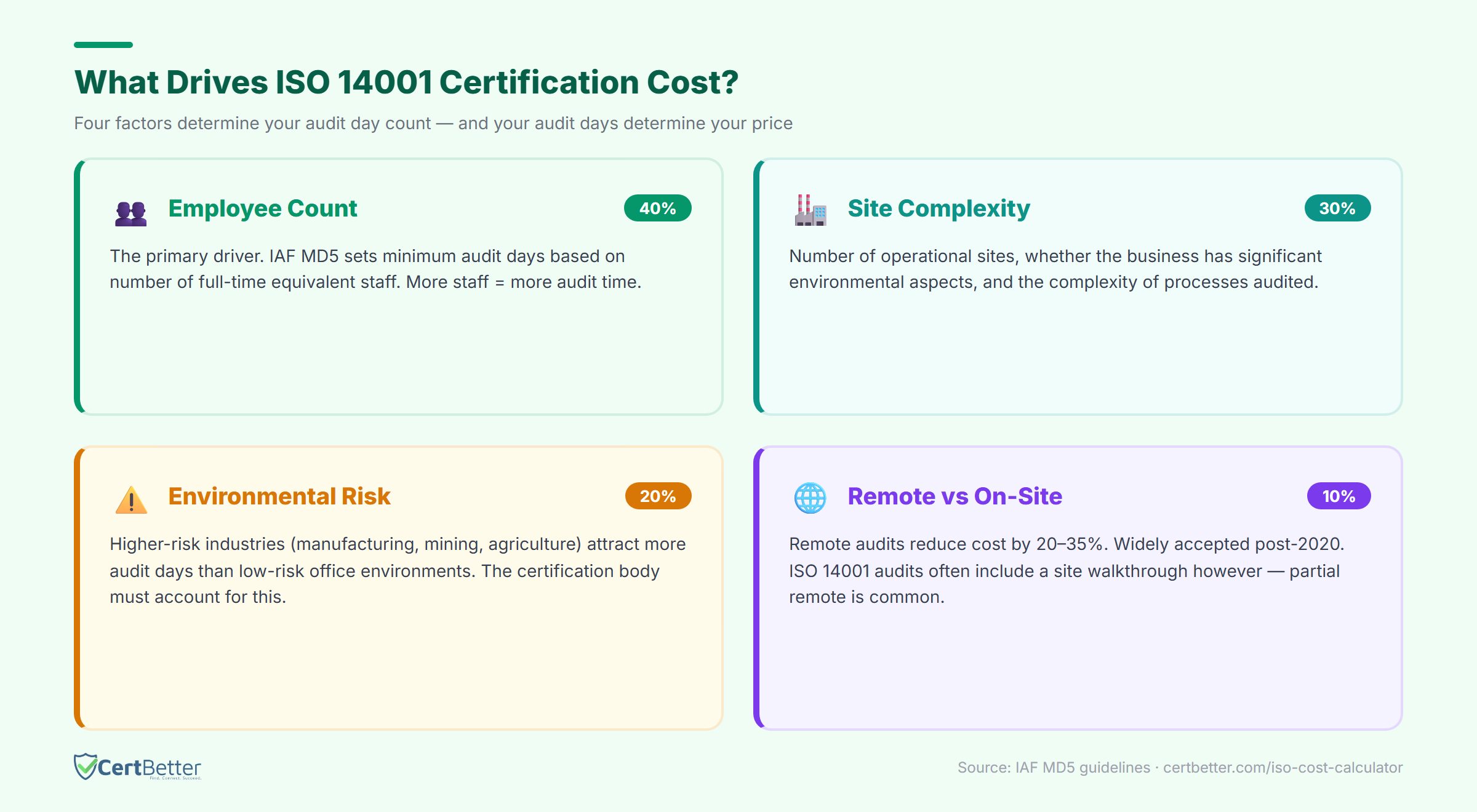
Source: IAF MD5 guidelines and CertBetter provider data. The percentage weights shown reflect typical influence on total audit day allocation.
Based on current market rates, here is what ISO 14001 certification typically costs by business size:
- Micro (1–10 staff): A$4,000–$9,000 / £3,500–£7,000 / US$4,000–$8,500
- Small (11–50 staff): A$8,000–$18,000 / £6,500–£14,000 / US$7,500–$16,000
- Medium (51–200 staff): A$15,000–$32,000 / £12,000–£25,000 / US$13,500–$28,000
- Large (201–500 staff): A$26,000–$55,000 / £21,000–£43,000 / US$24,000–$50,000
These are audit-only estimates. For a breakdown of implementation and ongoing costs, see our detailed guide on the total cost of implementing ISO 14001.
Can ISO 14001 Audits Be Conducted Remotely?
Partially, yes. Remote auditing became widely accepted post-2020, and many certification bodies now conduct document reviews, management interviews, and procedure walkthroughs via video. However, ISO 14001 audits typically include a site inspection element — particularly for Clause 8.1 (operational control) and Clause 9.1 (environmental monitoring). High-risk sites often require at least one physical visit per certification cycle.
This means ISO 14001 cost reductions from remote auditing are real but more limited than with ISO 9001. A hybrid approach — document review remotely, site walkthrough on-site — is common and accepted by most accredited certification bodies.
ISO 14001 and Sustainability Reporting: The Hidden Value
One factor that justifies the ISO 14001 investment beyond pure compliance is its alignment with sustainability reporting frameworks. Businesses reporting under GRI, TCFD, or preparing for mandatory climate disclosures find that a certified EMS provides the documented evidence base regulators and auditors expect. Our post on how ISO 14001 supports sustainability reporting covers this in detail.
For businesses responding to supply chain sustainability requirements from major customers, ISO 14001 certification often becomes commercially unavoidable. Understanding the cost upfront removes the surprise from what is actually a predictable investment.
What the ISO 14001 Cost Calculator Gives You
The free ISO 14001 cost calculator generates a personalised estimate in under two minutes based on your employee count, industry, location, and audit preference (remote or on-site). It uses IAF MD5 audit day logic and real data from verified ISO 14001 certification bodies currently active on the CertBetter platform.
If you want actual competing quotes — not just an estimate — you can request them through the calculator at no cost. Providers are verified, accredited, and current on ISO 14001:2015 requirements.
Does ISO 14001 cost more than ISO 9001?
Not necessarily, but it often does for businesses with significant environmental aspects. The audit day minimums from IAF MD5 are similar, but a complex environmental profile (multiple aspects, multiple sites, waste streams, chemical handling) can push the audit day requirement above an equivalent ISO 9001 audit. Low-environmental-impact businesses (professional services, IT) typically pay similar rates to ISO 9001.
Can I certify ISO 14001 and ISO 9001 at the same time?
Yes — an integrated management system audit covering both standards simultaneously is cheaper than two separate audits. Because ISO 9001 and ISO 14001 share the same High Level Structure, the audit time required for a combined audit is typically 30–40% less than certifying each separately. The cost calculator accounts for integrated audits.
How long does ISO 14001 certification last?
Three years, with annual surveillance audits in year one and year two. The surveillance audit is typically 50–70% of the initial audit cost. Budget accordingly — the true three-year cost of certification is approximately 2.2–2.5 times the initial audit fee.
Are there industries where ISO 14001 is mandatory in Australia?
Not as a statutory requirement in most sectors, but many government procurement frameworks and large-enterprise supply chain requirements effectively make it mandatory for suppliers. Construction, mining services, manufacturing, and transport are the sectors where we see the highest commercial pressure to certify. See our step-by-step guide to ISO 14001 certification in Australia for what the process looks like end to end.