The TGA and ISO 20417: Understanding the Relationship
If you manufacture or import medical devices for the Australian market, your labelling obligations do not come from ISO 20417 alone. They come from the Therapeutic Goods Act 1989, the Therapeutic Goods (Medical Devices) Regulations 2002, and the TGA guidance documents that sit beneath them. ISO 20417 is the international standard the TGA references in its technical guidance, but referencing is not the same as mandating.
On this page
ISO 20417:2026 was published in March 2026 as the second edition of the standard governing information supplied with medical devices. It introduces meaningful changes including annex consolidation, a new Applicable Policy concept, full alignment with IMDRF/GRRP WG/N52:2024, and stronger digital labelling provisions. For a detailed breakdown of what changed in the standard itself, see our ISO 20417:2026 requirements guide.
This article focuses specifically on the Australian regulatory dimension: how the TGA relates to the new standard, what the Applicable Policy concept means for your compliance documentation, when TGA enforcement is likely to catch up with the 2026 edition, and what Australian manufacturers and importers should do now.
How TGA References ISO 20417
The TGA does not automatically adopt new editions of international standards when they are published. Its approach is more deliberate. The TGA publishes its own guidance documents that reference specific international standards, and those references are updated through a consultation and publication process that can take anywhere from several months to a couple of years after a standard revision is released.
Under the Therapeutic Goods (Medical Devices) Regulations 2002, manufacturers seeking inclusion on the Australian Register of Therapeutic Goods must demonstrate that their devices meet the Essential Principles, which cover safety and performance requirements including labelling. The TGA guidance on labelling for medical devices has historically referenced ISO 20417, but the specific edition referenced in any given guidance document is the edition current at the time that guidance was written or last updated.
This creates a compliance gap that manufacturers need to actively manage. You cannot assume that because you conform to ISO 20417:2026 you automatically satisfy current TGA requirements. Nor can you assume that conforming to the 2021 edition is sufficient indefinitely. You need to monitor both the standard and TGA guidance simultaneously and document how you are managing the transition between editions within your quality management system.





TGA Enforcement Timeline: What to Watch For
The TGA has not yet published specific guidance on how it is adopting ISO 20417:2026. Based on historical patterns with other standard updates, the following sequence is typical.
First, the TGA publishes a consultation or information notice acknowledging the new standard edition. This usually happens within six to twelve months of publication. Second, the TGA updates its relevant guidance documents to reference the new edition. This can take another six to twelve months after the initial notice. Third, the updated requirements flow into the audit framework for ARTG applications and post-market surveillance.
Given that ISO 20417:2026 was published in March 2026, manufacturers should expect TGA guidance updates referencing the new edition by late 2026 or early 2027. Certification bodies auditing against ISO 13485 are likely to incorporate the new standard on a similar timeline, and some may begin referencing it in surveillance audits sooner.
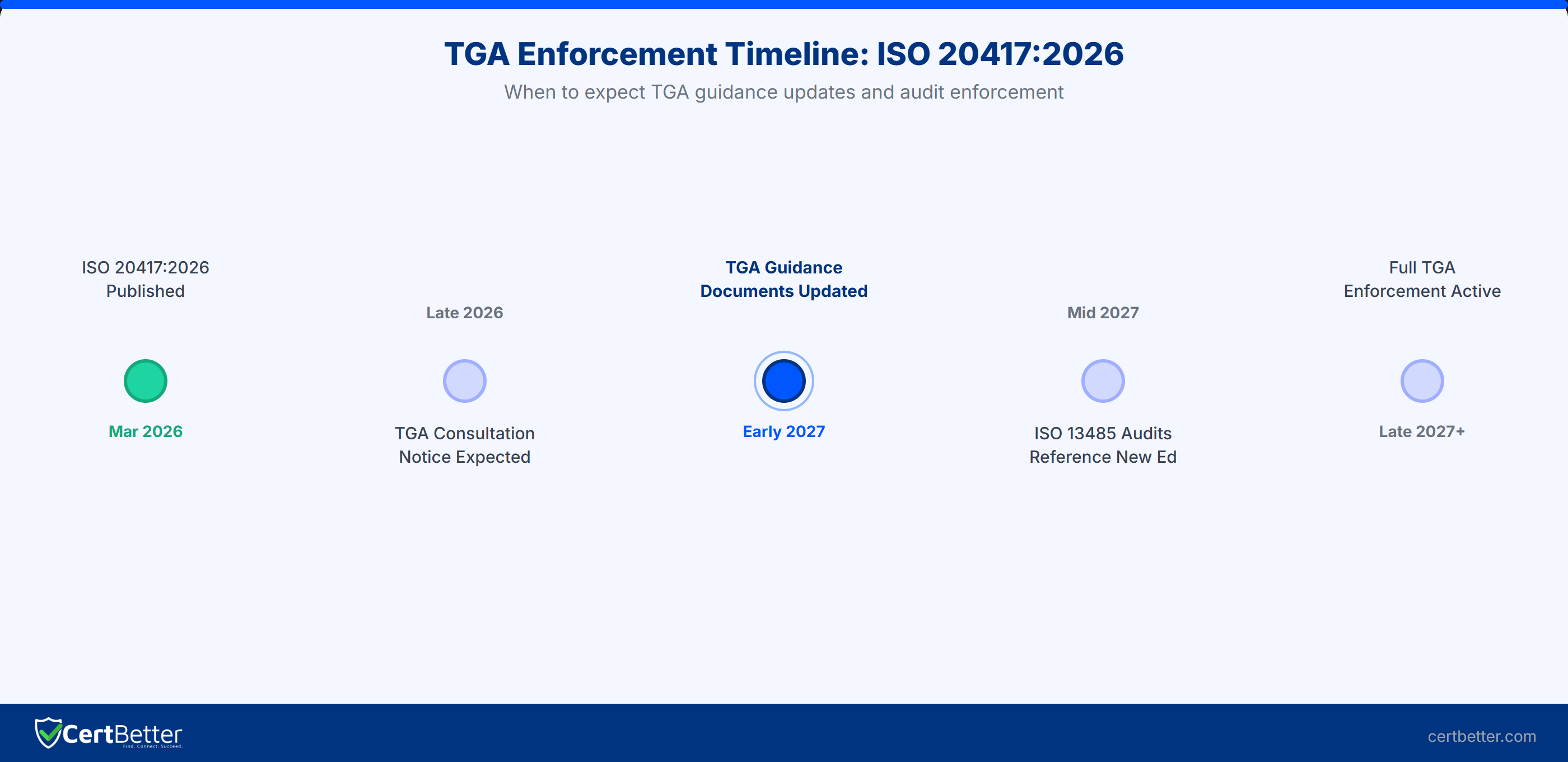
The practical implication is straightforward. If you begin your transition to ISO 20417:2026 now, you will be ahead of the enforcement curve. If you wait until TGA guidance is formally updated, you will be making reactive changes under time pressure, which is a less controlled and higher risk position.
The Applicable Policy Concept and Australian Law
One of the most useful additions in ISO 20417:2026 for Australian manufacturers is the formalised Applicable Policy concept. This provides a structured mechanism for documenting how national regulatory requirements apply to your labelling system without treating those requirements as deviations or exceptions from the standard.
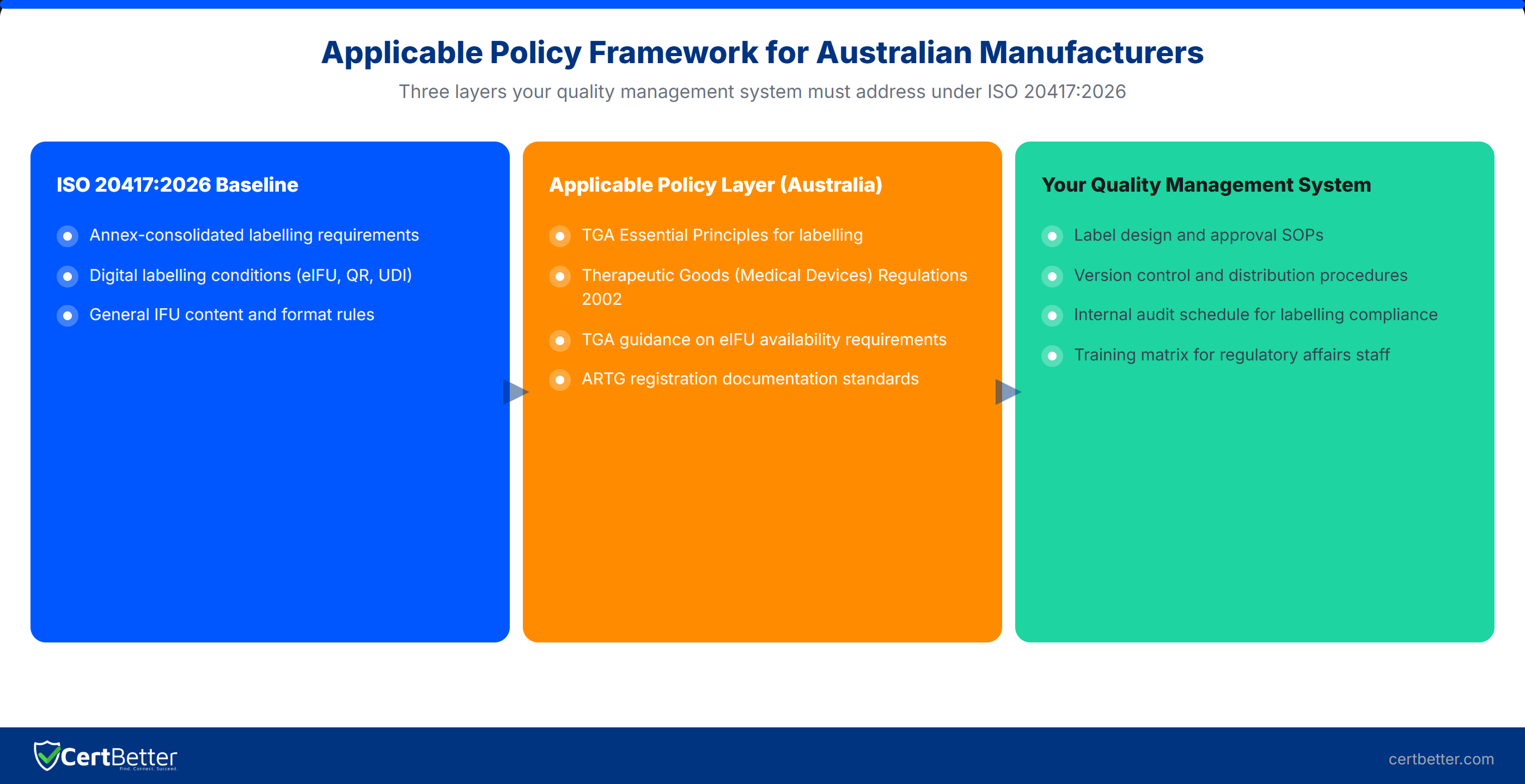
In practical terms for Australia, your Applicable Policy documentation should capture the following:
- The specific TGA labelling requirements that apply to your product class under the Therapeutic Goods (Medical Devices) Regulations 2002
- Any TGA guidance documents that specify labelling requirements beyond the regulations themselves
- How those requirements interact with the baseline requirements of ISO 20417:2026, including where Australian requirements are more specific or more prescriptive
- How your labelling system satisfies both the standard and the Australian regulatory requirements simultaneously
This documentation becomes a key reference point during TGA audits and ARTG application reviews. Rather than auditors needing to work out how your labelling system addresses TGA requirements from first principles, you are providing a clear, explicit mapping. This reduces audit friction and demonstrates the kind of regulatory awareness the TGA looks for in well-managed quality systems.
If your business sells devices in multiple markets, you will need a separate Applicable Policy layer for each jurisdiction. The same framework applies: document the jurisdiction-specific requirements, map them against ISO 20417:2026, and show how your labelling system satisfies both. This is substantially less work than maintaining entirely separate labelling documentation sets for each market, which is the approach many Australian exporters have managed historically.
ARTG Registration and Labelling Compliance
When you apply for ARTG inclusion or respond to post-market surveillance activity, the TGA assesses your labelling against the Essential Principles and applicable guidance. The evidence you provide needs to demonstrate conformance with those requirements as they stand at the time of assessment, not simply that you hold ISO 13485 certification or that you reference ISO 20417 in your quality management documentation.
ISO 20417:2026 supports ARTG compliance in several concrete ways. The cleaner, consolidated structure of the new edition makes it easier to demonstrate a complete and systematic approach to labelling requirements. The Applicable Policy concept gives you a defensible framework for addressing TGA-specific requirements within your ISO-aligned quality management system. The stronger digital labelling provisions give you formal backing for eIFU and QR code approaches that you may already be using informally.
However, none of this replaces the need to specifically address TGA requirements in your technical documentation. ISO 20417:2026 conformance is evidence of a rigorous, internationally recognised approach to labelling. It is not a substitute for demonstrating that your specific product labelling meets the TGA requirements for that product class.
Manufacturers that hold ISO 13485 certification and are actively maintaining their quality management systems have a significant advantage here, because the infrastructure for systematic labelling compliance already exists. The transition to ISO 20417:2026 builds on that infrastructure rather than requiring a parallel compliance effort from scratch.
eIFU and Digital Labelling: TGA Position
ISO 20417:2026 provides considerably stronger and more structured support for electronic instructions for use and digital labelling tools than the 2021 edition. This matters for Australian manufacturers because the TGA has its own position on eIFU that does not always align neatly with international practice.
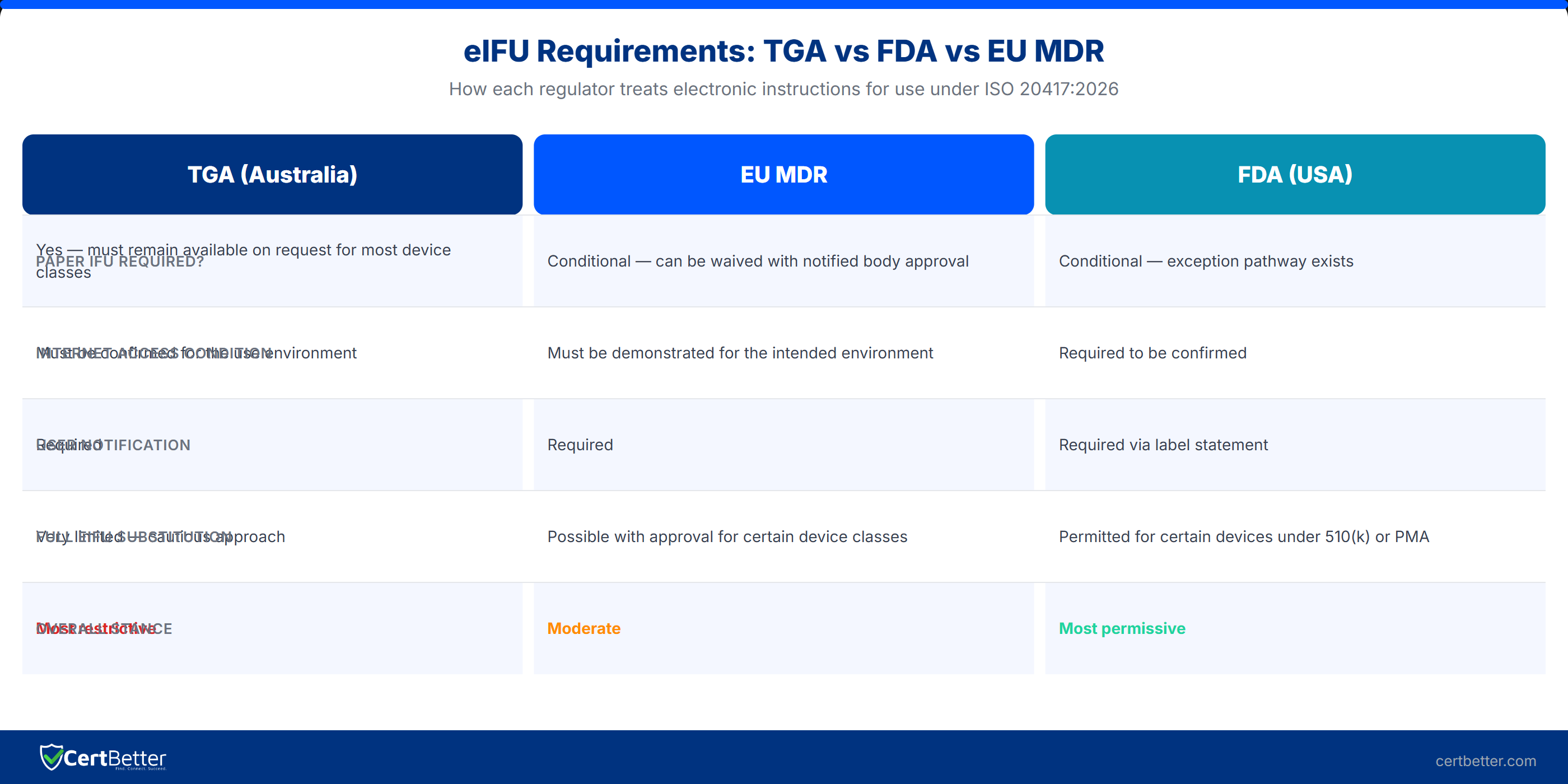
The TGA takes a cautious approach to eIFU. For most medical device classes, the TGA requires that paper-based IFU be available on request even where eIFU is the primary delivery mechanism. The conditions under which eIFU can fully substitute for paper IFU are more restricted in Australia than under EU MDR or FDA guidance, driven by the TGA assessment of the environments in which Australian healthcare practitioners and patients access device information.
ISO 20417:2026 builds its eIFU framework around specific conditions: confirming the healthcare environment has reliable internet access, that users are notified of the electronic delivery approach, and that access to the current version of the IFU is assured at the point of use. These conditions are broadly consistent with TGA thinking but they do not override TGA-specific requirements for paper IFU availability.
Your Applicable Policy documentation for Australia should explicitly address the TGA eIFU position and explain how your digital labelling approach satisfies both the standard conditions and TGA requirements for your product class. If you have been using QR codes or website-hosted information informally, ISO 20417:2026 now gives you a formal framework to document those approaches properly, and that documentation needs to include the TGA layer explicitly.
Australian Exporters: TGA, FDA, and EU MDR Together
For Australian businesses that export medical devices to the United States or European Union, the full alignment of ISO 20417:2026 with IMDRF/GRRP WG/N52:2024 is the most commercially significant change in the new edition.
Before ISO 20417:2026, Australian exporters dealing with TGA, FDA, and EU MDR labelling requirements typically maintained separate documentation streams for each jurisdiction. The core labelling content might be similar, but the compliance documentation, supporting procedures, and evidence packs were necessarily different because the regulatory frameworks referenced different standards and principles.
ISO 20417:2026 IMDRF alignment means the core labelling principles are now consistent across all three jurisdictions. You can build one labelling framework around the standard and apply jurisdiction-specific Applicable Policy overlays for TGA, FDA, and EU MDR requirements. The overlays address the specific differences in each regulatory framework, but the underlying system is unified.
This reduces duplication in several ways. Labelling procedures need to be written once rather than three times with minor variations. Training covers one framework with jurisdiction-specific modules rather than three separate programmes. Internal audits assess one system with targeted jurisdiction reviews rather than three parallel processes. Version control covers one document set with market-specific variants rather than multiple separate sets.
For smaller Australian exporters managing multi-market compliance with limited regulatory affairs resources, this consolidation can be genuinely significant. The upfront investment in rebuilding your labelling system around ISO 20417:2026 with proper Applicable Policy documentation should produce meaningful ongoing savings in compliance effort. Understanding how ISO standard updates affect your existing certifications is useful context when planning this transition across multiple markets.
Practical Steps for Australian Manufacturers
Map Your Current TGA Labelling Compliance Position
Before you can transition to ISO 20417:2026, you need a clear picture of where you stand against current TGA labelling requirements. Pull together your current ARTG documentation, your existing labelling procedures, and the TGA guidance documents that apply to your product class. Identify which TGA requirements are currently addressed through ISO 20417:2021 references and which are addressed through TGA-specific procedures. This baseline is the starting point for everything that follows.
Conduct a Gap Analysis Against ISO 20417:2026
With your current position mapped, assess what ISO 20417:2026 changes for your situation specifically. Pay attention to the removed annexes, the Applicable Policy provisions, and the digital labelling sections. Not all changes will affect every manufacturer equally. The annex consolidation matters most if your current procedures explicitly reference the removed annexes. The digital labelling provisions matter most if you are using or planning eIFU or QR code approaches.
Build Your Applicable Policy Documentation for TGA
This is the most important new element for Australian manufacturers. Create a structured document that defines your Applicable Policy for the Australian market, mapping current TGA labelling requirements against the baseline requirements of ISO 20417:2026. Document where TGA requirements go beyond the standard, where they differ, and how your labelling system addresses both. This document becomes a standing reference within your quality management system and a key piece of evidence during audits.
Update Your Labelling Procedures
Revise your standard operating procedures for label design, approval, version control, and distribution to reflect ISO 20417:2026 and your Applicable Policy. This includes procedures for eIFU and any digital labelling approaches you use. Ensure each procedure has a clear owner, a review cycle, and explicit references to both the standard requirements and the applicable TGA requirements. Reviewing how quality management tools support systematic documentation within medical device businesses, as covered in the context of AI-assisted quality assurance for ISO 13485, can inform how you structure and maintain these procedures going forward.
Run an Internal Labelling Audit Before Your Next External Audit
Before TGA surveillance or your next ISO 13485 surveillance audit, run an internal audit specifically targeting labelling compliance against ISO 20417:2026 and current TGA requirements. Use this to verify your gap analysis was complete, your updated procedures are being followed, and your Applicable Policy documentation is accurate. Capture any non-conformities and address them before external auditors see them.
Monitor TGA Guidance Updates
Set up a formal mechanism within your regulatory watch process to track TGA guidance updates related to labelling and ISO 20417. When the TGA publishes guidance referencing ISO 20417:2026, review your Applicable Policy documentation against the updated guidance and update as needed. If you work with a JASANZ accredited certification body for ISO 13485 surveillance, ask specifically how they are incorporating ISO 20417:2026 into their audit programme and what timeline they are working to.