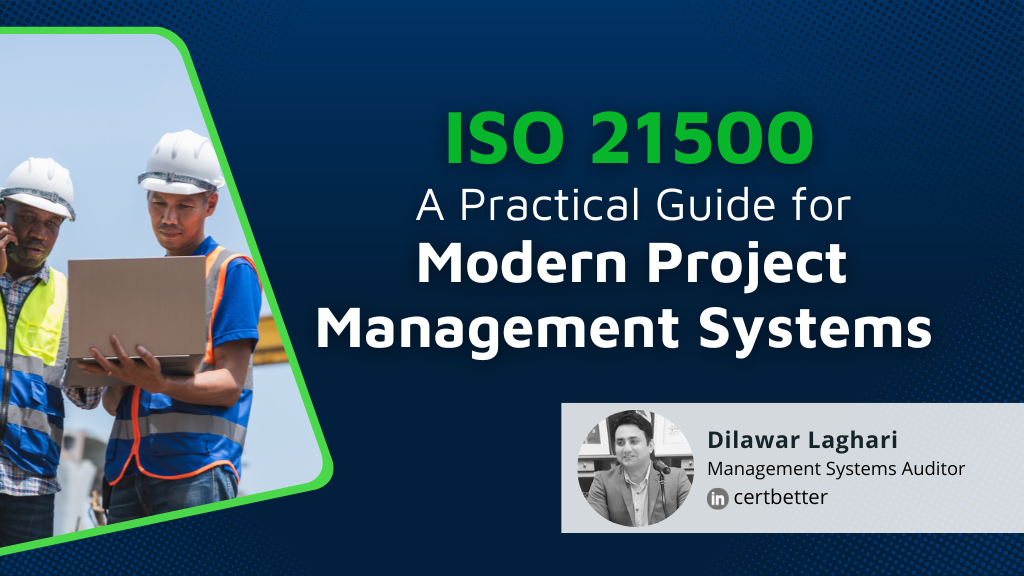
A large infrastructure project begins with excitement and clear objectives. However, as months pass, deadlines slip, budgets increase, and communication between teams becomes inconsistent.
On this page
Each stakeholder has a different explanation. The contractor blames changing requirements, the client points to poor coordination, and the consultants identify weak project controls.
The real issue is not the effort, but the absence of alignment.
ISO 21500 provides that alignment. It is a globally recognized standard that guides how projects, programmes, and portfolios should be structured, managed, and delivered across any sector.
Whether you are overseeing a construction project, implementing a new IT system, or coordinating a government program, ISO 21500 helps ensure consistency, accountability, and clarity at every stage.
Why the Standard Matters
Project success depends on more than technical skills. It requires a structured approach that links strategy, people, and processes. ISO 21500 helps organizations achieve this by providing a unified project management framework that can be applied across industries and regions.
Creates a Universal Language for Project Management
ISO 21500 establishes a shared vocabulary and methodology. This allows teams in different departments or locations to communicate clearly and apply consistent processes from initiation to closure.
Reduces Cost Overruns and Delays
By promoting structured planning, risk management, and progress monitoring, the standard helps organizations prevent schedule drift, manage resources effectively, and reduce financial waste.
Strengthens the Link Between Strategy and Execution
Each project is connected to broader organizational objectives. ISO 21500 ensures that every deliverable contributes to long-term business goals, creating strategic alignment across the portfolio.
Improves Transparency and Governance
The standard defines roles, responsibilities, and reporting structures. This makes decision-making more traceable, which is particularly valuable for organizations operating in regulated industries.
Integrates with Other ISO Standards
ISO 21500 complements management systems such as ISO 9001 (Quality) and ISO 31000 (Risk). Together, they provide a comprehensive foundation for quality assurance and risk-based thinking within project management.
Builds Trust and Credibility
Clients, regulators, and investors value organizations that follow internationally recognized standards. Adopting ISO 21500 signals professionalism and commitment to best practice.





Do You Need ISO 21500?
ISO 21500 is relevant to any organization that manages projects, regardless of size or industry. Whether you are a global enterprise or a small consultancy, the principles in this standard help you create structure and consistency.
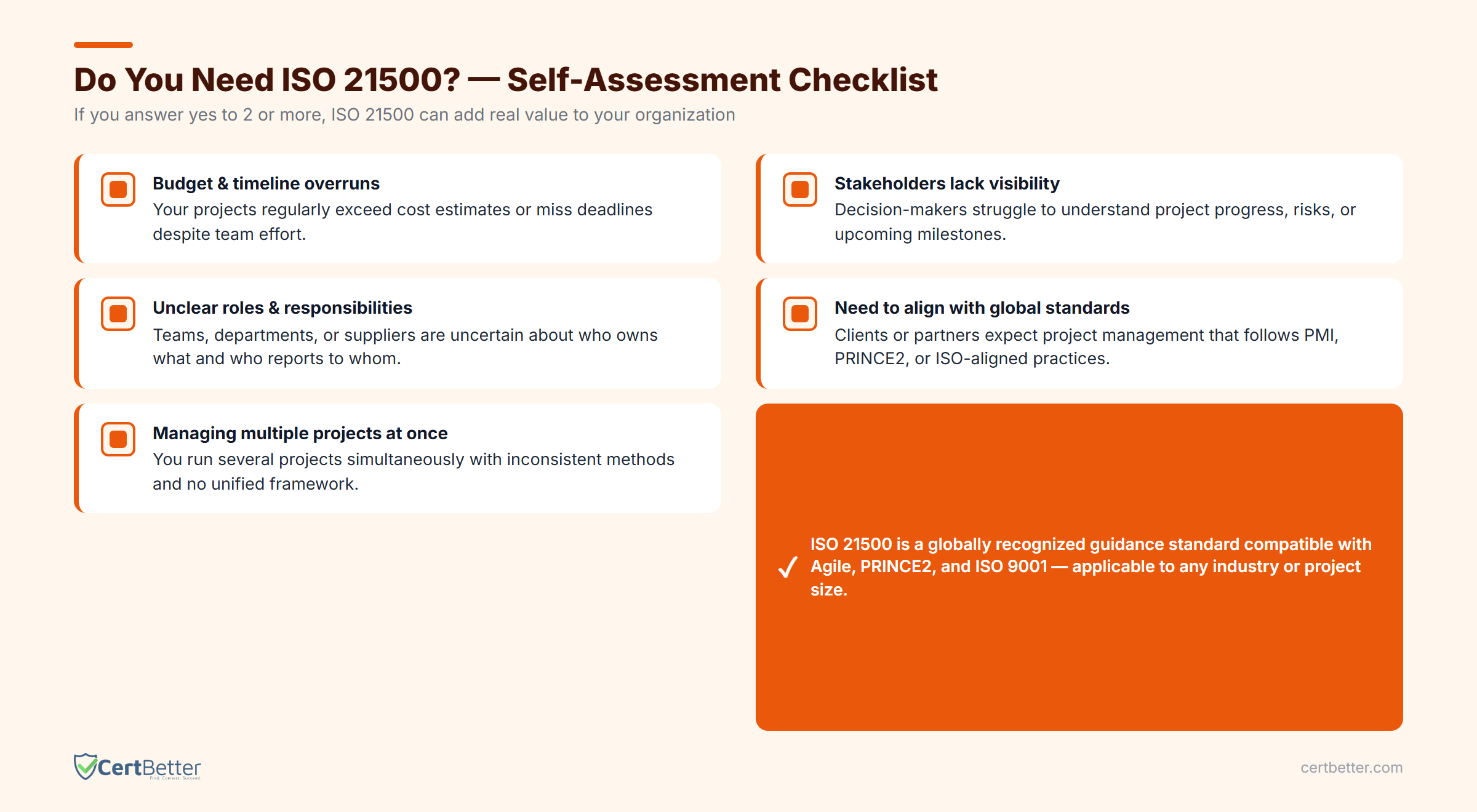
To determine whether ISO 21500 can add value to your business, review the following questions:
Do your projects often exceed budgets or timelines?
Unclear objectives, poor coordination, or weak monitoring can easily lead to overruns. ISO 21500 introduces a framework for defining goals, tracking progress, and controlling performance.
Are responsibilities and communication unclear across departments or suppliers?
Miscommunication is one of the most common causes of project delays. The standard sets out clear governance structures and communication plans so that every participant understands their role.
Do you manage several projects at the same time without a unified system?
Running multiple projects with inconsistent methods can create duplication, resource conflicts, and reporting challenges. ISO 21500 ensures that all projects follow a consistent life cycle and reporting structure.
Do stakeholders struggle to understand project progress or risks?
Transparency is essential for stakeholder confidence. The standard emphasizes documentation, reporting, and measurable indicators that keep all parties informed and accountable.
Do you want to align with global project management frameworks?
If your clients or partners expect structured and internationally accepted project management methods, ISO 21500 provides a clear foundation that aligns with PMI, PRINCE2, and ISO 21502.
Key Components of ISO 21500
Understanding ISO 21500 becomes much easier when you view it as a collection of structured principles rather than a technical document. The standard is designed to help organizations manage projects in a consistent, logical, and repeatable way.
Below are the key components explained in simple terms.
Context and Concepts
ISO 21500 begins by defining the environment in which projects operate. It explains how projects connect to the organization’s overall strategy and objectives. Recognizing this context helps decision-makers ensure that every project contributes to a clear business outcome.
Governance and Roles
Clear governance is one of the most important principles of ISO 21500. The standard defines the responsibilities of project sponsors, managers, and teams to ensure accountability and effective oversight. Stakeholder engagement is also emphasized to maintain alignment between project teams and organizational leadership.
Processes and Phases
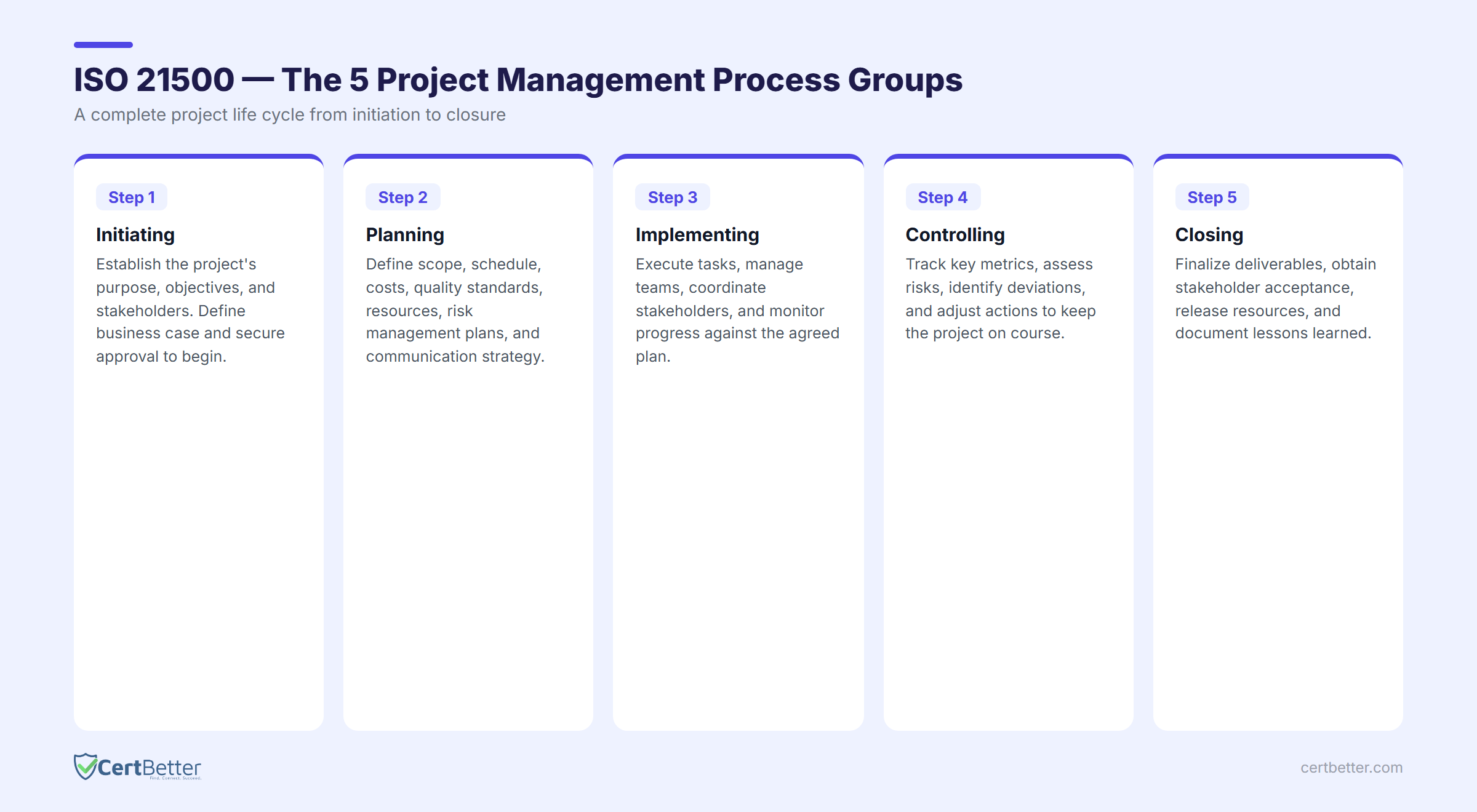
The standard divides project management into five key process groups that create a complete project life cycle:
- Initiating: Establish the project’s purpose, objectives, and stakeholders.
- Planning: Define scope, schedule, cost, quality, resources, and risk management plans.
- Implementing: Execute tasks, manage teams, and monitor progress against the plan.
- Controlling: Track key metrics, assess risks, and adjust actions to stay on course.
- Closing: Finalize deliverables, obtain stakeholder acceptance, and document lessons learned.
These phases ensure that projects are not only well-planned but also properly reviewed and improved after completion.
Subject Groups
ISO 21500 organizes project activities into subject groups that represent key areas of management. These include:
- Scope Management: Defining what is included in the project and controlling changes.
- Time Management: Planning schedules, milestones, and dependencies.
- Cost Management: Budgeting and tracking expenditures.
- Quality Management: Ensuring outputs meet defined standards and customer expectations.
- Risk Management: Identifying, assessing, and mitigating potential issues.
- Resource Management: Allocating and managing human, financial, and material resources.
- Communication Management: Establishing effective information flow among all stakeholders.
- Procurement Management: Managing supplier relationships and contract obligations.
These subjects help ensure that no critical project area is overlooked during planning or execution.
Integration with Other Standards
ISO 21500 does not operate in isolation. It connects closely with several related standards that strengthen project performance:
- ISO 21502: Provides detailed guidance for managing projects, programmes, and portfolios.
- ISO 10006: Focuses on quality management in projects.
- ISO 31000: Helps integrate risk-based thinking into project decision-making.
Organizations that use these standards together build more mature, resilient project management systems.
Steps to Align with ISO 21500 (Implementation Roadmap)
Adopting ISO 21500 does not require rebuilding your entire project management structure. Instead, it involves aligning your existing practices with the principles outlined in the standard. The goal is to bring order, consistency, and accountability to every stage of your project life cycle.
Below is a clear roadmap to guide your organization through the process of alignment.
Step 1: Assess Current Maturity
Begin by evaluating your current project management practices. Identify what is already working well and where inconsistencies exist. This may involve reviewing project documentation, team communication, governance frameworks, and reporting structures.
A maturity assessment helps you understand the gap between your existing practices and ISO 21500’s recommendations.
Step 2: Gain Leadership Support
Successful implementation requires visible commitment from senior management. Leadership endorsement ensures that the standard becomes part of the organization’s culture rather than just a set of procedures.
Communicate the benefits of ISO 21500 to executives, such as improved project outcomes, risk control, and stronger client confidence.
Step 3: Map Your Project Life Cycle
Review how your organization currently defines the stages of a project, from initiation to closure. Align these stages with ISO 21500’s five process groups.
This step will create a structured framework that applies to all projects, regardless of department or size.
Step 4: Develop Frameworks and Templates
Standardization is key to repeatability. Develop or update project management templates such as project charters, stakeholder registers, risk matrices, and progress reports.
Consistent documentation makes project performance easier to track and simplifies audits and reviews.
Step 5: Train Teams and Build Competence
Educate project managers, coordinators, and team members on the concepts and terminology of ISO 21500. Training should focus on practical application, including how to plan, monitor, and close projects in line with the standard. Consider certification courses or workshops to strengthen internal capability.
Step 6: Monitor, Review, and Improve
Establish performance indicators to measure project outcomes, cost efficiency, and client satisfaction. Conduct regular reviews to identify lessons learned and areas for improvement.
Continual monitoring ensures that ISO 21500 becomes an integral part of your organizational development, not a one-time exercise.
Additional Considerations (Leadership, Training, Integration)
Implementing ISO 21500 successfully requires more than processes and documentation. The strength of any project management system depends on leadership commitment, competent teams, and the ability to integrate with other management systems and technologies. These elements determine whether the framework becomes part of the organization’s culture or remains only on paper.
Leadership Commitment
Senior management must lead by example. Projects are most effective when executives actively support planning, review progress, and allocate adequate resources. Leadership involvement demonstrates that project management excellence is a strategic priority, not just an operational function.
Executives should also promote a culture of accountability, open communication, and continuous improvement across all project teams.
Training and Staff Competency
A well-trained workforce is essential for consistent project delivery. Project managers, coordinators, and team members should understand the concepts, processes, and terminology used in ISO 21500.
Regular training ensures that staff can apply the standard confidently, adapt to challenges, and maintain consistent quality. Investing in professional development also helps retain talent and strengthen overall project performance.
Integration with Other ISO Standards
ISO 21500 works best when integrated with complementary standards. For example:
- ISO 9001 (Quality Management): Enhances consistency and customer satisfaction.
- ISO 31000 (Risk Management): Supports proactive decision-making and risk control.
- ISO 10006 (Quality Management in Projects): Focuses on achieving project-specific quality outcomes.
Integrating these systems helps create a unified management structure where quality, risk, and performance align with organizational goals.
Use of Digital Tools and Technology
Modern project management increasingly relies on software for planning, monitoring, and reporting. Using digital tools aligned with ISO 21500 can streamline communication, improve visibility, and support data-driven decision-making.
Automated dashboards, document control systems, and risk-tracking tools ensure that the principles of ISO 21500 are applied efficiently across all projects.
FAQs: Common Questions About ISO 21500
1. Is ISO 21500 certifiable?
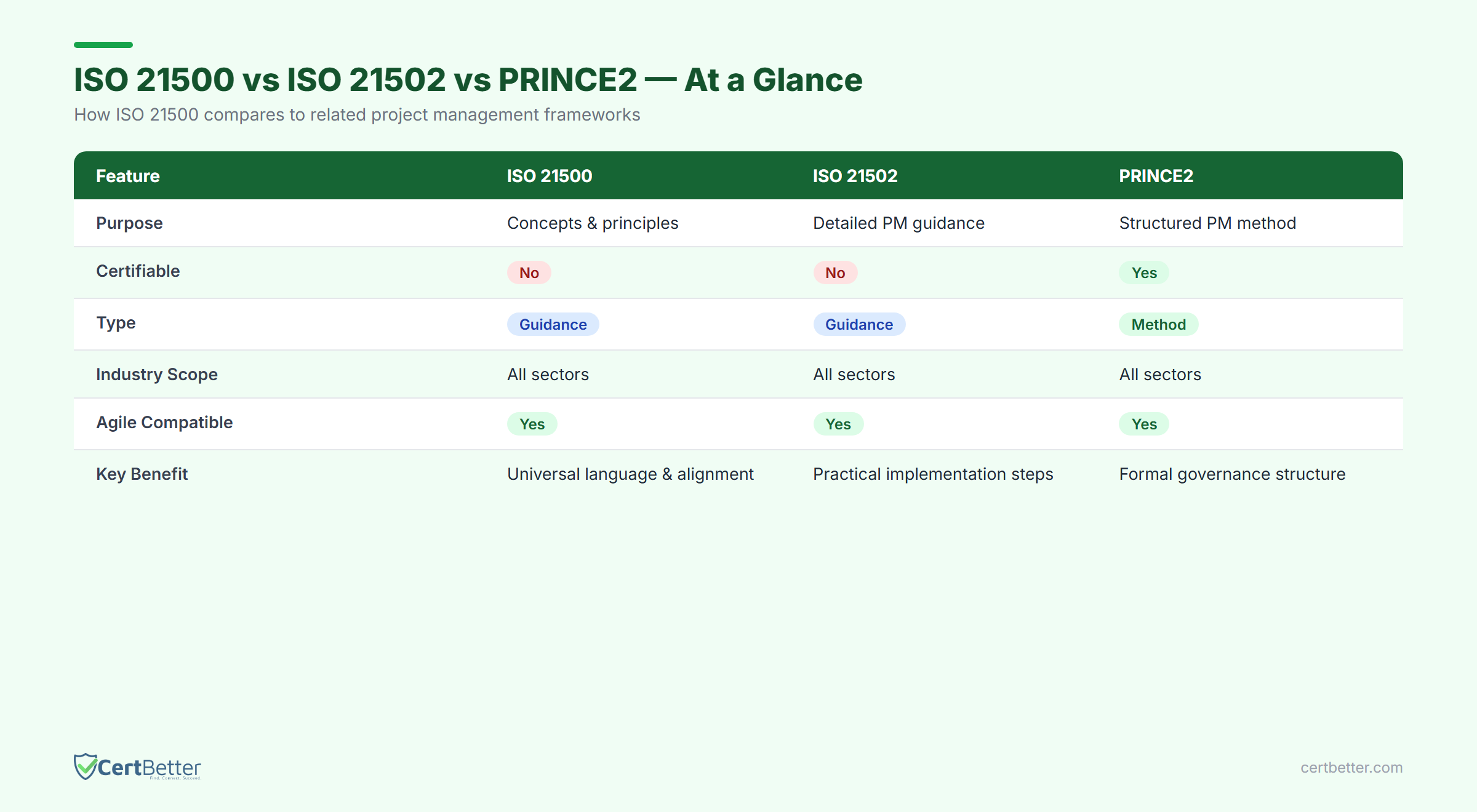
No. ISO 21500 is a guidance standard, not a certifiable one. It provides principles and recommendations to improve project management practices but does not result in a formal certification.
2. What is the difference between ISO 21500 and ISO 21502?
ISO 21502 builds on ISO 21500 by providing detailed guidance on managing projects, programmes, and portfolios. While ISO 21500 focuses on concepts and principles, ISO 21502 offers practical management instructions for implementation.
3. Can ISO 21500 work with Agile or PRINCE2 methodologies?
Yes. ISO 21500 defines what needs to be achieved and why, while frameworks like Agile and PRINCE2 focus on how to achieve it. Many organizations use these methods together for flexibility and structure.
4. Who benefits most from using ISO 21500?
Organizations that manage multiple or complex projects benefit most. This includes construction firms, engineering consultancies, IT companies, public agencies, and research organizations.
5. How does ISO 21500 integrate with other management systems?
ISO 21500 aligns easily with standards such as ISO 9001 (Quality), ISO 31000 (Risk), and ISO 10006 (Project Quality). Integrating these frameworks helps organizations manage performance, risk, and quality together under one structure.
Where to Download ISO 21500 PDF?
To ensure you are working with the most accurate and up-to-date version, always purchase ISO 21500: Project, Program and Portfolio Management from official and trusted sources. The standard is available from the ISO Store, BSI Group (UK), ANSI (USA), and Standards Australia.
Conclusion: Why ISO 21500 Matters for Every Organization
Good project management is not only about charts, reports, or meetings. It is about alignment, accountability, and shared purpose. ISO 21500 provides the foundation for achieving that.
By following ISO 21500, organizations create a clear structure for planning, managing, and reviewing projects. It ensures that every activity supports strategic objectives and that resources are used efficiently. The result is stronger teamwork, improved decision-making, and more predictable outcomes.
For businesses managing multiple or complex projects, ISO 21500 helps reduce uncertainty and build trust. Clients, investors, and regulators gain confidence knowing that the organization applies an internationally recognized project management framework.
If your goal is to improve consistency and strengthen governance, ISO 21500 is the right place to start. It connects strategy with execution and brings stability to the fast-paced world of projects.