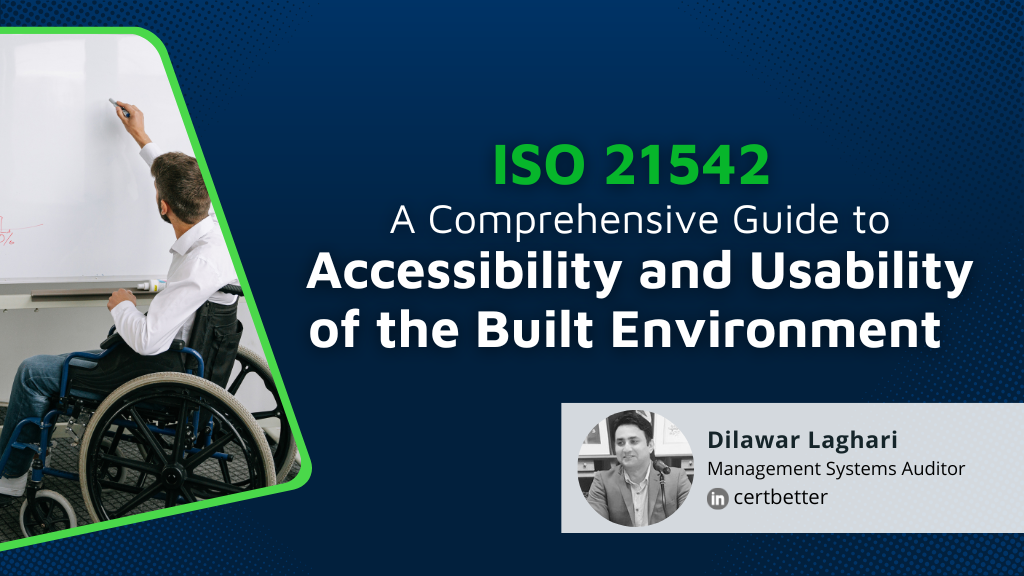
As cities evolve and diversity in user needs increases, accessibility has become a defining measure of quality, safety, and social responsibility in construction. From public facilities to private developments, organizations are expected to provide environments that can be used safely and independently by everyone, regardless of physical ability or age.
On this page
ISO 21542 sets the international benchmark for inclusive design. It defines the technical and functional requirements that make buildings accessible from approach routes and entrances to internal circulation, signage, lighting, and emergency egress.
“Accessibility is not optional; it is a core requirement of modern building design.”
By implementing ISO 21542, architects, engineers, and developers can move beyond compliance and deliver projects that meet both regulatory expectations and global sustainability goals, while demonstrating a genuine commitment to inclusion and equality.
- Why the Standard Matters
ISO 21542 matters because accessibility defines modern quality. It reshapes how buildings are planned, designed, and maintained, ensuring that every person, regardless of ability, can use spaces safely, comfortably, and independently. For architects, developers, and facility managers, the standard delivers both social and commercial value.
1.1 Promotes equality and inclusion
Accessible design benefits everyone. It supports the principles of universal design and enables people of all abilities to navigate and use buildings without barriers. This includes individuals with disabilities, older adults, parents with young children, and those with temporary mobility limitations.
1.2 Strengthens compliance and reduces legal risk
Many countries reference ISO 21542 within their national building codes and disability access regulations. Aligning with this standard helps organizations meet global requirements such as the United Nations Convention on the Rights of Persons with Disabilities (CRPD) and ensures readiness for accessibility audits and legal reviews.
1.3 Enhances user experience and safety
Good accessibility improves both safety and usability. Features such as clear signage, adequate lighting, handrails, and tactile guidance make buildings easier to navigate and reduce the likelihood of accidents or confusion.
1.4 Increases property value and reputation
Developers who design with accessibility in mind gain long-term advantages. Accessible buildings are more marketable, attract socially responsible tenants, and demonstrate corporate commitment to diversity and inclusion.
1.5 Supports sustainability and ESG objectives
ISO 21542 aligns with Sustainable Development Goal 11 on Sustainable Cities and Communities. By integrating accessibility into every stage of construction, organizations contribute to broader environmental, social, and governance (ESG) commitments valued by investors and regulators.
1.6 Establishes a global benchmark
For international developers and design firms, ISO 21542 provides a consistent framework across different countries. It simplifies coordination, improves quality assurance, and replaces fragmented regional guidelines with one globally recognized reference.
- Do You Need ISO 21542?
Not every construction project requires certification against ISO 21542, but nearly every organization involved in building, renovation, or facility management can benefit from applying its principles. Use this quick self-assessment to see whether the standard is relevant to your work.
2.1 Are you designing or renovating public, commercial, or residential buildings?
If your project includes offices, hospitals, schools, shopping centers, hotels, or residential complexes, accessibility requirements likely apply.
2.2 Do you want to meet international accessibility expectations rather than just local code minimums?
ISO 21542 goes beyond basic national compliance and offers a global framework recognized by regulators and developers around the world.
2.3 Does your facility include multiple floors, shared spaces, or external access routes?
The standard covers internal and external circulation, vertical movement, parking, pathways, and entrances, all of which are critical to user accessibility.
2.4 Do your clients or stakeholders operate in countries that enforce disability access or equal-opportunity regulations?
Compliance with ISO 21542 demonstrates proactive alignment with legislation such as the UN CRPD and national building accessibility acts.
2.4 Are you developing inclusive design policies for your organization or municipality?
ISO 21542 offers a structured foundation for creating long-term accessibility policies, staff training programs, and design checklists.
- Key Components of ISO 21542
ISO 21542 is a comprehensive standard that translates accessibility into measurable design and construction requirements. It does not just outline general principles; it defines the specific technical features that make buildings truly usable for everyone.
3.1 General Principles
The foundation of ISO 21542 is universal design, creating environments that everyone can access and use without special adaptation. It promotes safety, dignity, and independence for all users, considering physical, sensory, and cognitive differences.
3.2 Approach and Site Access
Accessibility begins before a person enters the building. The standard defines how parking areas, walkways, and pathways should be designed to provide clear, obstacle-free movement. It sets requirements for slope gradients, curb ramps, surface textures, and tactile indicators to guide people with visual impairments safely to the entrance.
3.3 Entrances and Circulation
Once inside, users must be able to move freely. ISO 21542 specifies minimum door widths, threshold limits, and space requirements for wheelchairs and mobility aids. It covers corridors, ramps, and interior routes to ensure easy navigation and turning space. Clear signage and visual contrast between floors, walls, and doors are also emphasized.
3.4 Vertical Movement
Lifts, escalators, and stairs must accommodate a wide range of users. The standard defines lift car dimensions, control panel heights, handrail placement, and step geometry. Audio and visual indicators are recommended to support users with hearing or vision impairments.
3.5 Facilities and Rooms
ISO 21542 includes detailed guidance for restrooms, kitchens, workspaces, and other functional areas. It specifies fixture heights, reach zones, and maneuvering space for wheelchairs. Grab rails, non-slip surfaces, and emergency call systems help ensure both safety and independence.
3.6 Lighting, Acoustics, and Signage
Proper lighting levels reduce glare and help visually impaired users orient themselves. The standard provides guidance on uniform illumination and contrast between surfaces. It also addresses acoustics to minimize echo and background noise, improving communication. Signage should be clear, readable, and, where necessary, supported by Braille or tactile symbols.
3.7 Emergency Egress
Evacuation procedures must consider everyone’s safety. ISO 21542 outlines how escape routes, refuge areas, visual alarms, and emergency communication systems should function. The goal is to ensure that people with disabilities can evacuate safely, either independently or with assistance.
3.8 Adaptability and Maintenance
Accessibility is not a one-time effort. The standard encourages adaptable design that can accommodate future changes in user needs, occupancy, or building function. It also stresses ongoing maintenance to keep accessibility features functional over time.
4. Steps to Align (Implementation Roadmap)
Step 1: Review Project Scope
Start by mapping every element of your building that affects accessibility, including site approach, parking, entrances, interior circulation, and emergency exits. Clarify whether the project is a new build, extension, or renovation, as each has different compliance expectations under ISO 21542.
Step 2: Assess Current Compliance
Carry out a structured review of your existing designs or facilities against the requirements of ISO 21542. Document any nonconformities such as inadequate door widths, poor signage, or unsafe ramp gradients. For older structures, apply the standard’s “exceptional considerations” to balance feasibility with accessibility goals.
Step 3: Engage an Accessibility Consultant
Bring in an experienced accessibility consultant or auditor during the design phase. They can interpret technical clauses, validate floor plans, and identify improvements before construction begins. This step ensures your project meets both ISO 21542 and local building regulations.
Step 4: Train Design and Construction Teams
Provide targeted training for architects, engineers, and contractors on how to integrate accessibility features into their work. Training should include practical examples such as handrail placement, lift specifications, and tactile surface design.
Step 5: Integrate Early
Include accessibility criteria from the very beginning of the design process. Early integration avoids expensive redesigns, ensures structural compatibility, and makes accessibility a natural part of the building’s form and function rather than an afterthought.
Step 5: Conduct Usability Testing
Once designs are completed or the facility is built, perform usability tests with real users. Invite individuals with different mobility or sensory needs to navigate the space. Collect their feedback on barriers, comfort, and safety to make practical adjustments.
Step 6: Maintain and Monitor
Accessibility does not end after construction. Develop maintenance procedures to regularly inspect lifts, signage, lighting, and emergency systems. Keep records of inspections and corrective actions to demonstrate ongoing compliance and readiness for audits.
5. Challenges (Pitfalls + Practical Advice)
5.1 Late Integration
Accessibility is often considered too late in the design process, leading to costly rework or structural limitations. Integrate ISO 21542 principles from the early planning stage to ensure accessibility is built into the design rather than added later.
5.2 Over-Reliance on Local Codes
National or local building codes may cover only the minimum legal requirements. ISO 21542 offers a more comprehensive global framework. Use it as a benchmark to achieve a higher level of accessibility and consistency across international projects.
5.3 Design-Only Focus
Many organizations meet accessibility standards on paper but fail to maintain them in daily operations. Accessibility features such as lifts, tactile signs, or lighting systems need regular checks to remain functional. Combine good design with ongoing maintenance and management.
5.4 Historic and Existing Buildings
Older structures often present practical challenges due to layout or preservation restrictions. Apply the “exceptional considerations” clause of ISO 21542 to achieve reasonable compliance. Creative solutions, such as portable ramps or adaptive wayfinding systems, can improve access without altering historical integrity.
5.5 Budget Constraints
Some teams view accessibility as an additional cost rather than an investment. In reality, early integration reduces long-term expenses by preventing redesigns, improving safety, and increasing building usability for more occupants.
5.6 Limited User Involvement
Design teams often overlook input from people who will actually use the space. Involve users with different abilities in design reviews or post-occupancy evaluations to gain practical insights that technical drawings cannot reveal.
6. Additional Considerations (Leadership, Training, Integration)
6.1 Leadership Commitment
Accessibility begins with leadership. Senior management must clearly define accessibility as a strategic objective, not just a compliance task. When leadership allocates budgets, sets measurable goals, and monitors progress, accessibility becomes an embedded part of the organization’s culture and project planning.
6.2 Inclusive Project Teams
Diverse teams lead to better design outcomes. Involve people with disabilities, elderly users, and accessibility experts in the planning and review process. Their insights reveal barriers that might be overlooked during technical design, helping ensure real-world usability.
6.3 Training and Awareness
Provide continuous training for all stakeholders involved in the design, construction, and maintenance process. Architects, engineers, and facility managers should understand the key principles of ISO 21542 and know how to apply them effectively. Regular workshops and refresher sessions reinforce good practices and keep teams updated on regulatory changes.
6.4 Integration with Other Standards
ISO 21542 works best when integrated with related management system standards. Link it with ISO 9001 for quality management, ISO 14001 for environmental management, and ISO 45001 for occupational health and safety. Together, these systems promote safe, sustainable, and inclusive infrastructure across all project stages.
6.5 Monitoring and Continuous Improvement
Accessibility performance should be reviewed regularly, just like safety or quality metrics. Conduct internal audits, gather user feedback, and update design standards as technology and community needs evolve. Continuous improvement ensures accessibility remains relevant over the building’s lifetime.
6.6 Digital and Smart Building Integration
Modern technology can enhance accessibility. Automated doors, voice-guided navigation, tactile maps, and smart lighting systems can significantly improve user experience. Incorporating digital solutions early in design supports ISO 21542 objectives and prepares buildings for future innovation.





7. Where to Download the ISO 21542 PDF?
To ensure accuracy and compliance, always purchase ISO 21542:2021 Accessibility and Usability of the Built Environment from verified sources. The latest edition can be obtained directly from the ISO Store, or through national standards bodies such as BSI Group (UK), ANSI (USA), and Standards Australia. Always confirm you are using the most recent version before implementation, as the 2021 update includes expanded guidance on sensory accessibility, vertical movement, and emergency egress that replaces the earlier 2011 edition.
8. FAQs (Frequently Asked Questions)
Q1: Who should use ISO 21542?
The standard is intended for architects, engineers, developers, facility managers, auditors, and regulators involved in building design, construction, and refurbishment.
Q2: Does ISO 21542 apply only to new buildings?
No. It also covers extensions, alterations, and renovations. For older or historical buildings, the standard allows reasonable adjustments under “exceptional considerations.”
Q3: What are the main updates in the 2021 edition?
The 2021 version expands guidance on sensory accessibility, provides clearer technical data for vertical movement (stairs and lifts), and strengthens requirements for evacuation and safety planning.
Q4: How does ISO 21542 connect with sustainability goals?
It supports the United Nations Sustainable Development Goal 11 by promoting inclusive, safe, and resilient cities and communities. Accessible design is now a key element of global ESG and sustainability strategies.
9. Conclusion
Accessibility is more than a compliance requirement; it is a statement of respect for human dignity and inclusion. Buildings that follow ISO 21542 demonstrate a commitment to social responsibility, safety, and equal opportunity for every person who enters them.
By integrating accessibility principles from the very beginning of the design process, organizations create spaces that are not only compliant but also comfortable, safe, and future-ready. Such environments welcome diversity, reduce risks, and align with the growing expectations of clients, regulators, and communities.
At CertBetter, we connect you with verified consultants, auditors, and training providers who specialize in accessibility and built environment standards. Whether you are designing a new facility or improving an existing one, our experts can help you align with ISO 21542 confidently and efficiently.