Every ISO 45001 provider website buries certification pricing under pages of "holistic approach to workplace safety" nonsense or a range that doesn't make any sense. After auditing for more than 7 years, here's what ISO 45001 certification actually costs in Australia in 2026, based on real quotes from 50+ consultants and certification bodies on the CertBetter platform.
On this page
Before we go any further, I want to quickly mention that I have seen ISO 45001 costs 30-40% more than ISO 9001 because safety is harder to audit than quality (not everyone can easily get safety auditing competency!). Quality auditors usually sits in meeting rooms (no offence to my colleagues) reviewing purchase order records. Safety auditor needs steel-cap boots, high-vis, and 4 hours walking a hazardous plant or construction site checking if reality matches your procedures.
The Real Numbers (Stop Wasting Time)
Small business (5-15 employees):
- Certification audit: $3,500-$8,000
- With consulting/setup: $12,000-$18,000
- Annual surveillance: $2,500-$5,500
Medium business (15-50 employees):
- Certification audit: $8,000-$16,000
- With consulting/setup: $18,000-$35,000
- Annual surveillance: $5,500-$11,000
Large business (50+ employees, multi-site):
- Certification audit: $22,000-$45,000+
- With consulting/setup: $45,000-$90,000+
- Annual surveillance: $12,000-$25,000+
High-risk industries (construction, manufacturing, mining): Add 20-30% to above figures. Why? Because safety auditors actually have to walk your site, observe hazardous work, check your confined space entry isn't a death trap, and verify workers know how to isolate machinery without losing fingers.
These aren't guesses. This is market data from actual quotes.





Why ISO 45001 Costs More Than ISO 9001
I've audited both standards for 7 years with SAI Global and other certification bodies. Here's why ISO 45001 costs more and takes longer:
ISO 9001 (Quality):
- Review documentation in office
- Interview management about processes
- Check records match procedures
- Verify customer complaints are tracked
- Sample a few transactions
ISO 45001 (Safety):
- Walk entire site identifying hazards
- Observe actual work (heights, confined spaces, machinery, chemicals)
- Interview workers across all shifts
- Verify control measures actually work (not just documented)
- Check emergency equipment functions
- Review incident investigations for root causes
- Assess safety culture through worker conversations
- Verify contractor safety management
- Evaluate psychosocial risks (bullying, work pressure, violence)
Real example from my audits
Melbourne metal fabricator, 5 staff, wanted ISO 9001 + 45001.
ISO 9001 Stage 2: 1.5 days. Sat in office reviewing quality records, spot-checked 3 customer orders and related processes such as purchasing, workshop SOPs, competency records, quick walk through the workshop to review material, product, equipment and process quality, interviewed team, done.
ISO 45001 Stage 2: 2 days. Walked entire workshop observing welding, grinding, cutting. Checked noise levels, ventilation, PPE use. Interviewed workers about their involvement in safety. Reviewed months of incident reports. Inspected emergency exits, first aid equipment, spill kits. Verified forklift operators had current licences. Checked equipment maintenance and inspection. Checked permit system actually worked. Assessed psychosocial risks (shift work fatigue, production pressure).
Same business. Different standards. Different complexity. Different cost.
The kicker: ISO 45001 auditor needs OHS qualifications, not just auditing credentials. OHS specialists cost more than quality auditors. Supply and demand.
The Hidden Costs Everyone Forgets
Most businesses budget for ISO certification audit and get financially ambushed by everything else. Here's what actually hits your account:
Pre-certification (the expensive bit nobody tells you about):
Hazard identification and risk assessments: $3,000-$8,000 Not optional. Can't certify without identifying every hazard in your workplace and assessing risks. This takes time:
- Site inspections (every work area, every task)
- Worker consultations (mandatory under WHS law)
- Risk assessment documentation
- Control measure identification
I audited a Sydney electrical contractor who tried to skip this. Their "hazard register" had 9 entries for a business doing switchboard work, height access, and live electrical testing. I stopped the audit. "Come back when you've actually identified your hazards."
Gap analysis: $2,500-$6,000 Comparing what you do now versus what ISO 45001 requires. For most businesses: massive gap.
Policy and procedure development: $6,000-$22,000 ISO 45001 needs functional safety procedures, not generic templates. Procedures for:
- Incident investigation
- Hazard identification and risk assessment process
- Emergency response
- Contractor management
- Training and competency
- Consultation and participation
- Psychosocial risk management
- Legal compliance management
Generic procedures don't work. Melbourne manufacturing business copy-pasted servicing safety procedures. When I observed procedures about "kitchen safety" and "customer service stress." They manufacture industrial pumps. Instant non-conformance.
Training: $3,000-$8,000
- Management training on ISO 45001 requirements
- Worker training on new procedures
- Emergency response training
- Specific hazard training (confined spaces, heights, chemicals)
- Psychosocial hazard awareness
Internal audit: $1,500-$4,000 Mandatory before Stage 2. Either train internal auditor or hire external.
Management system software: $1,200-$6,000/year Track incidents, manage training records, store risk assessments, monitor corrective actions.
Standard purchase: $220 You need to buy the actual ISO 45001 standard. Yes, you pay for the rules.
Post-certification (ongoing forever):
Annual surveillance audits: $2,500-$12,000 Every year, certification body returns to verify your system still works. Not optional. Miss surveillance = lose certification.
Recertification (every 3 years): $6,000-$30,000 Full audit every 3 years to renew certificate.
Incident investigations: Variable but expensive Serious incident occurs? You'll spend 10-40 hours investigating, documenting, implementing corrective actions. Consultant support: $2,000-$6,000.
System updates when things change: Ongoing New equipment? New chemical? New work location? New hazard? System needs updating.
Real total cost example for 35-person manufacturing:
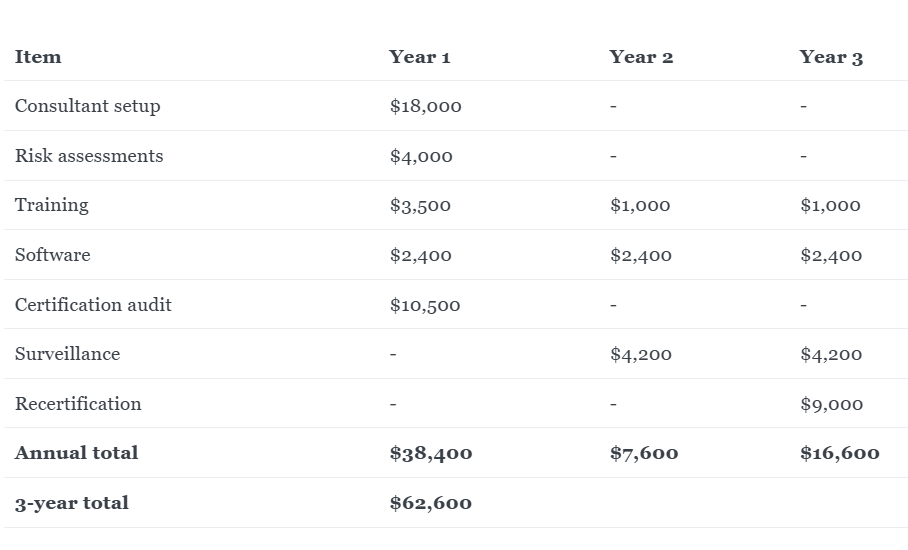
Most businesses budget $12,000 for "certification." Reality: $62,600 over 3 years.
The Certification Audit Formula (How Bodies Calculate Your Price)
Certification bodies follow ISO 17021-1 and IAF MD5. They can't make up numbers. Here's the actual calculation:
Base audit days from IAF MD5 tables:
- 1-5 employees: 2-2.5 days
- 6-25 employees: 2.5-3.5 days
- 26-65 employees: 3.5-5 days
- 66-125 employees: 5-7 days
- 126-350 employees: 7-10 days
Then they add complexity factors:
Industry risk multiplier (+20-40%):
- Low risk (office, retail, hospitality): Base days
- Medium risk (warehousing, light manufacturing): +15-20%
- High risk (construction, heavy manufacturing, mining): +25-40%
Why? High-risk work requires more audit time. Auditor needs to observe hazardous tasks, verify complex control measures, check emergency procedures actually work.
Multi-site additions (+15-40% per site): Two locations? Auditor samples both sites. Three locations? More sampling. Adds days.
Shift operations (+10-15%): 24/7 operation? Auditor needs to observe different shifts. Day shift safety might be good. Night shift might be cowboys. Adds time.
Contractor complexity (+10-20%): Heavy contractor use? Auditor verifies your contractor management system actually controls contractor risks. More contractors = more verification needed.
Psychosocial risk assessment (+5-10%): New since 2022 WHS regulations. Auditor must verify you've assessed psychosocial hazards (bullying, work pressure, violence, harassment, etc.). Adds interview time.
Real calculation example:
Perth construction company, 55 employees, 2 sites, high-risk work:
Base days: 4.5 days (55 employees from table) High-risk industry: +1.5 days (construction = +30%) Multi-site: +0.75 days (2 sites with sampling) Contractor management: +0.5 days (20+ subcontractors regularly) Total: 7.25 days required
Split:
- Stage 1: 2.5 days @ $2,200 = $5,500
- Stage 2: 4.75 days @ $2,200 = $10,450
- Total certification: $15,950
- Surveillance (33% of total): $5,264/year
This isn't negotiable. Certification bodies must follow IAF MD5 or lose JASANZ accreditation.
If someone quotes significantly fewer days, they're either:
- Not calculating correctly (incompetent)
- Planning to add days later via scope creep
- Not JASANZ accredited (worthless certificate)
Why Cheap ISO 45001 Is Dangerous
With ISO 9001, cheap consultant delivers weak system. You pass audit but procedures don't really work. Annoying, not dangerous.
With ISO 45001, cheap consultant delivers weak system. Worker gets injured because hazard wasn't identified or controlled. You face:
- WorkSafe prosecution
- $1-3 million fine (company)
- $300,000+ fine + jail (directors/officers)
- Civil liability claims
- Reputation damage
Real example:
Adelaide manufacturer hired cheapest ISO 45001 consultant ($9,500 all-inclusive for 40-person business—red flag price).
Consultant delivered:
- Generic hazard register (15 hazards listed for manufacturing with grinders, lathes, presses, overhead cranes)
- Copy-pasted risk assessments from different industry
- Procedures that didn't match actual work
- No psychosocial risk assessment (mandatory)
- Emergency procedures that referenced equipment they didn't have
Passed Stage 2 audit (auditor wasn't thorough—different story).
Six months later: Worker caught hand in unguarded machine. Serious injury. WorkSafe investigation.
WorkSafe findings:
- Hazard wasn't in hazard register
- Risk assessment didn't exist
- No training on machine guarding
- ISO 45001 certificate meant nothing—system was decoration
Company fined $280,000. Director personally fined $45,000.
The ISO 45001 certificate didn't protect them. The weak system behind it made prosecution easier.
WorkSafe prosecutor: "You had ISO 45001 certification. You claimed to have systematic safety management. Yet basic hazards weren't identified or controlled. This demonstrates negligence, not compliance."
Cheap ISO 45001 certification is worse than no certification. It creates false confidence.
Red Flags That Should Make You Walk Away
"We'll get you certified in 6 weeks guaranteed"
Impossible. ISO 45001 requires:
- Comprehensive hazard identification (site inspections + worker consultation)
- Risk assessments for all identified hazards
- Control measure implementation
- Worker training on new procedures
- Evidence of system operation (minimum 3 months records)
- Internal audit
- Management review
This takes 4-7 months minimum for competent implementation.
Anyone promising 6 weeks is:
- Delivering documentation theatre (fake system)
- Planning to fail you at Stage 2 then charge extra to fix
- Lying to win the sale
I audited a Brisbane business that paid for "8-week express certification." Week 8, they had procedures but zero implementation evidence. Couldn't certify. Paid consultant another $8,000 for 3 more months work. Total timeline: 5 months. Total cost: $27,000 for what should have been $18,000 with honest timeline.
"Our consultant has 20 years quality experience"
Quality experience ≠ safety competence.
ISO 45001 consultant needs:
- OHS qualifications (Cert IV WHS minimum, preferably Diploma or degree)
- Understanding of Australian WHS legislation
- Hazard identification and risk assessment expertise
- Safety culture development experience
- Incident investigation methodology
- Emergency management knowledge
Quality consultant might understand management systems but won't identify that your chemical storage creates fire risk or your noise levels breach exposure standards.
"We use the same procedures for everyone in your industry"
Safety hazards vary between businesses in the same industry.
Two commercial builders:
- Builder A: 3-storey residential, minimal height work, standard machinery
- Builder B: 15-storey apartments, tower cranes, complex edge protection, multiple subcontractors
Same industry. Completely different hazard profiles. Need different risk assessments and control measures.
Consultant using identical procedures for both isn't doing hazard identification properly.
"Psychosocial risks? That's just HR stuff, not real safety"
Wrong and illegal.
Since 2022-2025, all Australian states mandate psychosocial hazard management under WHS legislation. Victoria's Psychological Health Regulations took effect 1 December 2025.
Psychosocial hazards include:
- High job demands
- Low job control
- Poor support
- Bullying and harassment
- Violence and aggression
- Traumatic events
- Inadequate reward/recognition
- Poor organisational justice
- Remote/isolated work
These are WHS hazards, not HR issues. ISO 45001 system must address them. Consultant dismissing psychosocial risks doesn't understand current legal requirements.
"We'll just copy your ISO 9001 structure for ISO 45001"
Dangerous thinking.
ISO 9001 and 45001 share high-level structure (both use Annex SL format) but operational content is completely different:
ISO 9001 clause 8.1: Operational planning = "plan how you'll deliver products/services to meet requirements"
ISO 45001 clause 8.1: Operational planning = "eliminate hazards, assess risks, implement controls using hierarchy, prepare for emergencies"
Trying to retrofit quality procedures into safety system fails. Different purpose, different content, different legal implications.
How to Get Accurate Quotes
When requesting quotes, provide specific information:
Business context:
- Employee count (permanent + contractors + casuals across all shifts)
- Number of locations and addresses
- Industry sector with detail (not "manufacturing"—specify "precision sheet metal fabrication" or "food processing—dairy products")
- High-risk activities (heights, confined spaces, chemicals, machinery, mobile plant)
- Contractor arrangements (how many, what work)
Current safety state:
- Existing WHS documentation level
- Previous incidents or WorkSafe interactions
- Current safety management approach
- Certification status (new/lapsed/transferring from AS 4801)
Scope requirements:
- ISO 45001 only or integrated (9001+45001, or 9001+14001+45001)
- Sites to certify
- Exclusions if any
Critical questions to ask every consultant:
1. "What OHS qualifications do you hold?" Acceptable: Cert IV WHS, Diploma WHS, OHS degree, or equivalent international credentials Not acceptable: "20 years experience" without formal qualifications
2. "How many ISO 45001 implementations have you completed in our industry?" Want: 5+ in your sector Red flag: "We've done lots of ISO 9001, safety is similar" (it's not)
3. "How do you conduct hazard identification?" Good answer: "Site walkthroughs with workers, task observations, incident history review, worker consultation workshops, industry hazard databases" Bad answer: "We have comprehensive templates covering standard hazards"
4. "How do you address psychosocial hazards?" Good answer: "Worker surveys, consultation sessions, assessment against 14 psychosocial hazard categories, control measure identification, monitoring plan" Bad answer: "We add a policy about bullying" or "That's HR's job"
5. "What happens if we have a serious incident during certification?" Good answer: "We help with incident investigation, root cause analysis, corrective actions, and support you through WorkSafe engagement if required" Bad answer: "That's your problem"
6. "Can you provide 3 client references in our industry who achieved certification in the last 18 months?" If they can't provide recent, relevant references, walk away.
For certification bodies, ask:
1. "What are your auditors' OHS qualifications and industry experience?" Not just audit qualifications—actual safety expertise.
2. "How do you assess psychosocial risk compliance?" Tests whether they understand 2022+ WHS requirements.
3. "What's your process if we fail Stage 2?" Understand the financial and timeline implications.
4. "Are travel costs included or additional?" Regional businesses: this matters. Perth business using Sydney-based certification body might pay $3,000+ in travel on top of audit fees.
Get 5-8 quotes. Compare on competency and value, not just price.
Consultant vs DIY: The Safety Reality Check
DIY ISO certification approach reality:
Unless you have experienced WHS manager on staff who's implemented ISO 45001 before, DIY is:
- Longer (8-15 months vs 4-7 months)
- Higher failure risk (35-45% vs 8-15%)
- Legal compliance risk (missing WHS requirements)
- More internal time (250-500 hours)
What DIY actually looks like:
You spend 6 months:
- Reading ISO 45001 standard (confusing if you're not familiar with ISO language)
- Identifying hazards (did you get them all? How do you know?)
- Conducting risk assessments (using correct methodology? Hierarchy of controls applied?)
- Writing procedures (do they match legal requirements?)
- Implementing controls (are they effective?)
- Training workers (did you cover everything?)
- Collecting evidence (what records do you actually need?)
Stage 2 audit arrives. Auditor finds:
- 15 hazards you missed
- Risk assessments don't follow AS/NZS ISO 31000
- Procedures reference outdated WHS legislation
- No psychosocial risk assessment
- Emergency procedures incomplete
- Worker consultation evidence inadequate
Result: Major non-conformances. Can't certify. Now you need consultant anyway to fix everything.
Total cost: 8 months wasted + $8,000 audit fee (failed) + $12,000 consultant to fix + $8,000 re-audit = $28,000 and 12 months.
Could have paid consultant $18,000 and been certified in 5 months.
With consultant reality:
Consultant brings:
- OHS expertise (knows hazards you'd miss)
- WHS legal knowledge (procedures comply with legislation)
- Risk assessment methodology (AS/NZS ISO 31000)
- Psychosocial risk expertise (new and confusing area)
- Incident investigation training
- Emergency planning experience
- Audit preparation (knows what auditors look for)
You provide:
- Information about your business
- Worker consultation access
- Management commitment
- Internal resources for implementation
Timeline: 4-7 months Success rate: 85-92% Total cost: Higher upfront, lower total cost including failed DIY attempts
The real question isn't cost. It's risk.
Weak ISO 45001 system = worker injury = WorkSafe prosecution = $100,000-$3,000,000 in fines and legal costs.
Proper consultant costs $18,000-$30,000. WorkSafe prosecution costs $200,000-$500,000 in legal defence alone (win or lose).
Which risk do you want?
2026 Market Reality (Psychosocial Hazards Changed Everything)
What changed in 2022-2025:
All Australian states (except Victoria until 1 Dec 2025) amended WHS regulations to mandate psychosocial hazard management:
- Identify psychosocial hazards
- Assess psychosocial risks
- Implement control measures
- Review effectiveness
This transformed ISO 45001 implementation.
Pre-2022: ISO 45001 focused on physical safety (slips, trips, machinery, chemicals, heights, confined spaces).
Post-2022: ISO 45001 must include psychosocial safety (bullying, harassment, work pressure, job demands, inadequate support, poor organisational justice, violence, traumatic events).
Impact on costs:
Businesses certified before 2022 that haven't updated their systems face non-conformances at next surveillance audit:
- "Where's your psychosocial risk assessment?"
- "How do you manage work-related stress?"
- "Show evidence of bullying prevention."
- "How do workers report harassment?"
Don't have these? Major non-conformance. Certificate suspended until corrected.
Update costs for pre-2022 certificates: $3,000-$8,000 for consultant to add psychosocial risk management to existing system.
2026 pricing trends:
Day rates increased 15-22% since 2024:
- 2024: $1,800-$2,100 average
- 2026: $2,200-$2,500 average
Why? Consultant cost inflation, increased demand (psychosocial regulations), limited supply of qualified OHS consultants.
Psychosocial risk adds complexity: Assessing psychosocial risks requires worker surveys, consultation sessions, analysis. Adds 20-40 consultant hours to projects. Adds $4,000-$10,000 to project costs.
Greater contractor safety scrutiny: Certification bodies now dig deeper into contractor management. Supply chain safety incidents increasing. Auditors verify you're actually managing contractor risks, not just having policy that says you do.
What this means:
If you're planning ISO 45001 certification, budget for current 2026 pricing. Waiting won't make it cheaper.
If you certified pre-2022, budget $3,000-$8,000 to update for psychosocial hazards before next surveillance audit.
Government Grants (Free Money You're Ignoring)
Many Australian businesses qualify for government funding covering 30-50% of ISO certification costs.
Business Growth Grants vary by state:
Western Australia:
- Small Business Grants Programme: Up to $20,000 for safety improvements
- Covers ISO 45001 certification, consultant fees, training, safety equipment
New South Wales:
- Business Connect: Advice and support for safety systems
- Regional Business Growth Grant: Covers consultancy costs
Queensland:
- Ignite Ideas Fund: Innovation and safety system improvements
- Up to $250,000 for eligible projects (ISO 45001 qualifies)
Victoria:
- Business Support Fund: Small business capability building
- Covers external expertise for safety management systems
South Australia:
- Industry Growth Program: Business improvement grants
- Covers certification and safety system development
Process:
- Check eligibility (usually businesses under 200 employees, operating 2+ years, demonstrating growth intent)
- Apply BEFORE engaging consultant (most grants require pre-approval)
- Complete ISO 45001 project
- Submit invoices for reimbursement
- Receive 30-50% rebate
Real example:
Townsville construction company, 32 employees, ISO 45001 certification:
- Total project cost: $31,500
- QLD Ignite Ideas Fund application: Approved
- Grant rebate: 40% = $12,600
- Net cost to business: $18,900
They got $12,600 back. You're leaving money on the table if you don't check grant eligibility first.
Important: Apply before starting project. Retrospective funding rarely approved.
The Bottom Line
Small businesses (5-15 employees): Budget $15,000-$22,000 complete ISO 45001 certification.
Medium businesses (15-50 employees): Budget $25,000-$45,000.
Large/multi-site businesses (50+ employees): Budget $55,000-$110,000+.
High-risk industries (construction, manufacturing, mining): Add 20-30%.
3-year cycle costs (including surveillance and recertification): Add 40-50% to initial certification cost.
Example: 40-person manufacturing business
- Year 1: $33,500
- Year 2: $7,200 (surveillance + maintenance)
- Year 3: $16,800 (surveillance + recertification)
- 3-year total: $57,500
What matters more than cost:
- JASANZ accreditation (non-negotiable)
- Auditor OHS qualifications (not just ISO auditing credentials)
- Industry sector experience (construction auditor understands construction hazards)
- Psychosocial risk competency (mandatory compliance since 2022-2025)
- Client references in your sector (verify they deliver what they promise)
- Australian WHS law knowledge (system must comply with state/federal legislation)
The real value question:
Cheap certificate from unknown body = worthless in tenders, no protection in WorkSafe prosecution.
Recognised certification body (Citation, SGS, SAI Global, LRQA, BSI, NQA) = tender acceptance, demonstrates legal due diligence.
Premium costs $5,000-$8,000 more. Pays for itself in first tender won. Protects you in first WorkSafe investigation.
More importantly: Proper ISO 45001 system protects workers. That's the point.
Next Steps
If you're serious about ISO 45001 certification:
- Check state grant eligibility FIRST (could recover $5,000-$18,000)
- Visit CertBetter and request matches with verified ISO 45001 providers
- Request quotes from 5-7 JASANZ accredited certification bodies
- Request 4-6 consultant quotes (verify OHS qualifications)
- Compare total 3-year costs, not just initial certification
- Check auditor OHS competency and industry experience
- Verify psychosocial risk management capability
- Review client references in your industry
- Understand payment terms and scope clearly
- Lock in pricing before further 2026-2027 increases
At CertBetter, we simplify certification process so businesses can discover, compare, and request ISO quotes from verified providers.
We've verified consultants and certification bodies across Australia—checking:
- OHS credentials
- JASANZ accreditation status
- Industry sector experience
- Client references and success rates
No sales pressure. No middleman markup. Just verified providers and transparent comparison.
Stop guessing. Start comparing. Get ISO 45001 certified properly—before WorkSafe makes it mandatory the hard way.
Before approaching providers, get a baseline figure with our ISO 45001 cost calculator powered by AI and tailored to your business size and industry risk level.