The Draft Is Published. The Changes Are Confirmed.
ISO 9001 is not just being revised. The Draft International Standard for ISO 9001:2026 was published on 27 August 2025, and we now know exactly what is and is not changing. This article covers the confirmed clause by clause updates, what the new Annex A means for your organisation, and a realistic transition timeline to help you plan ahead.
On this page
The short version: this revision is evolutionary, not revolutionary. The clause structure stays the same. The core requirements stay the same. Three new mandatory areas have been added, one clause has been restructured, and for the first time in ISO 9001’s history, a guidance Annex has been included.
Certification bodies will offer a three year transition period after publication, giving organisations until September 2029 to comply. There is no need to overhaul your quality management system overnight. What matters now is understanding what is coming and making a start on the areas that are already in force.
What Is Actually Changing: Clause by Clause
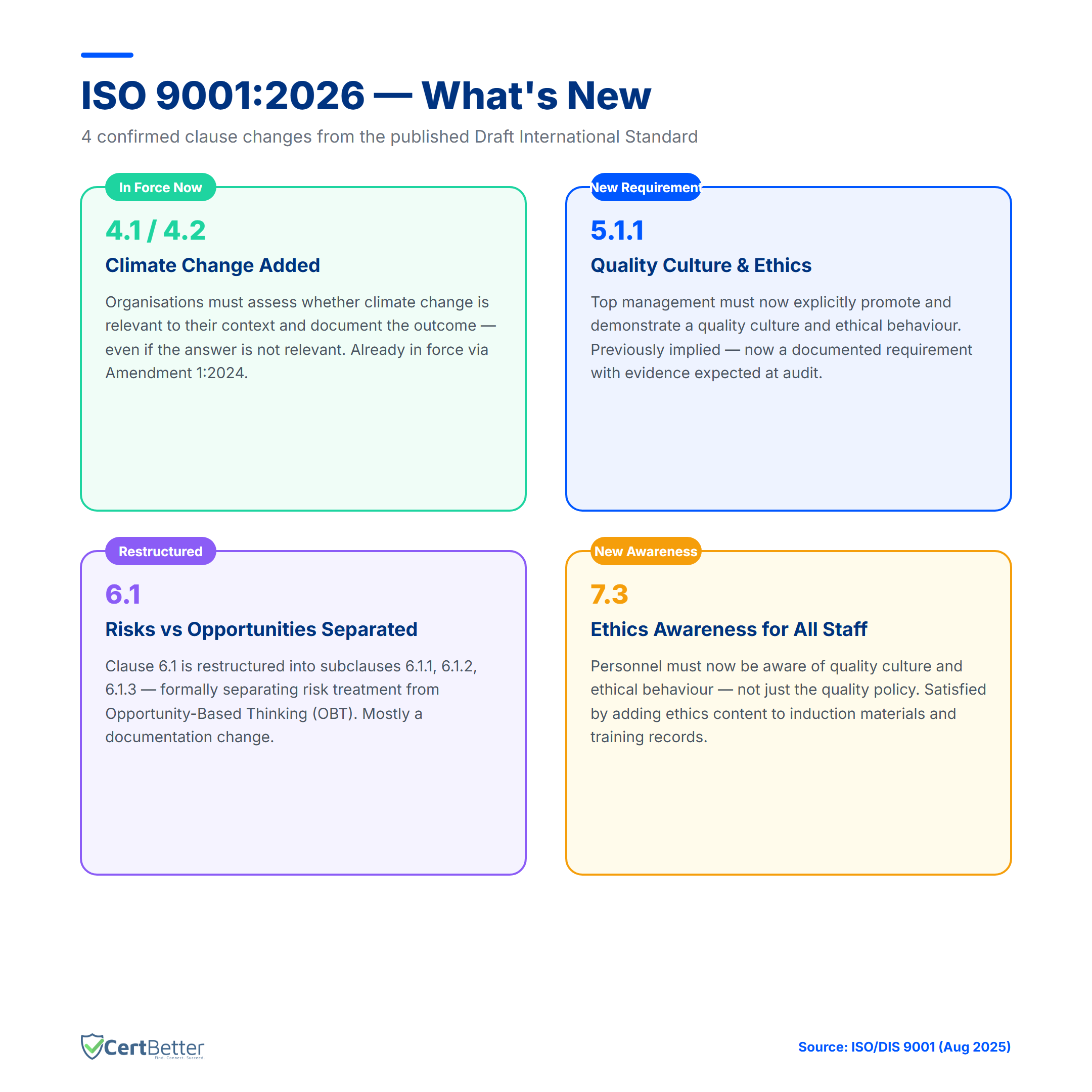
Four clauses receive confirmed changes in the DIS. None of them require a complete QMS rebuild. Here is what each one means in practice.
Clause 4.1 and 4.2: Climate Change Is Now Explicit
This change is already in force. ISO 9001:2015/Amd 1:2024, published in February 2024, formally added climate change to the standard. Clause 4.1 now requires organisations to determine whether climate change is a relevant issue for their context. Clause 4.2 adds a note that interested parties may have climate related requirements.
The critical point here is documentation. You must record your assessment even if your conclusion is that climate change is not relevant to your scope. Auditors will expect to see evidence that you considered it. A blank gap in your context analysis is a non conformance waiting to happen.
If your QMS context analysis has not been updated since 2024, this is the most immediate action item on your list right now. Our guide to implementing climate change into your QMS covers exactly what documentation your auditor will be looking for.
Clause 5.1.1: Quality Culture and Ethics Become Mandatory
ISO 9001:2026 adds an explicit requirement for top management to promote and demonstrate a quality culture and ethical behaviour. A new note clarifies that culture and ethics can be demonstrated through shared values, beliefs, history, attitudes, and observed behaviours.
Previously, quality culture was implied. From 2026, it is a documented requirement with evidence expected during certification audits. This does not mean you need a new culture programme or an ethics consultant. It means you need a light evidence trail: culture referenced in leadership communications, ethics policies in the quality manual, and management review discussions that go beyond just metrics.
For organisations in services, government, or healthcare, this clause will require the most practical attention. Our guide to Clause 5.1 leadership and commitment has practical examples of how top management can demonstrate this in practice. Start building that evidence trail now, before your next audit cycle.
Clause 6.1: Risks and Opportunities Separated into Subclauses
Clause 6.1 is being restructured into subclauses 6.1.1, 6.1.2, and 6.1.3. The purpose is to create a clear documented separation between how your organisation treats risks versus how it identifies and pursues opportunities. The DIS introduces Opportunity Based Thinking alongside the existing Risk Based Thinking approach.
In practice, if your current QMS combines risks and opportunities in a single register or table, you will need to separate them into distinct sections. This is largely a documentation change rather than a process change. Your underlying approach to risk management does not need to change. For a refresher on how Clause 4.1 context analysis feeds into this, the practical examples of Clause 4.1 article is worth revisiting.
Clause 7.3: Ethics Awareness for All Staff
The awareness clause now requires all personnel to be aware of quality culture and ethical behaviour, not just the quality policy and their contribution to objectives. A simple addition to induction materials and training records will satisfy this requirement for most organisations.





The New Annex A: ISO 9001’s First Ever Guidance Section
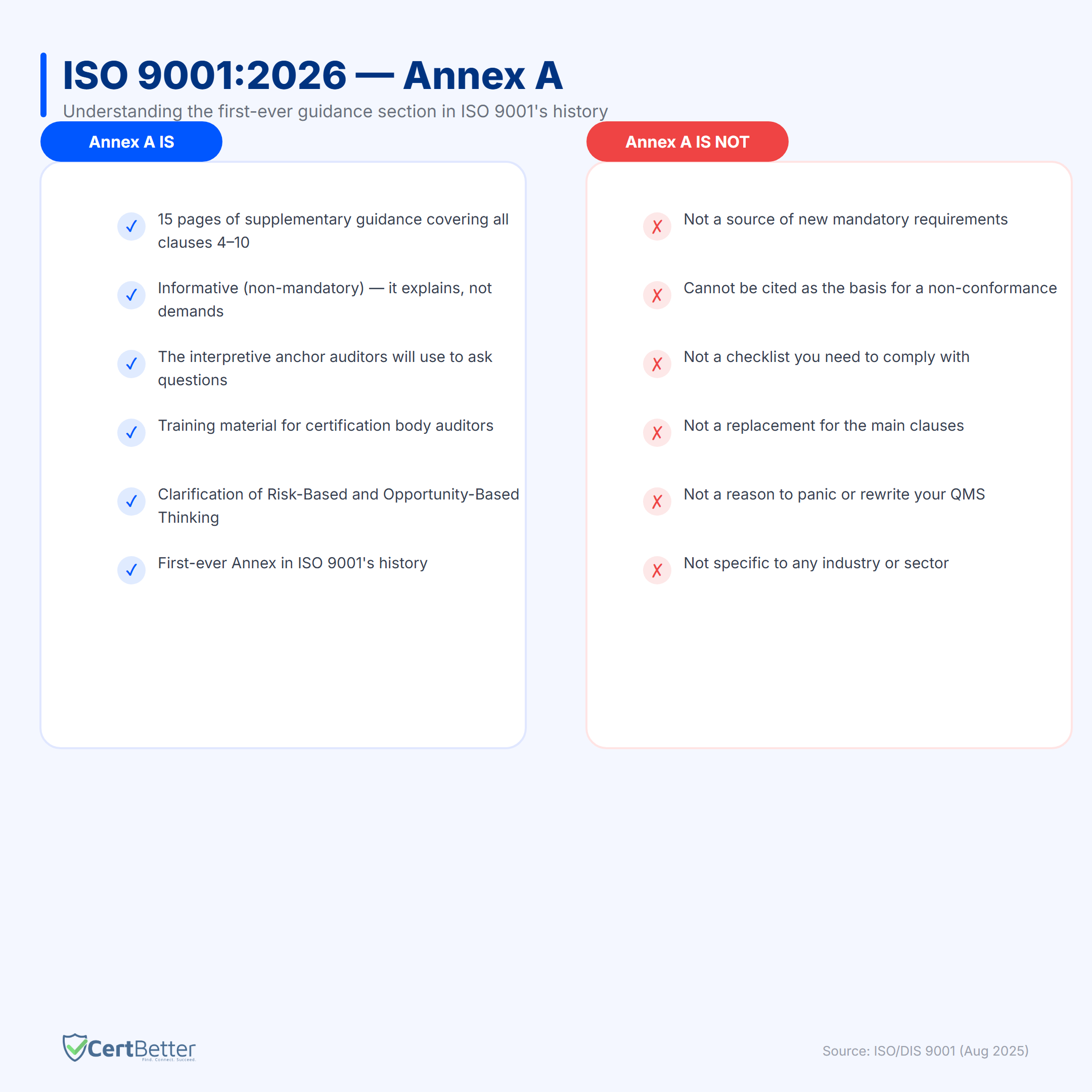
This is structurally new territory. ISO 9001:2026 includes a brand new Annex A, approximately 15 pages of supplementary guidance covering every clause from 4 through 10. This is the first time ISO 9001 has ever included an Annex of this kind, and it matters more than it might appear.
Here is what it means in practice:
- It creates no new mandatory requirements. Annex A is informative, not normative. Certification bodies cannot cite it as the basis for a non conformance finding.
- It will shape how auditors interpret the standard. Certification body training programmes will use it extensively. Expect audit conversations to reflect its language and framing.
- It clarifies Risk Based Thinking and Opportunity Based Thinking with expanded examples, which should reduce the inconsistency that has existed across different auditors and certification bodies for years.
- Annex A.5.1 explicitly states that ethical behaviour is part of the culture of quality. This is the interpretive anchor for the new Clause 5.1.1 requirement.
When the final standard is published, read Annex A first. It is the fastest way to understand how your certification body will approach audits under the new version.
What Is Not Changing
There has been considerable speculation about ISO 9001:2026 introducing requirements for AI governance, ESG reporting, supply chain resilience, remote audit protocols, and digital documentation systems. None of these are in the DIS.
The standard remains deliberately technology neutral. Clause 8, which covers Operations, has only minor terminology adjustments. The core process approach and PDCA framework are unchanged. If you have a well maintained ISO 9001:2015 quality management system, the gap to 2026 compliance is genuinely manageable within the transition window.
Be cautious of consultants or training providers who use the revision as a reason to sell you a complete QMS overhaul. The changes do not warrant it.
Transition Timeline
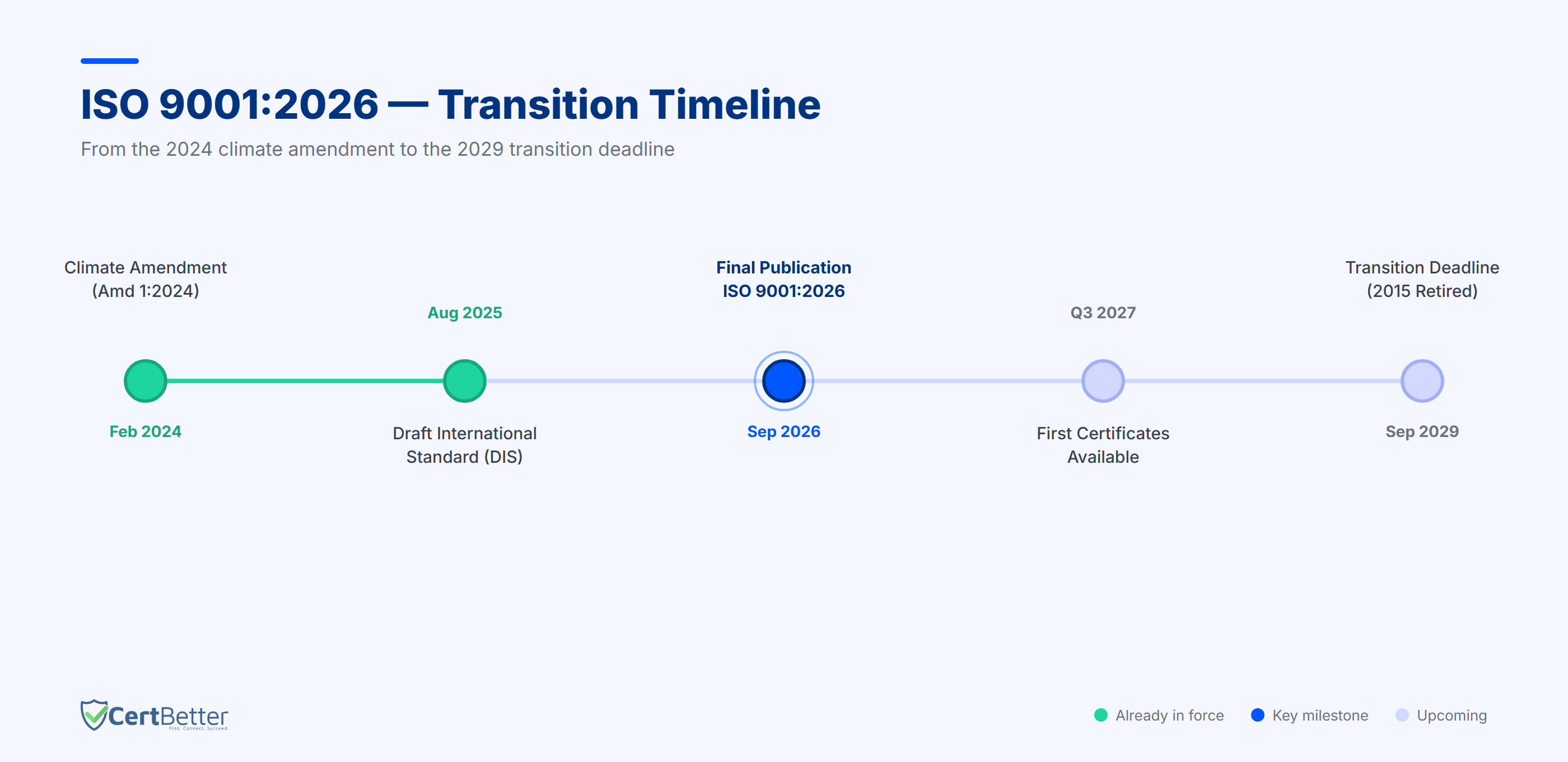
| Milestone | Date |
|---|---|
| Climate change amendment published | February 2024 |
| Draft International Standard published | 27 August 2025 |
| Final Draft International Standard expected | Early to mid 2026 |
| ISO 9001:2026 publication target | September 2026 |
| First ISO 9001:2026 certificates available | Approximately Q3 2027 |
| Transition deadline, ISO 9001:2015 retired | September 2029 |
Certification bodies will need nine to twelve months after publication to obtain accreditation for the new version before they can issue ISO 9001:2026 certificates. The first compliant certificates will realistically be available around mid 2027, and the three year transition window runs to September 2029.
Do not wait until 2028 to start your transition. There will be significant demand pressure on certification body capacity as the deadline approaches, and organisations that start early will have far more flexibility in scheduling their transition audit.
Impact on Sector Specific Standards
If your organisation holds a sector specific certification that builds on ISO 9001, expect follow on revisions on their own timelines:
- Automotive: IATF 16949. A revision is confirmed and underway, expected as IATF 16949:2027 approximately 12 to 18 months after ISO 9001:2026 publication. Will add sustainability alignment, data integrity requirements for AI assisted inspection, and MES/ERP traceability.
- Aerospace and Defence: AS9100 series. Being rebranded to the IA series, covering IA9100, IA9110, and IA9120. Expected in 2026 or 2027.
- Healthcare: EN 15224. Will align to ISO 9001:2026 after publication.
- Medical Devices: ISO 13485. Currently on its own revision cycle and will review for alignment.
If you hold one of these certifications, build the ISO 9001:2026 transition into your broader certification planning now. You will likely need to transition both standards within overlapping timeframes.
What To Do Now
The three year transition period gives organisations genuine breathing room. A sensible approach looks like this.
Before Publication: Now Until Late 2026
- Add climate change to your Clause 4.1 context analysis. Amendment 1:2024 is already in force. Document your assessment even if the outcome is that climate change is not relevant to your scope.
- Update your management review agenda to include quality culture and ethics discussion, with minutes that reference both topics.
- Conduct a gap analysis against the DIS. Most major certification bodies including SGS, BSI, DNV, and TUV are offering DIS gap analysis services now.
After Publication: 2026 to 2029
- Split your risk and opportunity documentation into distinct sections aligned to the new Clause 6.1 structure.
- Add ethics awareness content to induction and training materials for Clause 7.3.
- Add quality culture and ethics to your internal audit scope and checklists. If your internal audit programme needs a refresh, read our guide on how to run ISO internal audits that actually find problems.
- Use Annex A as a training reference for your internal audit team.
- Schedule your transition audit with your certification body at least 12 months before the September 2029 deadline. Capacity pressure will be real as the deadline approaches.
The ISO/TC 176 SC2 committee publishes regular updates on the revision progress. It is worth bookmarking for anyone with a direct stake in the transition.
The Bottom Line
ISO 9001:2026 formalises what good quality management already looks like in 2026: explicit leadership accountability for culture, a documented response to climate context, and a clear distinction between managing risk and pursuing opportunity. The changes are real but manageable.
Certification bodies are providing a full three years to transition. That is enough time to plan, prepare, and certify without disrupting your operations. The only change that is already mandatory is the climate amendment. Start there, build the rest into your next management review cycle, and you will be well ahead of the curve when the final standard lands.
If you are planning your ISO 9001 transition and want to compare quotes from certified consultants or accredited certification bodies, CertBetter makes it straightforward at no cost to your business.