A New Edition After 14 Years
ISO/IEC 17020:2026 was officially published on 27 March 2026. On the same day, the 2012 edition was withdrawn. This is Edition 3 of the standard, and it represents the most significant rewrite inspection bodies have seen in over a decade.
On this page
If your organisation holds accreditation under ISO/IEC 17020, or if you are working toward it, this revision affects you directly. The core purpose of the standard has not changed. It still defines what it means for a body to conduct inspections with competence and impartiality. What has changed is how those requirements are expressed, structured, and applied.
This article walks through the substantive changes, what they mean in practice, and what you need to start doing now before your accreditation body comes knocking.
The Three Year Transition Window
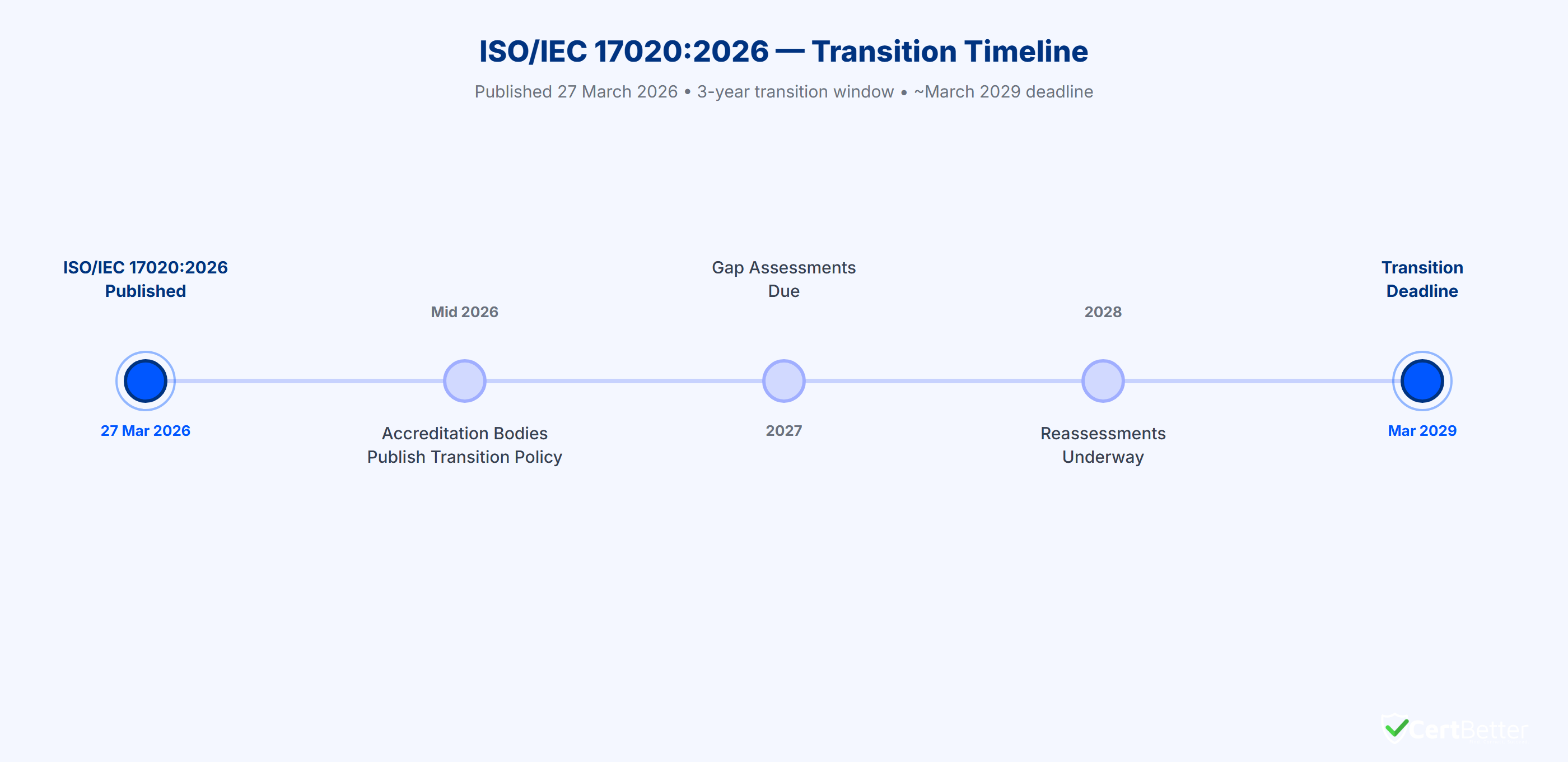
Accreditation bodies worldwide, including NATA in Australia and UKAS in the United Kingdom, will implement a transition period. The standard expectation for ISO/IEC 17000 series revisions is a three year transition from the publication date, which puts the deadline at approximately March 2029.
That may sound comfortable, but three years tends to disappear quickly when you factor in internal gap assessments, documentation rewrites, staff training, mock assessments, and the scheduling constraints of your accreditation body. Bodies that begin the process in 2027 or later will be competing for assessment slots with every other inspection body doing the same thing.
Formal transition timelines will be confirmed by accreditation bodies individually. NATA and JASANZ are expected to publish their guidance in mid to late 2026. Watch their websites directly for official transition policy documents.





The Title Change Signals Something Broader
The previous edition carried a long title: “Requirements for the operation of various types of bodies performing inspection.” The new title is simply “Requirements for Bodies Performing Inspections.”
This is not cosmetic. The old title tried to explain itself. The new title asserts scope with confidence. It signals that the standard is intended to apply broadly across all inspection contexts, without caveats built into the name itself. The phrase “various types of” has been dropped because the revised structure handles type distinctions within the body of the standard rather than in the title.
For bodies operating across multiple inspection sectors, this broader framing is intentional. The standard is written to be applicable whether you are inspecting buildings, pressure vessels, vehicles, food production environments, or any other regulated or commercial domain.
The Independence Classification Model Has Been Restructured
This is the change that will require the most careful reading. The original Type A, Type B, and Type C classification framework has been revised. The underlying logic of distinguishing between fully independent bodies, bodies with organisational connections to the entities they inspect, and bodies operating in-house has not been abandoned, but the way those distinctions are defined, applied, and documented has changed significantly.
Under the 2012 edition, many inspection bodies chose their type classification at accreditation and then more or less left it alone. The new edition requires a more active and ongoing approach to classification. Bodies need to demonstrate that their classification is accurate relative to their current client base and organisational relationships, not just at the point of initial accreditation.
Practically, this means reviewing your independence classification as part of your management review cycle. If your client base or your corporate structure has shifted since you last formally assessed your type, you may need to reassess which classification applies and whether your current controls are appropriate for that classification.
Bodies that sit at the boundary between Type A and Type B in particular should read the revised definitions carefully and document their rationale explicitly. Assessors will be looking for that documented reasoning.
Impartiality and Confidentiality Requirements Are More Explicit
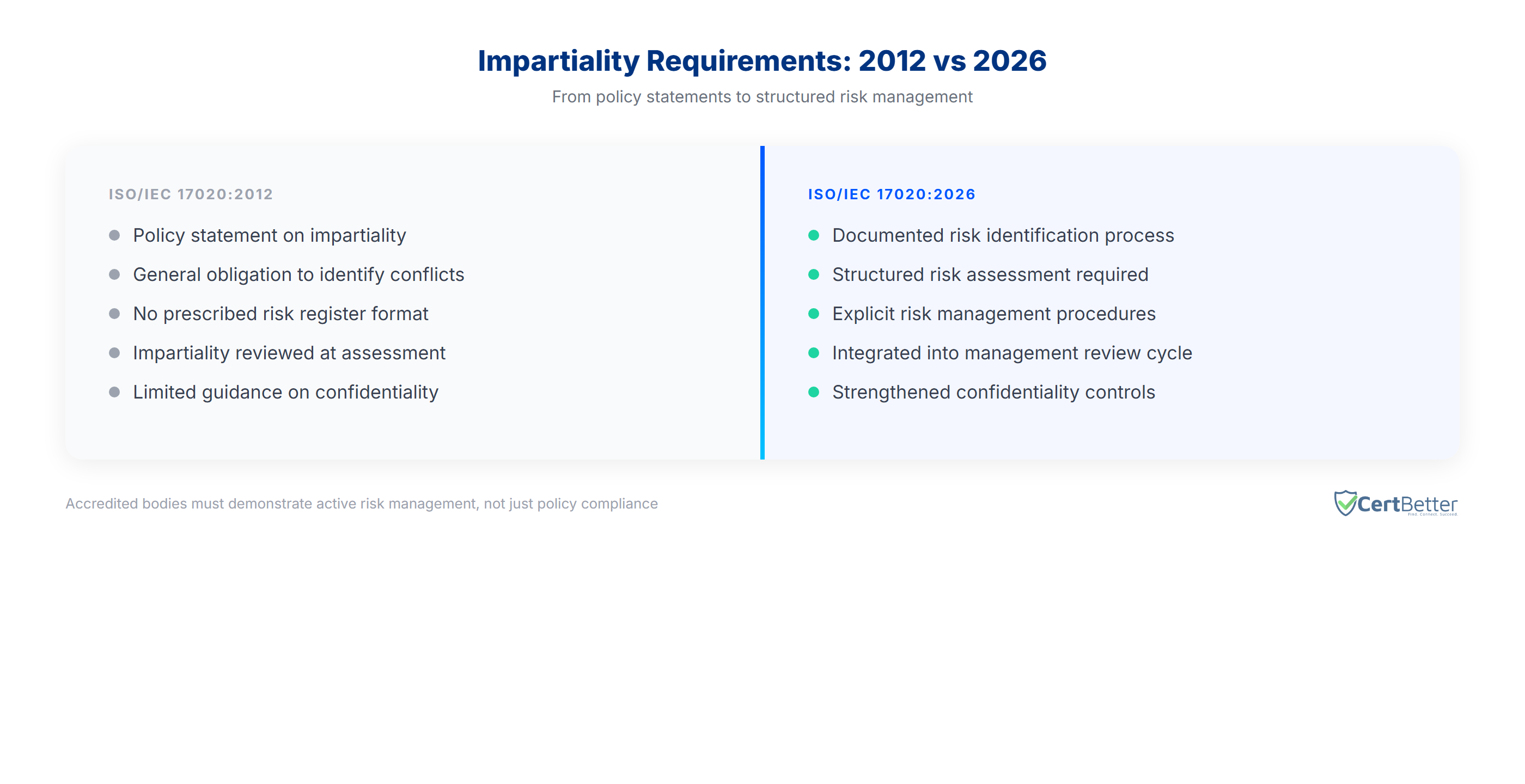
The 2012 edition addressed impartiality but left significant room for interpretation in how bodies identified and managed impartiality risks. The 2026 edition tightens this up considerably.
There are now more explicit requirements around risk identification, risk management processes, and documentation. It is not enough to have a policy statement about impartiality. You need a structured process for identifying situations where impartiality could be threatened, assessing the significance of those threats, and recording how they were addressed.
This aligns with how impartiality is treated in ISO/IEC 17025:2017 (the standard for testing and calibration laboratories), and it reflects a broader push across the ISO/IEC 17000 series toward documented risk-based thinking rather than policy assertions.
For confidentiality, the new edition strengthens requirements around how inspection information is protected and under what conditions it can be disclosed. Bodies that handle inspection results for regulated industries, where third parties such as regulators or insurers may request access, need to review their confidentiality agreements and their documented procedures for handling disclosure requests.
Management System Alignment Across the 17000 Series
One of the consistent threads running through recent revisions of ISO/IEC 17025 and ISO/IEC 17065 has been harmonisation. The organisations producing these standards have been working to make the management system requirements more consistent across the series so that bodies accredited to multiple standards do not face contradictory or duplicated requirements.
ISO/IEC 17020:2026 continues this work. The management system section has been updated to align more closely with the structure and language used in the broader 17000 series. If your body is already operating under ISO/IEC 17025 or ISO/IEC 17065, some of the management system requirements in the new 17020 will look familiar. That is deliberate.
This harmonisation also brings 17020 closer to the high-level structure used across ISO management system standards more generally. Bodies that also hold certification to ISO 9001 will find overlaps they can exploit during their gap assessment and documentation review. The overlap is not complete, and accreditation requirements are more prescriptive than certification requirements, but there is genuine alignment to work with.
To understand the distinction between the bodies that issue certifications and the bodies that grant accreditation, it is worth reading about the difference between a certification body and an accreditation body. The distinction matters here because ISO/IEC 17020 accreditation sits in a different tier of the conformity assessment system than ISO 9001 certification.
Appeals and Complaints Handling Has Been Revised
The requirements for managing appeals and complaints have been updated. The 2012 edition set out the basic expectation that bodies have a process for handling both. The 2026 edition is more prescriptive about what that process needs to include.
Key additions include clearer requirements for acknowledging receipt of complaints within a defined timeframe, keeping complainants informed of progress, documenting the outcomes and any corrective actions taken, and conducting analysis of complaints and appeals data as part of continual improvement activity.
Bodies that have been running informal complaints processes, where a senior inspector handles complaints case by case without a documented procedure, will need to formalise that approach. Assessors will expect to see documented evidence of how complaints and appeals have been handled, not just a procedure document that describes how they should be handled in theory.
What Inspection Bodies Need to Review and Update
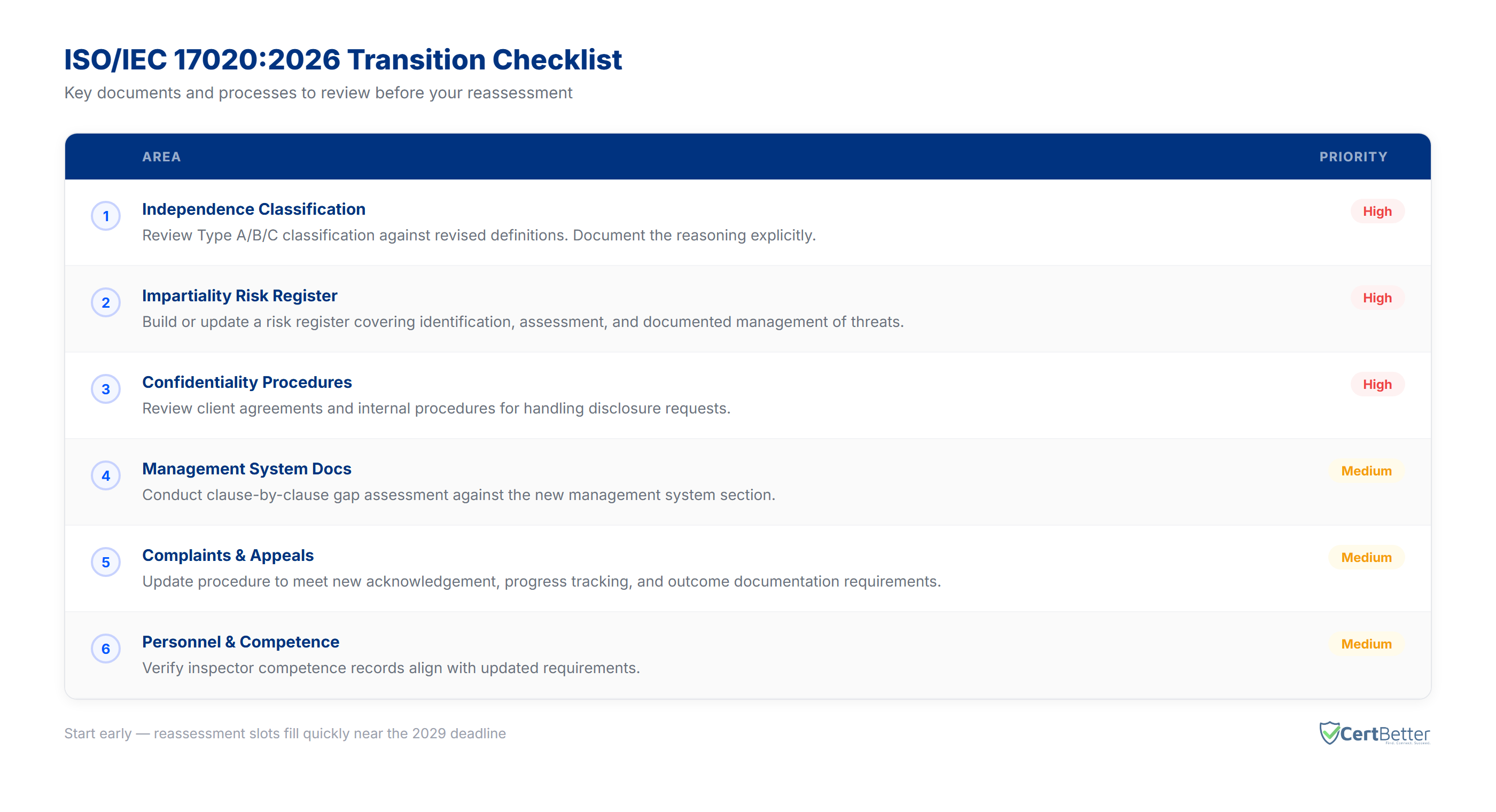
Rather than listing every clause, it is more useful to think in terms of the documents and processes that will need attention. Here is a practical starting point:
Independence classification statement. Review your current Type classification against the revised definitions. Document the reasoning. If you have had any changes to your organisational structure or client base since your last assessment, factor those in.
Impartiality risk register. If you do not have one already, you need one. If you do have one, review it against the new requirements to ensure it covers identification, assessment, and documented management of threats to impartiality.
Confidentiality procedures. Review your agreements with clients and your internal procedures for handling disclosure requests. Ensure they reflect the new requirements.
Management system documentation. Conduct a gap assessment against the revised management system section. Pay particular attention to areas where the language has shifted, even if the intent seems similar. Assessors will be working from the new text.
Complaints and appeals procedure. Update your procedure to meet the new requirements, and check that your records from the past 12 months would satisfy an assessor looking for evidence of implementation.
Personnel records and competence evidence. Review whether your current approach to documenting inspector competence aligns with the updated requirements.
How Accreditation Bodies Will Manage the Transition
Accreditation bodies like NATA in Australia, UKAS in the United Kingdom, and their counterparts in other jurisdictions are members of the International Accreditation Forum (IAF) and the International Laboratory Accreditation Cooperation (ILAC). These bodies coordinate transition policy to ensure that the global network of accredited bodies moves to the new edition in a consistent way.
In practical terms, this means your accreditation body will publish a transition policy that specifies the deadline, the assessment approach during the transition period, and whether any interim surveillance assessments will include evaluation against the new standard before your formal transition assessment.
For Australian inspection bodies, NATA is the primary accreditation body. JASANZ accredits certification bodies rather than inspection bodies, so if you are accredited under ISO/IEC 17020, NATA is the organisation to watch for transition guidance. Check the NATA website at nata.com.au for updates as they are published.
IAF and ILAC may also publish joint guidance documents. The ISO.org standard page for ISO/IEC 17020 will link to official documentation as it becomes available.
One pattern that has emerged from previous transitions in the 17000 series is that accreditation bodies use surveillance visits during the transition period as an opportunity to provide informal feedback on where bodies are tracking against the new requirements. If you have a surveillance visit scheduled in 2026 or 2027, it is worth raising the transition proactively and asking for assessor feedback on your gap assessment approach.
Connecting This to the Broader Standards Landscape
ISO/IEC 17020:2026 does not exist in isolation. If you want to understand how ISO standards get revised and what the process means for the bodies that hold accreditation or certification against them, read our article on how ISO standards are updated and what happens to your certificate.
It is also worth noting that ISO 9001 is going through its own revision process. If your organisation holds ISO 9001 certification alongside your 17020 accreditation, the management system alignment work you do for the 17020 transition may also position you well for the ISO 9001 update. Read our coverage of ISO 9001:2026 and how businesses are preparing for a broader picture of what is coming across the standards landscape.
Where CertBetter Fits In
CertBetter helps businesses find accredited inspection bodies, certification bodies, and conformity assessment providers across Australia and beyond. If you are an inspection body preparing for the ISO/IEC 17020:2026 transition, having a current and accurate profile on CertBetter ensures that organisations looking for accredited inspection services can find you during what will be an active period of market scrutiny. And if you are a business that relies on accredited inspection services, CertBetter makes it straightforward to verify that the body you are using holds current, relevant accreditation. Search the directory at certbetter.com.