If you're looking for the best ISO certification body for your business, the options in Australia can be difficult to compare. There are over a dozen JASANZ accredited certification bodies operating here, each with their own pricing, auditor capacity, and track record. Most publish their own case studies and client counts. None of those numbers can be independently verified.
On this page
This article uses a different approach. Every figure here is drawn from the JASANZ public register. Active certificate counts, withdrawal rates, accreditation status, and scope of accreditation are all pulled from those sources. Where a body's self-reported claims differ from the registry data, we use the registry data.
We have ranked ten bodies by active Australian certificate volume, then layered in withdrawal rate, JASANZ accreditation history, standards scope, and any notable events. The goal is to give you enough information to shortlist two or three bodies and go into your first conversation with them well prepared.
How We Ranked These CABs
The primary sort is active certificate count sourced from the JASANZ public register. This reflects real market activity, not marketing claims. We then reviewed the JASANZ public register for accreditation scope and renewal history. Withdrawal rates are calculated from JASANZ public register data and represent the percentage of certificates that were withdrawn rather than allowed to lapse or transferred. A high withdrawal rate can indicate client dissatisfaction, auditor inconsistency, or internal capacity problems. It is worth asking about directly. For more on what to look for before you sign, see our step-by-step selection checklist.
Two rates appear throughout this article. The annual withdrawal rate is the number of certificates withdrawn in a given year divided by the current active base. It is the most comparable figure across bodies because it reflects a consistent time window. Historical data in the JASANZ public register varies by body, so some cells show a dash where records do not go back that far.
| Certification Body | 2024 | 2025 | 2026 YTD |
|---|---|---|---|
| Compass Assurance | 5.4% | 5.0% | 4.7% |
| DNV | 4.7% | 4.7% | 4.4% |
| TQCSI | — | — | 2.0% |
| ECAAS | 0.8% | 0.8% | 1.3% |
| Intertek SAI Global | 0.4% | 0.1% | 0.2% |
| Bureau Veritas | — | 0.0% | 0.0% |
| Global-Mark | — | — | 0.0% |
| GCC | — | — | 0.0% |
| Citation | — | — | 0.0% |
| BSI | — | — | 0.0% |
Annual rate = certificates withdrawn in that year divided by current active base. (—) = historical records not available in JASANZ register for that period. Source: JASANZ Public Register (May 2026).





1. Intertek SAI Global
Full name: Intertek SAI Global Pty Ltd
Website: saiassurance.com.au
JASANZ accredited since: 1993
Active certificates: 5,008
Accredited standards: 32
Industries served: Quality management, food safety, information security, energy
Geographic reach: 125 countries
Australian offices: 18
Intertek SAI Global is the largest JASANZ accredited certification body in Australia by active certificate volume. With 32 accredited standards, 18 local offices, and a global footprint across 125 countries, it is the obvious first call for businesses that need multi-site or multi-standard certification with a single provider.
The track record is not without blemish. In 2018, its ANAB accreditation was suspended following an auditor backlog issue. In 2022, it exited AS9100 certification in Australia, leaving aerospace clients needing to transfer to another body. In 2023, there were publicly reported capacity warnings in some regions. None of these issues affected its JASANZ accreditation status.
On a positive note, Intertek SAI Global became the first body in Australia to achieve JASANZ accreditation for ISO 42001 (AI management systems) in 2025, which is relevant for businesses in regulated technology sectors.
2. Citation Certification
Full name: Citation Certification Pty Ltd
Website: citationgroup.com.au/certification
JASANZ accredited since: 1995
Active certificates: 3,475
Accredited standards: 7
Industries served: NDIS, health, community services, general management systems
Geographic reach: 54 countries
Australian offices: 1
Citation Certification has a clean regulatory record. No withdrawn certificates on record in JASANZ, and JASANZ accreditation renewed in 2024. For a body with nearly 3,500 active certificates, that consistency matters.
The standards scope is narrower than the larger players, with 7 accredited standards. The focus on NDIS, health, and community services makes it a strong fit for those sectors. A single Australian office means auditor scheduling may require more lead time for regional clients.
3. Global-Mark
Full name: Global-Mark Pty Ltd
Website: global-mark.com.au
JASANZ accredited since: 2005
Active certificates: 2,578
Accredited standards: 30
Industries served: Construction, manufacturing, sustainability, product certification, food
Geographic reach: 172 countries
Australian offices: 1
Global-Mark operates from a single Australian office but holds JASANZ accreditation across 30 standards with a geographic reach of 172 countries. It has zero recorded withdrawals and zero suspensions, and its JASANZ accreditation has been renewed to 2031. That is an unusually long renewal horizon and reflects a clean audit record with the accreditation body.
The breadth of standards and the construction and manufacturing focus make it a practical option for businesses that need product certification alongside their management system certification.
4. Compass Assurance Services
Full name: Compass Assurance Services Pty Ltd
Website: cas.com.au
JASANZ accredited since: 2013
Active certificates: 2,174
Accredited standards: 7
Industries served: General industry
Geographic reach: 64 countries
Australian offices: 4
Compass Assurance Services is owned by Kiwa Group, a Netherlands-based testing, inspection, and certification organisation. It merged with QCSE in February 2023, which expanded its Australian footprint to 4 offices. It achieved ISO 42001 accreditation in November 2025.
Two things to note. The annual withdrawal rate has been consistent at around 5% of the active certificate base across 2024, 2025, and into 2026. That consistency makes it a structural pattern rather than a one-off event, and is worth raising directly with Compass before committing. JASANZ accreditation is due to expire in June 2026. That is not necessarily a problem, as renewals are routine, but it is worth confirming the renewal status before you commit to a multi-year certification cycle.
5. GCC (Global Compliance Certification)
Full name: Global Compliance Certification Pty Ltd
Website: gccertification.com
JASANZ accredited since: 2015
Active certificates: 2,043
Accredited standards: 9
Industries served: General industry, cybersecurity
Geographic reach: 24 countries
Australian offices: 4
GCC has a zero withdrawal rate, which stands out. It joined IQNet in January 2026 as Australia's sole member, giving its certificates international recognition across the IQNet network. In February 2026, it added Essential Eight certification to its scope, making it one of the few JASANZ accredited bodies offering this alongside ISO standards.
The geographic reach is more limited at 24 countries, which is worth considering if you operate across multiple international markets. For Australian-focused businesses with cybersecurity compliance requirements, GCC is worth shortlisting.
6. TQCSI
Full name: TQCSI Pty Ltd
Website: tqcsi.com
JASANZ accredited since: 1993
Active certificates: 1,269
Accredited standards: 8
Industries served: Food, aerospace, defence, HACCP, QHSE
Geographic reach: 81 countries
Australian offices: 25
TQCSI has the largest number of Australian offices in this comparison at 25, which translates to genuine local auditor availability across the country. It has held JASANZ accreditation since 1993. The focus on food, aerospace, HACCP, and QHSE makes it a strong option for those sectors. Pricing is reported to be competitive.
7. DNV Business Assurance
Full name: DNV Business Assurance Australia Pty Ltd
Website: dnv.com
JASANZ accredited since: 1994
Active certificates: 1,223
Accredited standards: 15
Industries served: Maritime, energy, sustainability
Geographic reach: 62 countries
Australian offices: 8
DNV is a global organisation with over 15,000 staff. Its Australian presence covers maritime, energy, and sustainability sectors where it has deep technical expertise. With 15 accredited standards and 8 local offices, it has genuine breadth for larger organisations operating in regulated industries.
The annual withdrawal rate has held at 4.7% of the active certificate base in both 2024 and 2025, with 2026 tracking at 4.4%. Given DNV's sector concentration in maritime and energy, where corporate restructures and asset sales are common, some of this is expected. The consistency across three years suggests it is not purely event-driven. This does not mean DNV is the wrong choice, but it does mean you should ask directly about their auditor allocation process, capacity management, and what happens if your primary auditor leaves the business. The reasons businesses switch certification bodies are often rooted in exactly these issues.
8. Bureau Veritas
Full name: Bureau Veritas Certification (Australia) Pty Ltd
Website: bureauveritas.com.au
JASANZ accredited since: 1994
Active certificates: 1,131
Accredited standards: 11
Industries served: General industry, construction, government
Geographic reach: 70 countries
Australian offices: 3
Bureau Veritas has over 190 years of testing, inspection, and certification history globally. In 2015, a complaint was lodged regarding co-marketing arrangements with an ISO consultant, which raised questions about independence under ISO 17021. The ISO 17021 standard requires strict separation between certification and consulting. Understanding how to identify conflicts of interest between consultants and certification bodies is relevant when evaluating any body. In 2024, Bureau Veritas acquired The APP Group, which includes over 500 Australian consulting staff. That relationship is worth understanding before you engage.
9. ECAAS
Full name: ECAAS Pty Ltd
Website: ecaas.com
JASANZ accredited since: 2011
Active certificates: 903
Accredited standards: 4
Industries served: Agriculture, manufacturing
Geographic reach: 31 countries
Australian offices: 5
ECAAS is Adelaide-based and operates as a boutique certification body with a relationship-focused model. The scope is narrower than most bodies in this list at 4 accredited standards, but within agriculture and manufacturing it has genuine sector knowledge. Five Australian offices for 908 active certificates suggests strong auditor availability and lower client-to-auditor ratios than the larger bodies.
10. BSI Group
Full name: BSI Group Australia Pty Ltd
Website: bsigroup.com/en-au
JASANZ accredited since: 1993
Active certificates: 561
Accredited standards: 22
Industries served: Large enterprises, multinationals, government
Geographic reach: 56 countries
Australian offices: 3
BSI Group is one of the oldest standards bodies in the world, with between 7,000 and 8,000 global staff. Its Australian entity holds 22 accredited standards and has operated here since 1993. The active certificate count of 553 is the lowest in this comparison, which likely reflects a deliberate focus on larger, more complex clients rather than volume. In October 2024, BSI certified KPMG Australia as the first organisation globally to achieve ISO 42001 certification.
Data at a Glance
The charts below pull together the key data points across all ten bodies. Active certificate volume gives a sense of market presence. Withdrawal rate reflects client retention. Office locations indicate local auditor access. Countries of operation matter if you need multi-jurisdictional coverage. Accredited standards breadth determines whether one body can cover all your certification needs.
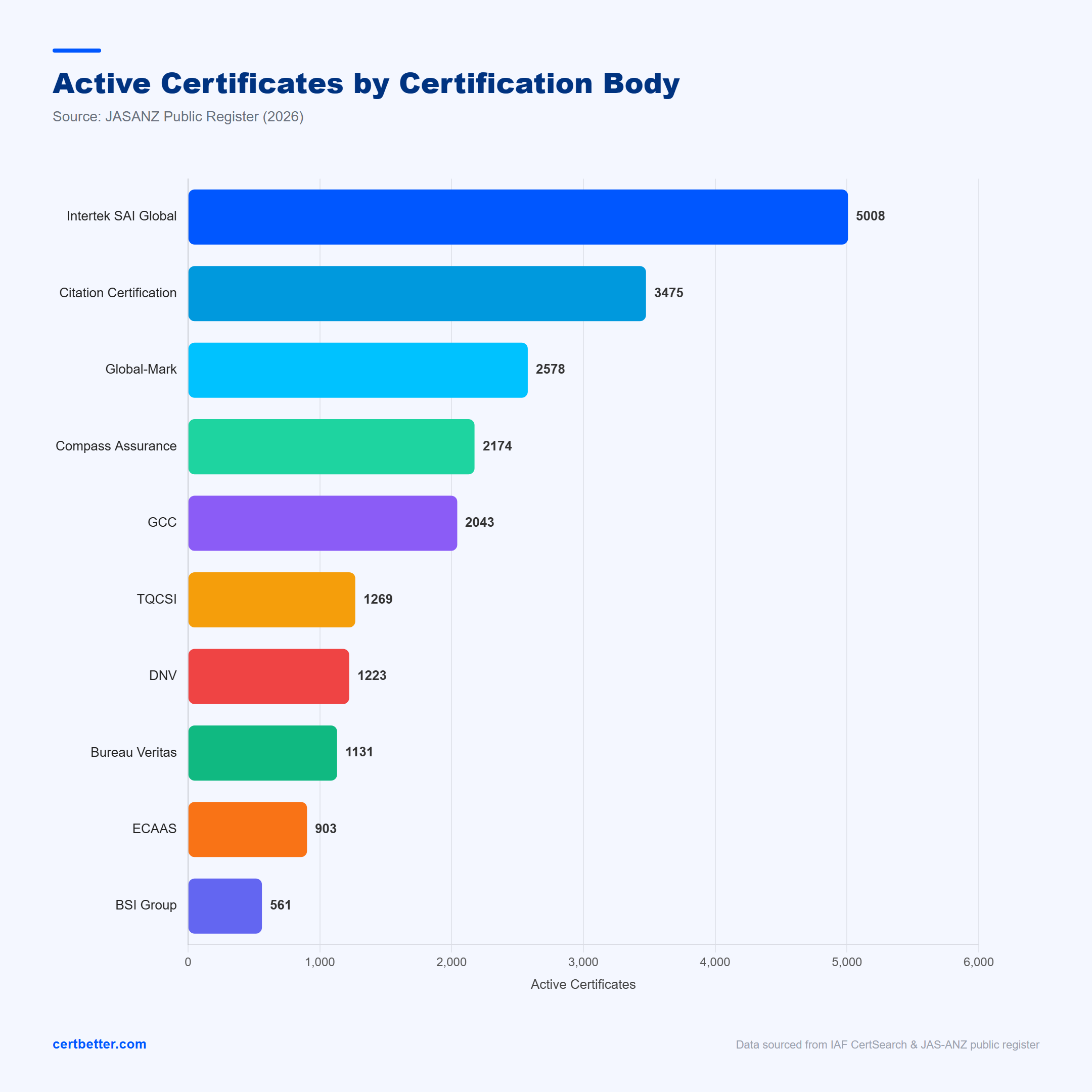
Intertek SAI Global's lead is substantial at 5,008 active certificates, with Citation Certification second at 3,475. The gap narrows more gradually across the remaining eight bodies, with BSI's 553 at the bottom despite its global brand recognition.
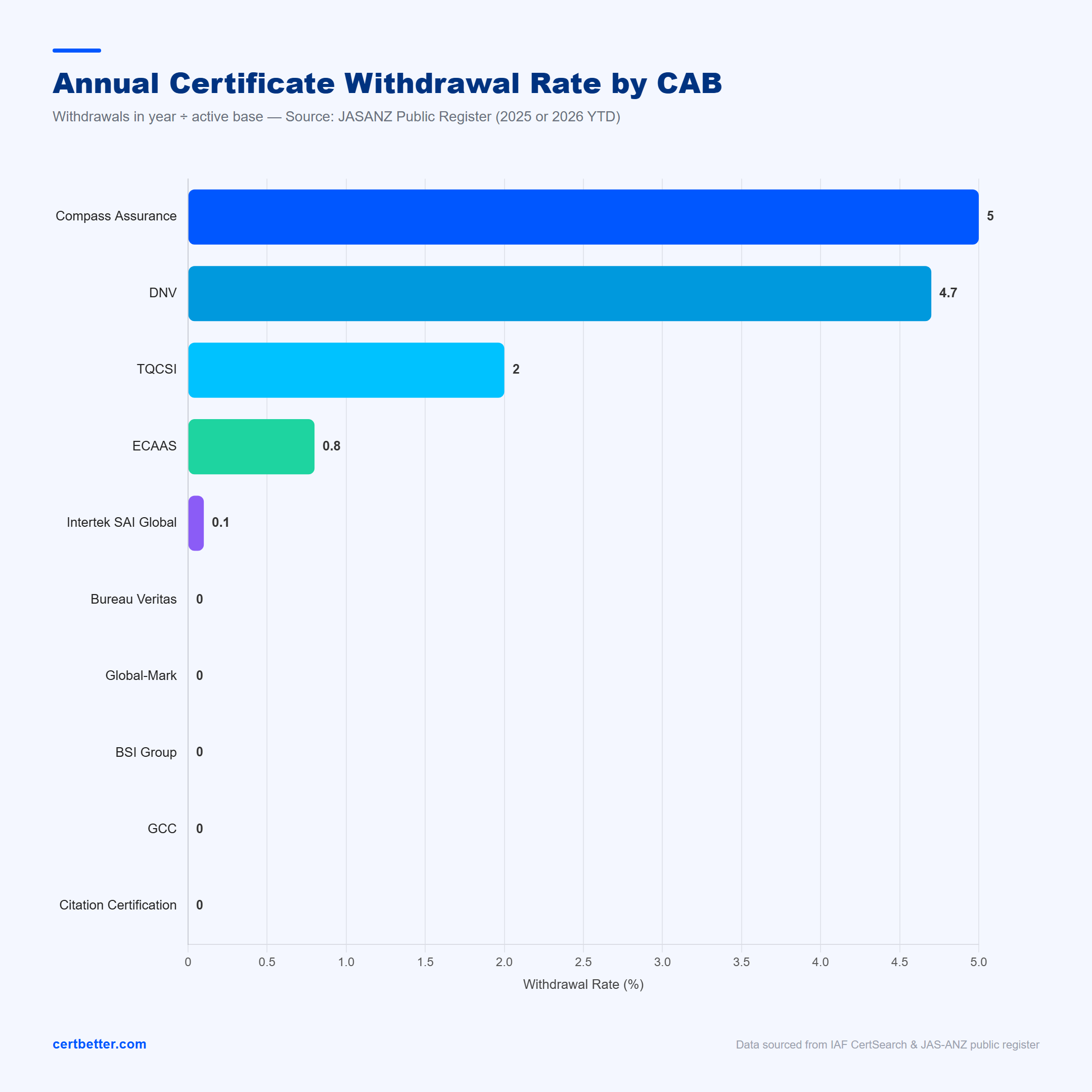
Compass and DNV both show annual withdrawal rates above 4%. The remaining eight bodies are at 2% or below. Global-Mark and GCC both register zero withdrawals. This metric is explored in more detail below.
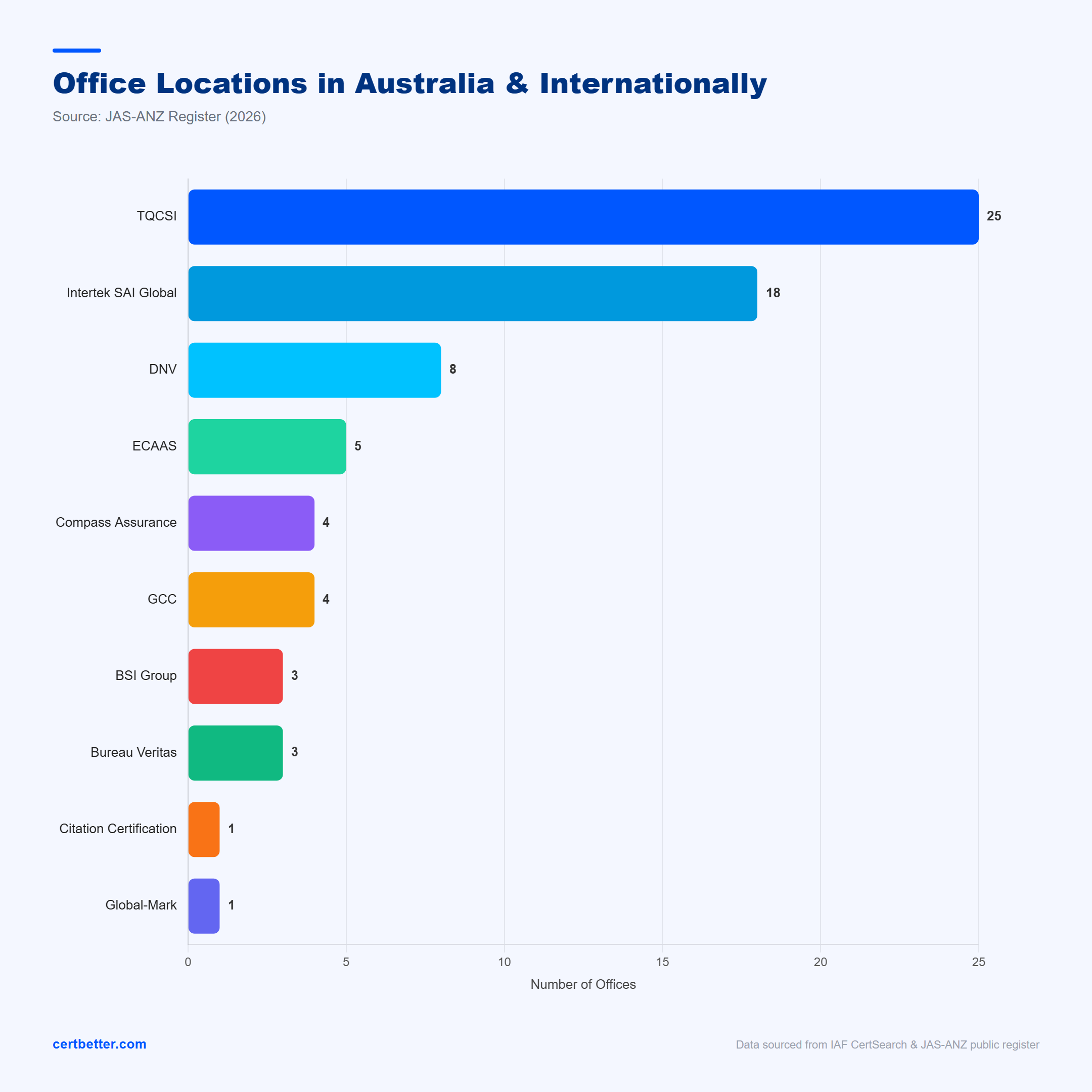
TQCSI's 25 Australian offices stand out clearly. For businesses in regional locations where auditor travel adds meaningful cost, office proximity is a practical factor.
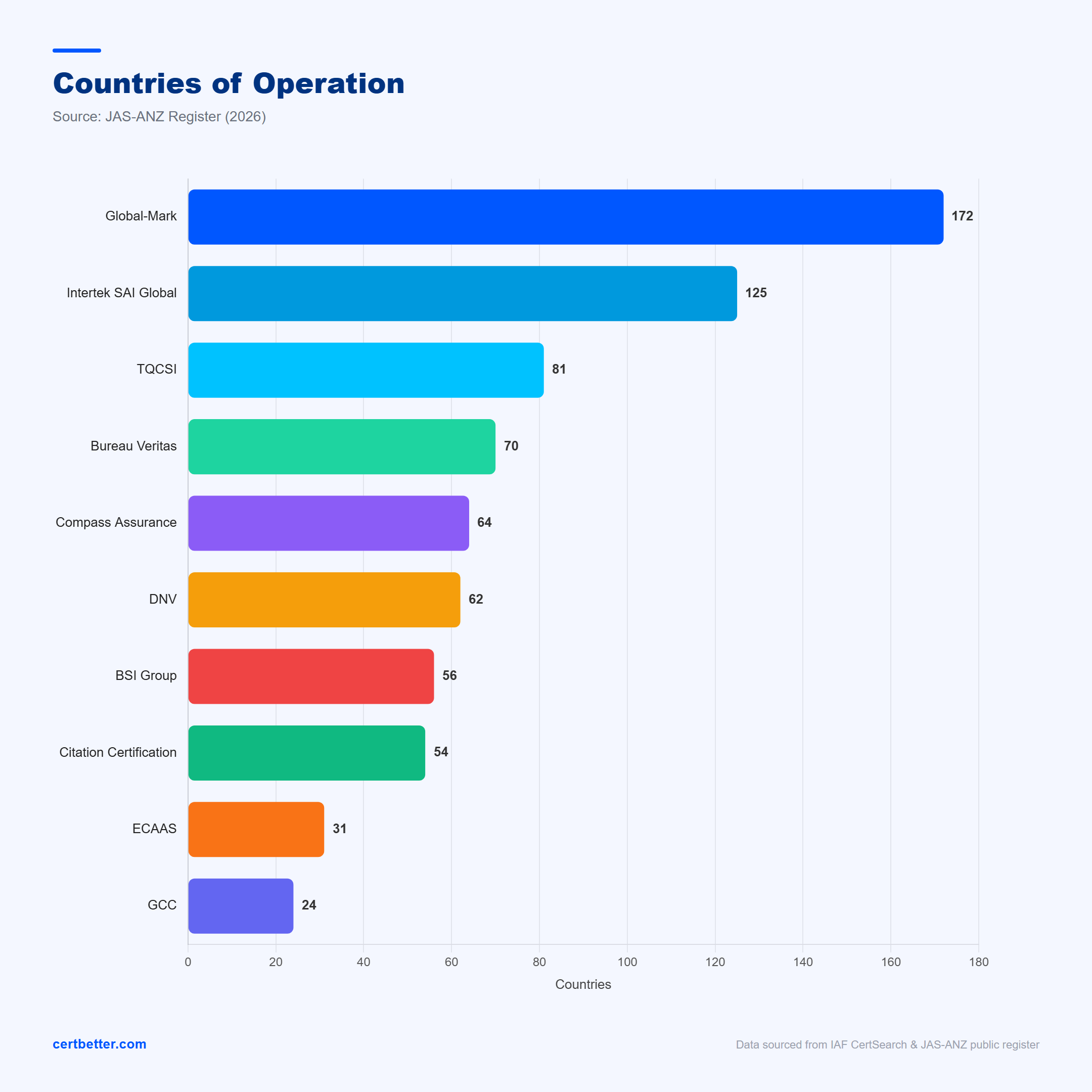
Global-Mark's reach into 172 countries is the highest of any body on this list, notable for a single-office Australian operation. Intertek SAI Global covers 125 countries, reflecting its multinational parent structure.
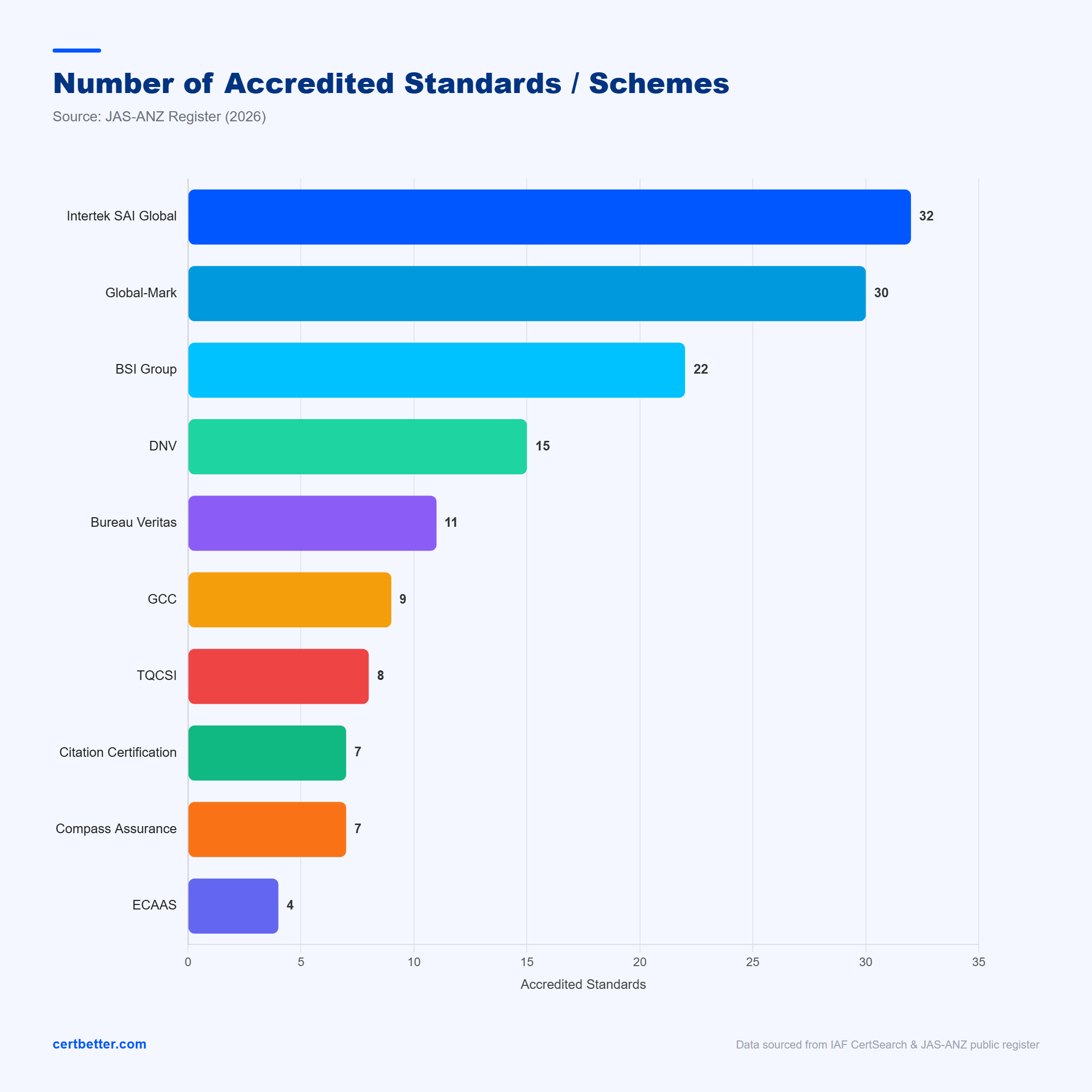
Intertek SAI Global leads on standards breadth at 32, followed by Global-Mark at 30 and BSI at 22. Bodies like Citation and Compass have narrower scopes at 7 accredited standards each.
What the Certificate Withdrawal Rate Actually Means
The withdrawal rate is the proportion of a body's certificates that were formally withdrawn from the JASANZ register. It is calculated as withdrawn certificates divided by total certificates issued.
A high withdrawal rate does not automatically mean the body is performing poorly, but it does mean you should ask questions. Certificates can be withdrawn because the client chose to leave the body or stop maintaining certification, the body withdrew certification following a failed surveillance audit, the client's business ceased or restructured, or scope reductions removed the certificate entirely.
What the data does not tell you is which of these reasons applies, or in what proportion. DNV's annual rate of around 4.7% is likely partly explained by the industries it serves, including maritime, oil and gas, and energy, where asset sales, project completions, and corporate restructures are common. Compass's annual rate of around 5% is harder to explain from the outside without more detail.
Global-Mark and GCC's zero withdrawal rates are genuinely unusual. Across thousands of active certificates, some attrition is expected. Zero is a positive signal worth noting. For a broader look at what drives businesses to leave their certification body, see our article on why Australian businesses are switching ISO certification bodies.
What to Ask Your Certification Body Before You Sign
Every body on this list will tell you they provide excellent service, responsive auditors, and competitive pricing. The questions below are designed to get past the sales conversation and into the operational reality.
Scheduling and Availability
Ask how far in advance you need to book your initial audit and your surveillance audits. Ask what happens if your allocated auditor becomes unavailable. Ask whether the body can guarantee auditor continuity across your three-year certification cycle. Bodies with a thin auditor bench in your region will struggle to give you a confident answer.
Auditor Competence
Ask for your auditor's sector-specific experience before the audit is booked, not after. A qualified lead auditor who has never worked in your industry will take longer, ask more generic questions, and may raise nonconformances based on misunderstanding rather than genuine gaps. You have the right to request an auditor with relevant sector experience.
Cancellation Fees
Ask what the cancellation policy is and what fees apply if you need to reschedule or exit the agreement before the three-year cycle is complete. Some contracts include substantial cancellation penalties that are not prominent in the initial proposal. Read the agreement before you sign.
Day Rates and Invoicing
Ask for a full breakdown of how audit days are calculated, what expenses are included, and how invoices are structured across the three-year cycle. The initial quote is often for the certification audit only. Surveillance audit fees, travel costs, and report preparation time may be invoiced separately. Comparing certification quotes properly means looking at total cost over three years, not just the first invoice.
Audit Report Turnaround
Ask how long it takes to receive the written audit report after the on-site audit is complete. Some bodies take four to six weeks, which can create problems if you need the report for a tender submission or customer request. Get this commitment in writing.
Complaints Process
Ask how you raise a complaint if you are unhappy with your auditor or the outcome of an audit. A body that cannot explain its complaints process clearly is telling you something. Our article on what to do about a bad ISO auditor covers your options if things go wrong. For a broader list of warning signs, see ten red flags to watch for when choosing a certification partner.
Verifying Accreditation Status
Check the JASANZ register directly and confirm the accreditation covers the specific standard you need. Verifying that a certificate is legitimate applies equally to checking the body issuing it has valid accreditation. At least one body in this comparison has a JASANZ expiry coming up in mid-2026, so confirm renewal status before committing to a three-year cycle. For the difference between accreditation and certification, see our explainer on certification versus accreditation.
- Rankings are based on JASANZ public register data, not self-reported claims.
- Intertek SAI Global is the largest body in Australia by active certificates at 5,008, but has a documented history of capacity issues worth knowing about.
- Global-Mark and GCC both have zero certificate withdrawals in the JASANZ data.
- Compass and DNV both show annual withdrawal rates of around 5% and 4.7% respectively across 2024 and 2025. Both deserve a direct conversation before committing.
- BSI has the lowest active certificate count despite being globally recognised. It serves a different market segment in Australia.
- TQCSI's 25 Australian offices make it a practical choice for businesses in regional areas.
- Bureau Veritas's 2024 acquisition of a consulting firm is worth raising directly given ISO 17021 independence requirements.
- Staff headcount data has been excluded from this comparison. The figures available from third-party aggregators are inconsistent and unverifiable at a country level. They are also largely irrelevant to the quality of your audit experience.
CertBetter helps Australian businesses find and compare JASANZ accredited certification bodies. Submit your requirements once and receive quotes from multiple bodies, with full visibility of pricing, auditor availability, and accreditation scope. Visit certbetter.com to get started.