Choosing an ISO certification body in the UK is one of the more consequential decisions a business will make in its compliance journey. More than 115 UKAS-accredited certification bodies are currently operating across the country. Some are global testing and inspection giants. Others are UK-native specialists who have built their reputation serving local businesses. The difference matters more than most people realise.
On this page
This breakdown covers the 10 most prominent UKAS-accredited certification bodies operating in the UK as of 2026. Rankings are based on verifiable data: how long each body has been issuing accredited certifications, how many clients they serve, how many standards they are certified to deliver, and where they sit in the market. We do not rank on self-reported claims or marketing copy.
How We Ranked These Certification Bodies
The International Accreditation Forum CertSearch database, which previously provided certificate counts by certification body, ceased operations on 1 January 2026. Without that data source, ranking UK certification bodies by active certificate volume is no longer possible in the way it was for our Australian breakdown.
Instead, we used three verifiable indicators: global active clients or certificates where the certification body has publicly disclosed this figure, the number of ISO management system standards they are UKAS-accredited to certify, and years of continuous UKAS-accredited operation. We also considered market positioning and client fit, which matters significantly in a market this fragmented.
UKAS, the United Kingdom Accreditation Service, is the only government-recognised national accreditation body in the UK. A certificate is only considered internationally valid if it comes from a UKAS-accredited certification body. All 10 bodies in this list hold current UKAS accreditation.





1. BSI Assurance UK Limited
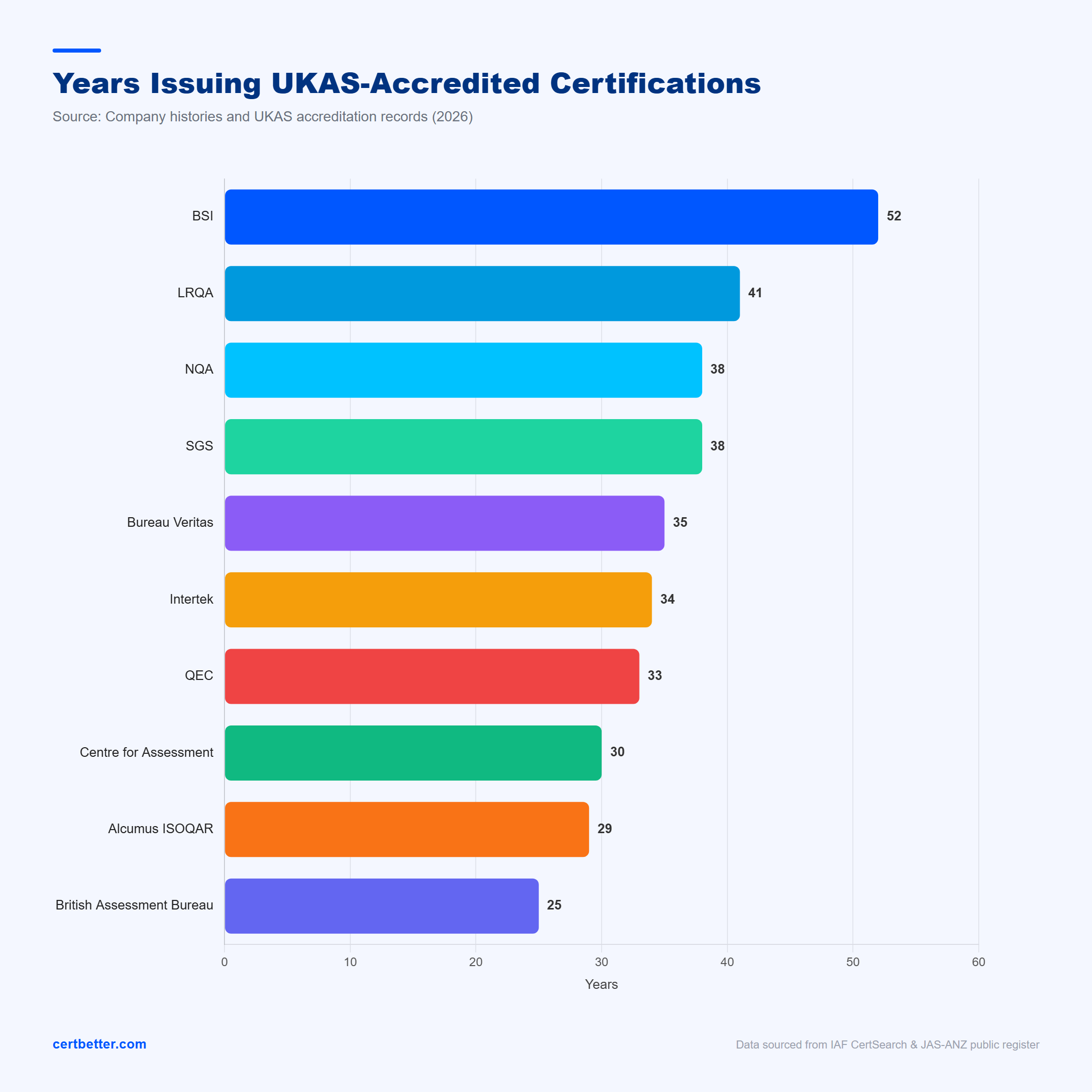
BSI is the UK's National Standards Body, established in 1901, and the longest-operating management systems certification body in the world. BSI issued its first quality management system certificate in 1974, making it the originator of third-party quality certification. That history is not merely symbolic. Many procurement frameworks, defence supply chains, and regulated industries require or strongly prefer certification from BSI specifically.
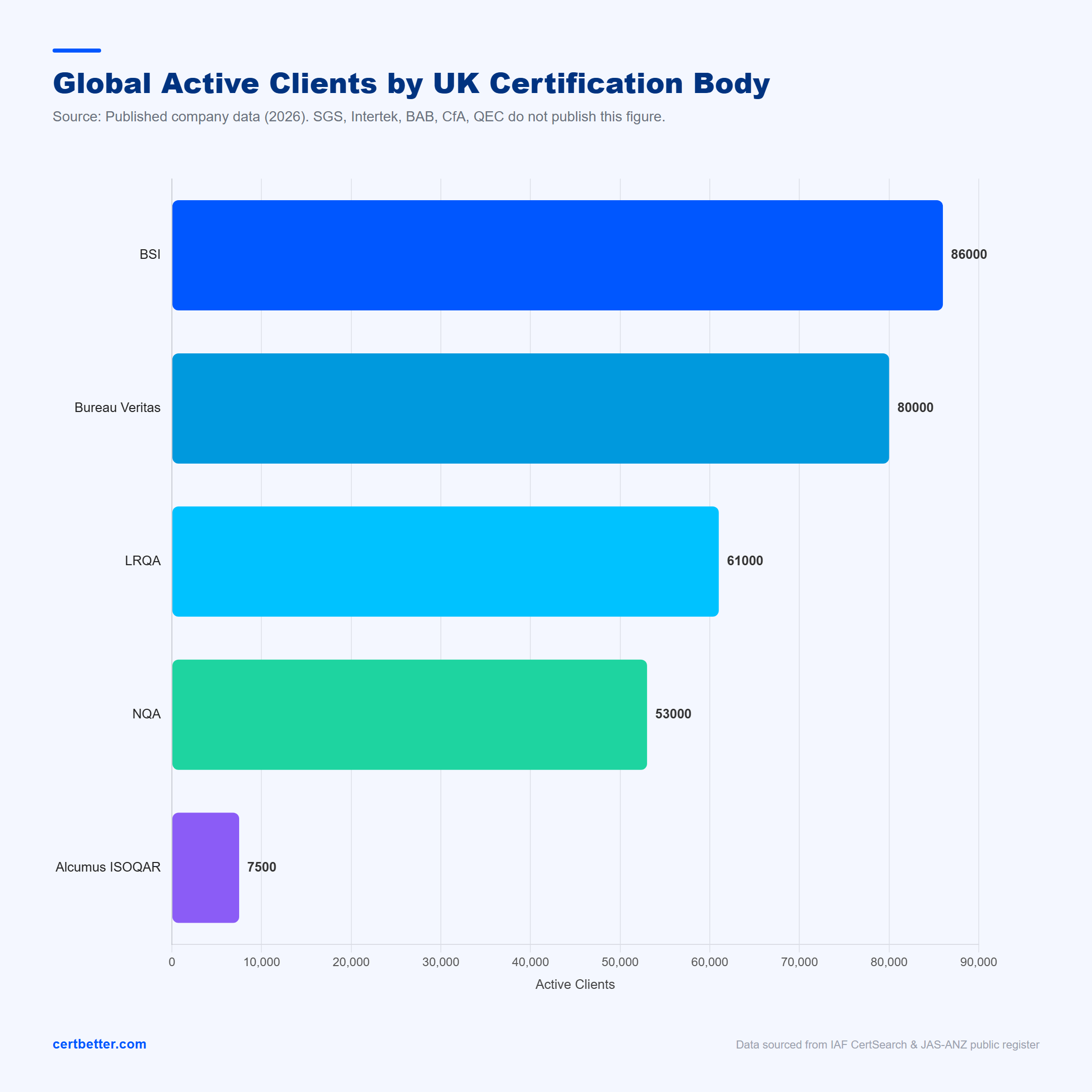
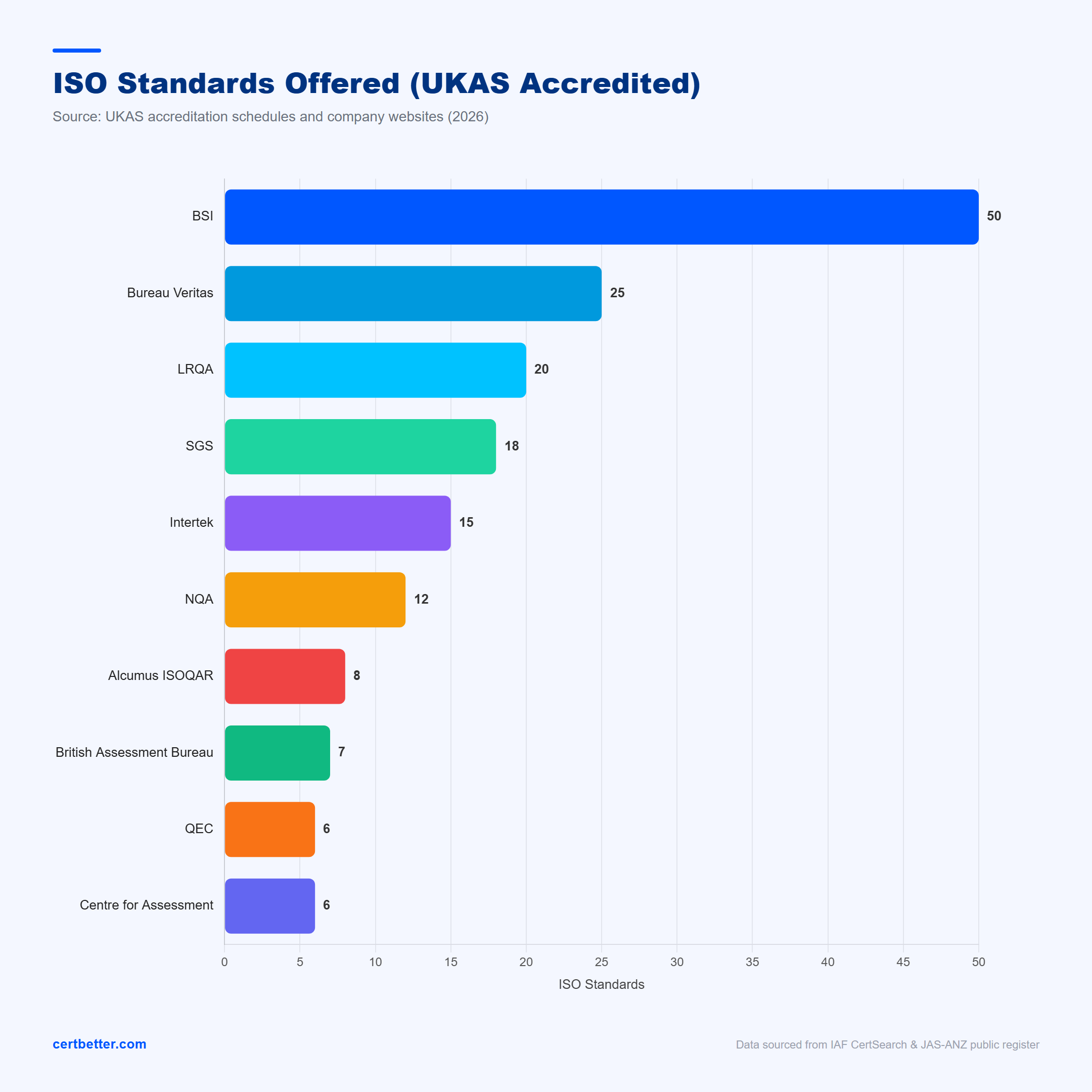
BSI serves approximately 86,000 clients in 195 countries through 90 offices worldwide. It holds UKAS accreditation for more than 50 management system standards, the broadest scope of any certification body operating in the UK. Standards covered include ISO 9001, ISO 14001, ISO 45001, ISO 27001, ISO 13485, ISO 42001, AS9100, and a wide range of sector-specific schemes.
The audit style is thorough and can feel intensive compared to smaller bodies. Fees are generally at the higher end of the market. For businesses where the BSI name carries weight with clients or in tender responses, that premium is justified. For an SME seeking straightforward ISO 9001 certification, the cost-to-value ratio deserves scrutiny.
Best for: Enterprise organisations, regulated industries, defence, aerospace, medical devices, government tenders.
2. Bureau Veritas UK Limited
Bureau Veritas traces its origins to 1828, making it one of the oldest inspection and assurance organisations in the world. Its UK certification division serves clients across construction, infrastructure, utilities, sustainability, and supply chain management. Bureau Veritas holds more than 60 accreditations globally and serves approximately 80,000 clients across 100 countries through a network of over 1,500 offices and laboratories.
In the UK context, Bureau Veritas is particularly strong in built environment certification, energy management, and ESG-linked assurance work. Businesses that need certification to ISO 14001 or ISO 50001 alongside sustainability reporting often find Bureau Veritas a natural fit. Multi-site programmes are handled effectively due to the global infrastructure behind each engagement.
The organisation suits medium and large businesses with complex operational footprints. Smaller businesses may find the process less personalised than a mid-sized UK-native body would offer.
Best for: Infrastructure, sustainability, built environment, large multi-site organisations.
3. LRQA
LRQA was formed in 2021 when Lloyd's Register separated its assurance and certification division into a standalone company. The management systems certification practice itself goes back to 1985 when Lloyd's Register Quality Assurance was established as one of the first UKAS-accredited certification bodies in the UK. That gives LRQA 41 years of continuous accreditation history in this market.
LRQA serves more than 61,000 clients in 150 countries. Revenue exceeds $750 million. It employs over 5,000 people. UKAS accreditation covers 20 or more management system standards, including ISO 9001, ISO 14001, ISO 45001, ISO 27001, ISO 50001, ISO 22000, and sector-specific schemes across maritime, energy, and food safety.
LRQA is a natural fit for organisations in safety-critical sectors: oil and gas, maritime, offshore, and heavy engineering. The auditing approach reflects that heritage. Clients who want technically deep audits from auditors with genuine sector expertise tend to rate LRQA highly. Businesses looking for a lighter touch may find it more than they need.
Best for: Safety-critical industries, engineering, energy, maritime, chemical and process sectors.
4. SGS United Kingdom Limited
SGS is the world's largest testing, inspection, and certification company. Founded in 1878, it employs approximately 99,500 people across 2,500 offices and laboratories in 115 countries. The UK division offers UKAS-accredited management systems certification across 18 or more standards, with particular depth in food safety, consumer goods, agriculture, and manufacturing supply chains.
SGS is the right choice when certification needs to align with supply chain onboarding requirements. Many large retailers and FMCG manufacturers specify SGS as a preferred or approved certification body in their supplier programmes. If your business sells into those supply chains, the SGS name carries practical commercial value beyond the certificate itself.
Customer service can vary between SGS regional offices. The organisation's scale means the experience is not always uniform. Businesses with straightforward certification needs in a single standard may prefer a more focused body.
Best for: Food and beverage, FMCG, manufacturing, supply chain compliance, retail supplier programmes.
5. Intertek Certification
Intertek has held UKAS accreditation for management systems certification since 1992, giving it 34 years of continuous accreditation in the UK market. It operates across more than 100 countries through approximately 1,000 locations. Intertek is UKAS-accredited for 15 or more management system standards and reports a 97% client retention rate, one of the higher published figures in the sector.
Intertek's UK certification practice is particularly strong in product conformity, consumer goods, and testing-adjacent sectors where quality management overlaps with product safety. If your business already works with Intertek for product testing or inspection, consolidating management systems certification with them can simplify scheduling and reduce administrative load.
Intertek does not publish total global client figures for its management systems division, so direct scale comparisons with BSI or Bureau Veritas are not possible from public data. The 97% retention figure is the most specific public indicator of client satisfaction available.
Best for: Consumer goods, retail, product-adjacent manufacturing, businesses already using Intertek for testing or inspection.
6. NQA (Kiwa)
NQA was established in 1988 and built its reputation as a practical, client-focused certification body for UK organisations of all sizes. In 2024, NQA became part of Kiwa, a Dutch-headquartered global assurance group. The NQA brand remains in use and the UKAS accreditation continues under the existing scope. NQA holds active certificates with more than 53,000 organisations across 90 countries.
NQA is accredited by both UKAS and ANAB (the US accreditation body), which makes it a strong choice for businesses that need certification recognised in both the UK and North American markets. Standards offered include ISO 9001, ISO 14001, ISO 45001, ISO 27001, ISO 13485, ISO 20000, and ISO 42001.
The NQA client portal is widely regarded as one of the better digital tools in the sector, which matters for businesses that have compliance teams managing multiple certificates. Average client tenure is reported at 10 years, which speaks to consistent audit quality. The Kiwa acquisition brings additional global reach for businesses that operate internationally.
Best for: Businesses needing dual UK and US recognition, multi-standard certification, organisations that value strong digital compliance tools.
7. Alcumus ISOQAR
Alcumus ISOQAR is the UK's most prominent mid-market certification body, with roots in the late 1990s. It operates from its Manchester headquarters and serves approximately 7,500 clients worldwide, with a strong concentration in the UK construction, contracting, and professional services sectors. UKAS accreditation covers ISO 9001, ISO 14001, ISO 45001, ISO 27001, and several sector-specific schemes.
ISOQAR's strength is accessibility. Auditors are generally experienced in UK SME contexts and the certification process is designed to be practical. The organisation is well known in the contractor supply chain space, where SSIP registration and ISO 45001 often need to be managed in tandem.
ISOQAR works as part of the wider Alcumus Group, which also offers health and safety software and risk management tools. For businesses that want certification alongside broader compliance support from a single provider, this integration is worth considering.
Best for: UK SMEs, contractors, construction supply chains, professional services businesses.
8. British Assessment Bureau
The British Assessment Bureau has been certifying UK businesses for 25 years and operates as part of the Amtivo Group. It focuses almost entirely on the UK market, which gives it a depth of local knowledge that global certification bodies cannot match. BAB holds Feefo's 10 Years of Excellence badge, awarded to businesses maintaining a minimum 4.5 star rating over a decade. Ninety-eight per cent of customers rate BAB 4 or 5 stars on Feefo.
BAB offers a digitally streamlined certification experience from its Kent headquarters. Online portals, clear audit scheduling, and responsive account management are consistently mentioned in customer feedback. Standards covered include ISO 9001, ISO 14001, ISO 45001, ISO 27001, ISO 13485, and ISO 22301.
BAB is the right choice for businesses that want a well-organised, UK-native experience and place high value on client service. It is not the body to choose if you need internationally recognised scale or a very broad standards scope.
Best for: UK SMEs and mid-market businesses prioritising service quality and a streamlined digital certification experience.
9. Centre for Assessment
Centre for Assessment is a UKAS-accredited certification body with accreditation number 0120, indicating it was among the earliest organisations to receive UKAS management systems accreditation when UKAS was established. It has been a trusted delivery partner for the Cabinet Office and the Law Society, which points to genuine capability in regulated and public sector environments.
Standards offered include ISO 9001, ISO 14001, ISO 27001, and ISO 45001 alongside associated sector schemes. The organisation operates primarily from Manchester and is particularly active in public sector, legal, and education sector certification. Client feedback consistently emphasises a personalised approach and auditors who understand their clients' industries.
Centre for Assessment carries less brand recognition than the global giants, but within its core sectors it has a long track record. Confirming that any ISO certificate is legitimate is straightforward via UKAS CertCheck, regardless of which body issued it.
Best for: Public sector organisations, legal and professional services, education sector.
10. QEC Certification
QEC has held UKAS accreditation continuously since 1993, giving it 33 years in the UK market. It operates from its Berkshire base with 17 offices globally across Europe, Asia, North America, and the Middle East. Standards covered include ISO 9001, ISO 14001, ISO 45001, and ISO 27001 among others.
QEC's positioning is as an established, mid-size certification body that offers genuine UKAS-accredited certification without the overhead of the global giants. Businesses that want a straightforward relationship, consistent audit teams, and clear pricing often find QEC a good fit. The global office network makes it viable for organisations with international operations who want to avoid managing multiple certification bodies across regions.
QEC is less visible in marketing terms than some competitors, but its 33-year UKAS track record is a meaningful signal of sustained operational quality.
Best for: SMEs wanting an established mid-size body, organisations with some international presence outside the UK.
Data at a Glance
The charts below summarise the verifiable comparative data available across the 10 certification bodies. Not all bodies publish client figures publicly. SGS, Intertek, BAB, Centre for Assessment, and QEC do not disclose total active management system clients, so they are not included in the client scale chart.
Global Giant vs UK-Native: What It Means for Your Business
There is a meaningful difference between choosing a global TIC giant and choosing a UK-native certification body. This is not about quality or validity. All 10 bodies on this list hold current UKAS accreditation and their certificates carry the same international recognition. The difference is about what you get for your money and how the relationship is managed day to day.
Global giants such as BSI, Bureau Veritas, LRQA, and SGS have auditors across virtually every industry sector, broad standards coverage, and internationally recognised names that carry weight in specific supply chains. If your business trades internationally, operates in regulated sectors, or needs certification that opens doors in particular procurement frameworks, global scale matters.
UK-native or mid-market bodies such as ISOQAR, BAB, and QEC often offer more responsive account management, auditors who genuinely understand UK business contexts, and more predictable pricing. Verifying that any certification is genuinely UKAS accredited is simple and free via the UKAS CertCheck platform, so there is no reason to pay for a bigger name if a mid-market body serves your needs.
What to Ask Before You Sign
The right questions to ask a certification body before committing are the same regardless of its size or reputation.
- Which specific UKAS accreditation number covers this certification, and can I verify it on UKAS CertCheck?
- Who will be my lead auditor and what is their sector experience?
- What is included in the quoted fee and what triggers additional charges?
- How is surveillance audit scheduling managed and how much notice will I receive?
- If I want to switch to a different certification body in the future, what does the transfer process involve?
- How long have you been certifying organisations in my specific industry?
- What happens if my lead auditor leaves the organisation mid-cycle?
Switching certification bodies is more common than most businesses realise. Informing clients about an ISO certification transfer is straightforward, but it is an administrative step worth avoiding if you choose carefully the first time around.
CertBetter helps UK businesses find and compare UKAS-accredited certification bodies in one place. Submit your requirements once and receive quotes from multiple bodies, with full visibility of pricing and auditor availability. Visit certbetter.com to get started.