SQF certification is one of the most widely recognised food safety and quality credentials in the world. If your business operates in food manufacturing, processing, storage, or distribution, chances are your retail or foodservice customers have already asked about it. This guide explains what SQF certification is, how the levels work, and the practical steps your business needs to take to achieve it.
On this page
What Does SQF Stand For?
SQF stands for Safe Quality Food. It is a rigorous, risk-based food safety and quality management system developed to help food businesses demonstrate that their products are safe, legal, and produced under quality-controlled conditions.
The SQF Programme was originally developed in Australia in 1994 under the auspices of the Food Marketing Institute (FMI). It is now owned and managed by the SQF Institute (SQFI), a division of FMI based in the United States. The programme is recognised by the Global Food Safety Initiative (GFSI), which is the benchmark that most major retailers and foodservice operators use when deciding which certification standards to accept from their suppliers.
GFSI recognition matters because it means one SQF certification is accepted by hundreds of major buyers globally, including Walmart, Costco, Kroger, and many other retailers. It removes the need for multiple site audits against different standards. You can read more about how GFSI benchmarks and recognises food safety certification programmes on the GFSI website.





SQF Certification Levels
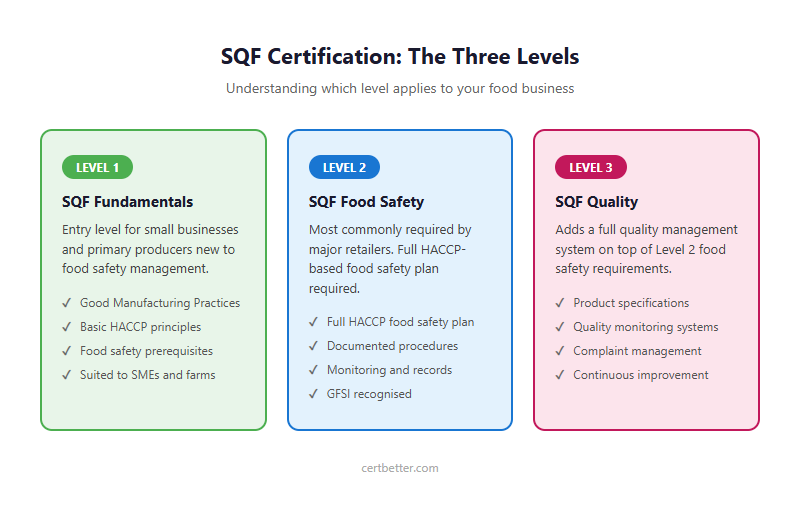
SQF operates across three certification levels. Each level builds on the previous one and addresses different aspects of food safety and quality management.
Level 1: SQF Fundamentals
This entry level is designed for businesses new to food safety management systems, particularly small and medium enterprises or primary producers. It focuses on the fundamentals of food safety, including Good Manufacturing Practices (GMPs), basic HACCP principles, and food safety prerequisites. It is a practical starting point for businesses building their food safety systems for the first time.
Level 2: SQF Food Safety
This is the most commonly achieved level and the one most retail and foodservice customers require. It demands a fully developed HACCP-based food safety plan, documented procedures, monitoring records, and a programme for managing food safety hazards across the entire production process. Achieving Level 2 demonstrates that your business operates a robust food safety management system that meets GFSI requirements.
Level 3: SQF Quality
Level 3 builds on Level 2 by adding a comprehensive quality management system on top of the food safety requirements. This level suits businesses that want to differentiate on quality, not just safety. It covers product specifications, quality monitoring, customer complaint management, and continuous improvement processes. It is less commonly required but carries significant weight with premium buyers and private label manufacturers.
Which SQF Code Applies to Your Business?
The SQF Institute publishes separate codes for different sectors of the food industry. The correct code depends on where your business sits in the food supply chain.
- SQF Food Safety Code for Manufacturing — for food and beverage manufacturers and processors
- SQF Food Safety Code for Primary Production — for farms, growers, and livestock producers
- SQF Food Safety Code for Storage and Distribution — for warehousing, logistics, and cold chain operators
- SQF Food Safety Code for Food Retail — for supermarkets and food retail outlets
- SQF Food Safety Code for Food Packaging — for manufacturers of materials that come into direct contact with food
Each code has its own specific requirements, but all share the same underlying structure: food safety fundamentals, a HACCP-based food safety plan, and system management requirements. When you register for SQF certification, you register under the code that matches your business activity.
SQF vs ISO 22000: Understanding the Difference
A common question from food businesses is whether to pursue SQF or ISO 22000. Both are internationally recognised food safety management standards with HACCP at their core. The key differences come down to recognition, structure, and market demand.
SQF is typically mandated by North American retailers and foodservice operators. ISO 22000 is more commonly required in European and Asia-Pacific markets. If you are supplying into the US or Canadian retail sector, SQF certification will almost always be the required credential. For a detailed comparison of the two standards, read our article on What Is the Difference Between ISO 22000 and SQF Certification?
Who Needs SQF Certification?
SQF certification is most commonly required by:
- Food manufacturers and processors supplying major supermarkets or retail chains, particularly in the US, Canada, and Australia
- Co-manufacturers producing private label products for retailers
- Food distributors and third-party logistics operators handling food products for GFSI-compliant customers
- Primary producers including farms, fisheries, and growers supplying into certified supply chains
- Food packaging manufacturers where direct food contact is involved
Even where it is not formally required, SQF certification is increasingly used as a differentiator. Buyers use it as a screening criterion when evaluating new suppliers, and it signals a commitment to food safety that goes beyond minimum regulatory compliance.
How to Achieve SQF Certification: Step by Step
Achieving SQF certification for the first time is a structured process. Below is a practical guide to what each step involves.
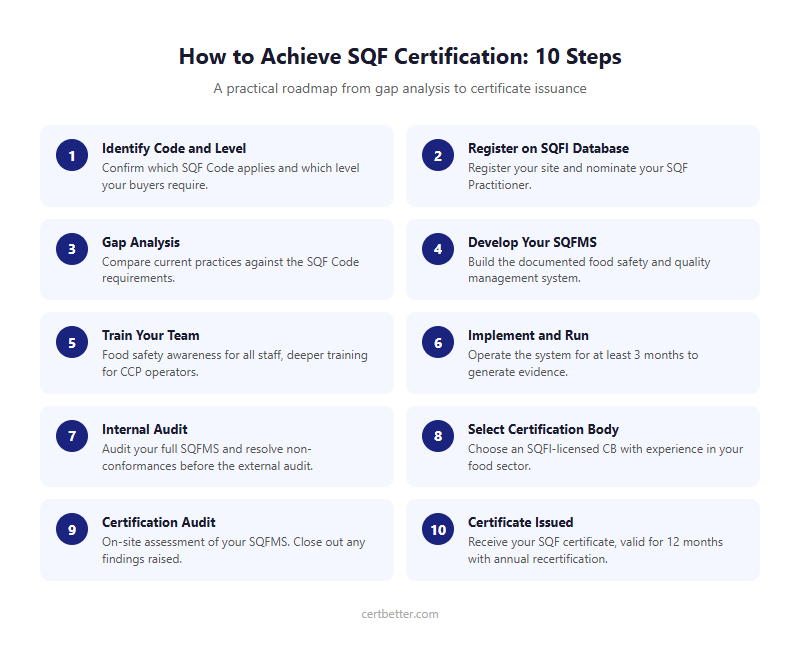
Step 1: Identify Your SQF Code and Level
Before anything else, confirm which SQF code applies to your business and which level your customers are requiring. Most food manufacturers will be working toward Level 2 (SQF Food Safety). Check your customer contracts or speak directly with your buyers to confirm what they need from you.
Step 2: Register on the SQFI Database
All SQF certified sites must be registered in the SQFI database. Registration is required before any certification audit can take place. At this stage you also need to nominate an SQF Practitioner: a trained individual employed by your business or contracted externally who is responsible for developing, implementing, reviewing, and maintaining your SQF System.
Step 3: Conduct a Gap Analysis
A gap analysis compares your current food safety practices against the requirements of the relevant SQF Code. It identifies what systems, procedures, and records you already have in place and what needs to be developed or improved. Many businesses bring in an external consultant at this stage to get an objective view. The gap analysis output becomes your implementation roadmap.
Step 4: Develop Your SQF System
Your SQF System (formally called the Safe Quality Food Management System, or SQFMS) is the documented framework that demonstrates how your business manages food safety and quality. It must include:
- A food safety policy and management commitment statement
- A HACCP-based food safety plan identifying hazards, critical control points, and corrective actions
- Documented prerequisite programmes covering GMPs, sanitation, allergen management, pest control, and supplier approval
- Procedures for monitoring, verification, and record keeping
- An internal audit programme
- A corrective and preventive action (CAPA) system
- Management review processes
The depth and complexity of your SQFMS will depend on the size and nature of your operation. A small food processor will have a simpler system than a large multi-line manufacturer, but both need to address the same core elements of the SQF Code.
Step 5: Train Your Team
Your staff need to understand their roles within the SQFMS. This includes food safety awareness training for all production personnel, specific training for those who operate critical control points, and deeper training for your SQF Practitioner. The SQFI offers formal SQF Practitioner training and there are accredited training providers globally. Training records must be documented and maintained.
Step 6: Implement and Run Your System
Implementation means putting your documented procedures into practice. This phase typically runs for at least three months before your certification audit, because auditors will want to see evidence that your system has been operating consistently, not just set up on paper. Monitoring records, corrective actions, internal audit reports, and management review minutes all need to demonstrate real, ongoing operation.
Step 7: Conduct an Internal Audit
Before the certification audit, conduct a thorough internal audit of your entire SQFMS against the relevant SQF Code. Your internal audit should identify any non-conformances and give you time to address them before the external auditor arrives. Businesses that skip or rush the internal audit tend to receive more non-conformances in their certification audit, which delays certification and increases cost.
Step 8: Select a Licensed SQF Certification Body
SQF audits must be conducted by a certification body licensed by the SQFI. The SQFI publishes a list of licensed certification bodies on their website. When selecting one, consider their experience in your food sector, their geographic coverage, their audit fees, and their responsiveness. The certification body assigns a qualified SQF auditor to your site.
Step 9: Certification Audit
The certification audit is an on-site assessment of your SQFMS against the SQF Code. The auditor reviews your documentation, observes operations, interviews staff, and inspects your facility. Any findings are classified as:
- Critical non-conformance — a serious failure with a direct food safety risk. Certification cannot be issued until resolved.
- Major non-conformance — a significant system failure that must be closed out before certification.
- Minor non-conformance — a minor deviation that can be addressed in the corrective action plan post-audit.
The audit report is submitted to the SQFI database. Where critical or major findings exist, you submit corrective action evidence before the certification body makes their decision.
Step 10: Certificate Issuance
Once the certification body is satisfied with your corrective actions, they issue your SQF certificate. The certificate specifies your site, the SQF Code, the level achieved, and the validity period. SQF certificates are typically valid for 12 months, with recertification audits required annually. Your certification is published in the SQFI database, where your customers can verify it directly.
SQF Audit Scoring and Grades
SQF uses a numerical scoring system. Auditors score each applicable element of the SQF Code, and the overall score determines your grade:
- Excellent — 96% to 100%
- Good — 86% to 95%
- Satisfactory — 70% to 85%
- Unsatisfactory — below 70% (certification not issued)
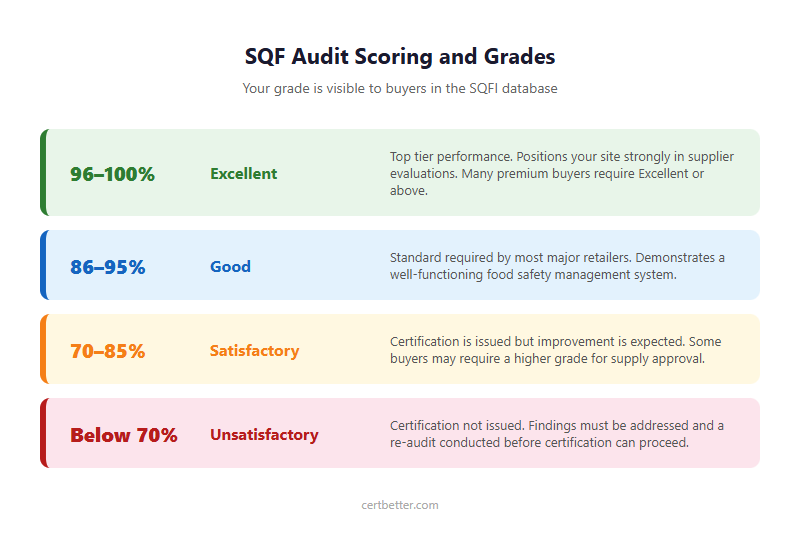
Your SQF grade is visible to buyers in the SQFI database. Many large retailers specify a minimum grade, typically Good or above. Achieving Excellent from your first audit positions your business strongly in supplier evaluations. According to SQFI, the programme currently has over 10,000 certified sites across more than 30 countries.
How Long Does SQF Certification Take?
For a business starting from scratch, a realistic timeline is 6 to 12 months. This includes the gap analysis, system development, implementation period, internal audit, and certification audit. Businesses with existing food safety systems, such as ISO 22000 or HACCP programmes already in place, can often achieve certification faster because much of the foundational work is already done.
The biggest variable is the implementation period. Auditors want to see records that demonstrate your system has been running, not just documented. A minimum of three months of operational records is generally expected. Rushing this phase is one of the most common reasons businesses miss their target certification date.
What Does SQF Certification Cost?
SQF certification costs vary depending on the size and complexity of your operation, the certification body you select, and the geographic location of your site. Typical cost components include:
- SQFI registration fee — charged annually for each registered site
- Certification body audit fees — based on site size, number of employees, and complexity
- Consultant fees — if you engage external support for gap analysis or system development
- SQF Practitioner training — cost of accredited training for your nominated practitioner
- Internal resource costs — staff time for documentation, training, and implementation
For a mid-sized food manufacturer, total first-year costs commonly range from $8,000 to $25,000 AUD depending on scope. Annual recertification audits are less expensive than the initial audit, as the system is already established. For a cost comparison with ISO 22000, see our guide on How Much Does ISO 22000 Certification Cost?
Maintaining Your SQF Certification
SQF certification is not a one-off event. Maintaining it requires ongoing commitment from your management team and operations staff. Key ongoing requirements include:
- Annual recertification audits conducted by your licensed certification body
- Continuous operation of your SQFMS, including monitoring records and corrective actions
- Annual management review of the food safety system
- Keeping up with SQF Code updates — SQFI releases new code editions periodically, and the current edition is Edition 10
- Updating your system when you introduce new products, processes, or facilities
For businesses managing the transition to SQF Edition 10, see our detailed guide on SQF Edition 10: What Food Businesses Must Do Before the 2027 Audit Deadline. You can also read our broader overview on ISO 22000: The Essential Guide to Safe and Reliable Food Production to see how the major food safety standards compare.
Finding the Right Certification Provider
One of the most practical decisions in your SQF journey is choosing the right certification body and, if needed, the right consultant to help you implement your system. The SQFI maintains a list of licensed certification bodies, but comparing them on price, sector experience, and audit availability takes time.
CertBetter simplifies this process. You submit a single request for quote describing your site, sector, and requirements, and we match you with verified SQF certification providers who can support your needs. It is a faster and more transparent way to find the right partner than contacting certification bodies one by one.