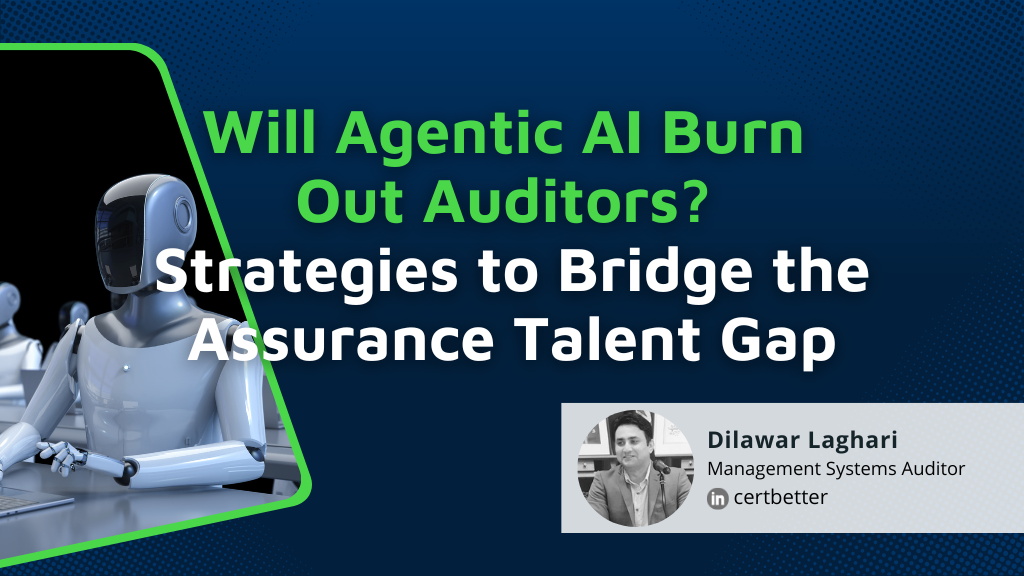
We’re on the cusp of an AI revolution and it’s no longer just automation replacing routine tasks. We’re entering the age of Agentic AI, systems that can act autonomously, learn from context, adapt to complex goals, and coordinate across multiple agents. From business strategy to customer experience, agentic systems will be deeply embedded in how companies think, act, and evolve.
On this page
Sounds exciting, right? But for assurance professionals, auditors, certifiers, compliance officers this evolution isn’t just about opportunity. It’s about survival. Because the assurance industry is heading into a talent crisis. One that risks collapsing under the weight of AI-driven complexity, unless we act now.
Recommended Read: Understanding ISO IEC 42001 Standard for AI Artificial Intelligence Management System
I. Agentic AI: What’s Changing (And Why It’s Bigger Than You Think)
Traditional AI, what most businesses are just starting to use is reactive. You give it a prompt, it gives you an answer. But Agentic AI doesn’t wait for instructions. It thinks in systems, pursues goals, and learns from feedback. Think less “smart chatbot” and more “digital executive assistant that rewrites your supply chain overnight.”
Already, we’re seeing early signs:
- Multimodal AI combines language, vision, voice, and action in real-time across entire workflows.
- Digital agents coordinating procurement, HR, or legal processes without human input.
- Autonomous decision-makers in cybersecurity, safety management, risk profiling, and even finance.
And when AI is operating autonomously across entire business units. Who assures it’s doing the right thing?





II. Why Assurance Professionals Are Heading for Burnout
Assurance has always played catch-up with innovation. But the pace and scope of agentic AI puts us in uncharted territory:
- Speed of change: AI systems update themselves. Certifiers can't rely on annual audits when a digital agent rewrites its operating model every week.
- Opaque decision chains: How do you trace a decision made by a network of AIs pulling from dozens of models, all updated on-the-fly?
- Ethics and accountability gaps: When AI acts autonomously, who’s responsible for harm, error, or manipulation?
Now combine that with the most pressing issue: there simply aren’t enough assurance professionals to keep up.
III. The Looming Assurance Talent Gap
In Australia, the Joint Accreditation System of Australia and New Zealand (JASANZ) has flagged shortages in qualified technical auditors, particularly in high-demand sectors like cybersecurity (ISO 27001), environmental management (ISO 14001), and occupational health and safety (ISO 45001). And it’s not just a regional problem. Globally, accredited Certification Bodies have reported increasing difficulty sourcing qualified lead auditors with sector-specific experience and up-to-date training.
Here’s what ISO auditors are now being asked to deal with:
- Tech startups seeking ISO 27001 for investor trust — but their entire data governance is managed by autonomous AI agents that update access rules and policies daily.
- Smart factories pursuing ISO 9001 or 45001 — with production environments controlled by digital twins and ML-based safety systems that self-adjust in real time.
- SaaS companies chasing ISO 42001 compliance — where LLMs generate their own operational workflows, including onboarding, risk classification, and internal messaging.
Who checks if an AI’s "thought process" aligns with regulatory requirements? It’s not just a headcount we need, it’s a new breed of assurance professional.
IV. Where Will the Pressure Show First?
We’re already seeing signs of strain in:
- Certification and compliance: Many ISO auditors are being asked to validate not just processes, but also AI tools used in quality management, data protection, and risk analysis.
- Cybersecurity assurance: AI-driven threat detection needs continuous assurance, yet most cybersecurity auditors don’t have the tools or training to assess adaptive machine learning.
- ESG and sustainability: Autonomous reporting tools can now write full ESG statements based on live data feeds. But who's validating the data inputs, model assumptions, or bias filters?
This isn’t just a corporate issue. Governments, regulators, cert bodies, and independent auditors are all scrambling to keep pace.
V. Five Strategies to Bridge the Assurance Gap
We don’t need to panic. But we do need to pivot fast. Here are five strategies to future-proof assurance in the age of Agentic AI:
1. Develop AI-Literate Auditors
We need to shift from “tech awareness” to AI fluency, auditors who understand how large models operate, how to interrogate digital agents, and how to audit dynamic decision loops. Microcredentials, blended training, and AI scenario simulations should be standard.
At CertBetter, we’ve already seen training providers beginning to specialise in AI-integrated ISO systems—especially ISO 27001, ISO 42001 (AI management), and ISO 9001 with embedded data intelligence.
2, Split Assurance into Layers
Instead of relying on one annual audit to verify everything, split assurance into continuous micro-assurance layers:
- AI assurance plugins that run in real time
- Human auditors focused on governance and oversight
- “Meta-audits” to test the tools doing the checking
This hybrid model (part human, part automated) can handle AI’s complexity without burning out professionals.
3. Standardise AI Auditing Frameworks
New standards are emerging. ISO/IEC 42001 is the world’s first AI-specific management system standard. Others like the EU AI Act’s risk tiers will reshape what “compliance” means in AI environments.
Auditors must adopt these early, and CertBetter is tracking training and consultant offerings around them to help providers get ready.
Helpful Read: Schellman Becomes the First Accredited Certification Body to Launch ISO 42001 AI Certification
4. Build Interdisciplinary Audit Teams
A single auditor won’t cut it. AI assurance demands teams with:
- Risk experts
- Data scientists
- Legal interpreters
- Ethics reviewers
Just as financial audits evolved into firm-wide risk management, AI audits need to bring together varied expertise.
5. Create Trusted Networks of AI-Safe Providers
Right now, most businesses have no way to find a consultant or certifier with proven AI assurance experience. That’s a big part of why platforms like CertBetter exist: to connect companies with trusted, verified ISO professionals and to show which ones are adapting to emerging technologies.
In the future, “AI-ready” status will be a market differentiator, not just a buzzword.
VI. Final Thoughts: This Is Bigger Than Audit
What’s coming isn’t just a technology wave, it’s a governance revolution. Businesses will need to rethink how they prove trust, explain systems, and show responsibility. The lines between human and digital accountability are blurring.
We can’t afford to treat assurance like an afterthought or a checkbox. If we do, the result won’t just be audit fatigue, it will be systemic failure of trust. It’s time for bold moves, smarter frameworks, and a new generation of assurance leaders.