If you're looking to understand Clause 5 Leadership of the ISO 9001 Quality Management System (QMS) with some examples, you're in the right place. At CertBetter, I write articles to share my auditing experience and make it easy to understand ISO standards. In this guide, I will try to explain all things behind this wonderful Clause 5 Leadership, breaking it down into sub-clauses with some nice examples (as well as my auditing experience where I raised Major NCs due to lack of leadership!). Let me know your thoughts in the comments section please.
On this page
Let's first try to understand what Leadership is, specially in the eyes of ISO 9001 standard. In my later write-up, I'll deep dive into sub-clauses of 5.
What is Leadership under Clause 5 ISO 9001?
It's undeniable that strong leadership plays a crucial role in the success of any business. I view leadership as individuals who provide resources to implement anything - to achieve anything.
When it comes to QMS, the ISO 9001 standard expects leaders to prioritise quality in all aspects, including objectives, customer focus and overall commitment.
When leaders wholeheartedly embrace the quality, it sends a positive message that improves the entire organisation, boosting employee morale, customer satisfaction and enhancing operational efficiency.
Guess what? That's what's required from ISO 9001 under Clause 5!





Why is Leadership So Important?
As someone who has worked as a certification auditor for many years, I’ve seen firsthand how a lack of leadership can derail even the best-intentioned organisations.
The Clause 5 of the ISO 9001 QMS is all about leadership (Examples in the later sections) and there's a strong reason that it’s one of the most important aspects of a successful business (including QMS).
In this section, I’ll break down the key leadership responsibilities as outlined in Clause 5 and help you understand how these elements play a pivotal role in achieving ISO 9001 certification. Whether you’re a business owner, manager, or an ISO 9001 consultant, grasping these concepts will set a strong foundation for your QMS.
Benefits of Leadership in ISO 9001:2015 Quality Management
One thing we have to clearly understand that the Leadership is not about just controlling people and everything. It's a big job because it involves governance. Having clear goals, being dedicated to quality and making sure that everyone knows what they are doing (and why!) makes for effective leadership under Clause 5 of ISO 9001 QMS.
In my ISO audits, for example I have seen that companies with strong leadership have quality control over their processes. Leaders who are involved in the QMS ensure that processes are followed correctly and any issues are addressed quickly. Let's take a look at some of great benefits of Quality Leadership!
Quality Culture — A culture of quality is one of the best things about having good leadership. I'll probably write about Quality culture later on but let's keep our focus on making sure everyone is taking quality seriously especially the ones sitting at the top. This makes mistakes less likely, results in better goods or services and makes customers happier.
Continual Improvement — A leadership is also important to make sure that the company meets all of ISO 9001's rules. This shows that the business is not only following the rules to conform with ISO standard and certification requirements but also getting better all the time (the continual improvement theory!), which is what ISO 9001 is all about.
Effective Communication — Another benefit is that strong leadership helps in effective communication. When leaders are clear about their expectations and communicate them well, it reduces confusion and ensures that everyone is working towards the same goals. This alignment makes the QMS more effective and helps the company achieve its quality objectives.
Key Leadership Activities Under Clause 5
These are the key leadership responsibilities outlined in the ISO 9001 QMS standard under Clause 5. Let's take a closer look:
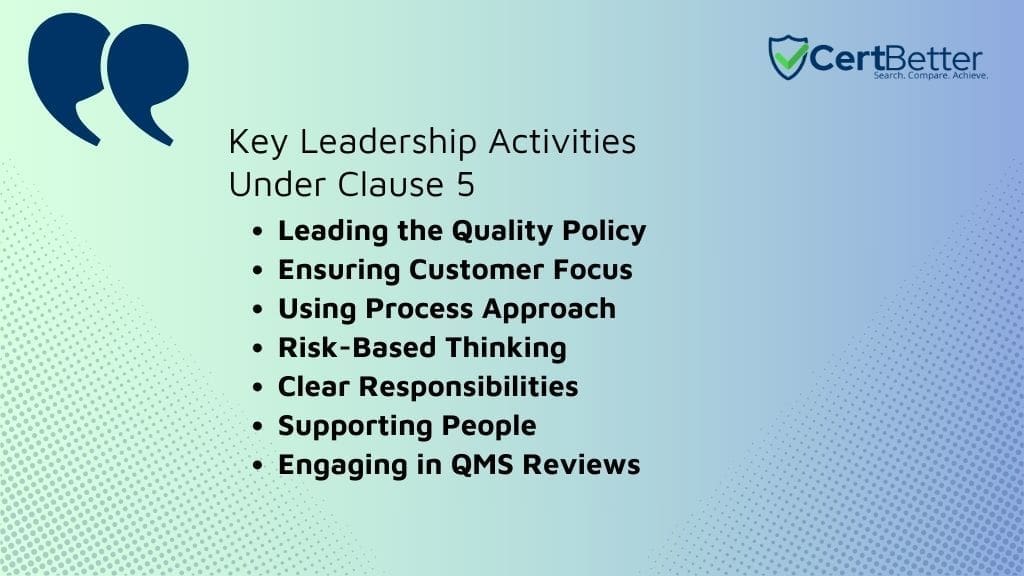
Creating a Quality Policy — It is the responsibility of top management to develop and uphold a quality policy that is in line with the organization's strategic direction. It is essential that this policy is effectively communicated, thoroughly understood, and consistently applied throughout the entire organization.
Ensuring Customer Focus — It is crucial for leadership to prioritize customer satisfaction by determining and meeting their requirements. Our top priority is always meeting the needs of our customers and constantly enhancing our relationships with them.
Encouraging the Use of the Process Approach and Risk-Based Thinking — It is the responsibility of leadership to promote the implementation of a process approach in the QMS and incorporate risk-based thinking. Part of the job is to identify potential risks and opportunities that could affect quality and take proactive measures to address them.
Establishing Roles, Responsibilities, and Authorities — Leadership plays a crucial role in ensuring that roles and responsibilities within the QMS are clearly defined and effectively communicated. This ensures clarity and sets clear expectations for everyone involved, preventing any confusion.
Engaging, directing, and supporting people — It involves actively connecting with staff, giving clear direction, and providing unwavering support to help them achieve quality objectives. We can offer various forms of training, provide helpful resources, and create an environment that encourages constant growth and improvement.
Regularly reviewing and evaluating the QMS — is essential for leadership to ensure its ongoing suitability, adequacy, and effectiveness. Management reviews are a great way to evaluate the performance of the QMS against objectives and make decisions for improvement. It's an exciting opportunity to assess and enhance the system.
ISO 9001 Clause 5 Requirements With Examples
ISO 9001 has distributed the leadership activities into 05 sub-clauses. Let's break this clause 4 into parts to understand the specific requirements.
Clause 5.1 — Leadership and Commitment
Leadership and Commitment is beyond just a nicely written Quality Policy. Like I explained above, the leaders must actively participate in the QMS. You have to demonstrate that you're committed to quality.
5.1.1 General
Top management shall demonstrate leadership and commitment with respect to the quality management system by:
I remember one of my audits where I observed that the CEO personally led weekly quality team review meetings (they call it: Quality Catch-up). The presence of CEO enabled lower staff to engage and report any issues on the spot. This lead to an effective continual improvement programs.
In some cases, I've observed companies where upper management views the QMS as a mere checkbox activity, prioritising it only to secure tenders, rather than recognising its strategic importance.
During one of my previous auditing experiences, I encountered a situation where I raised a major non-conformance due to a lack of effective leadership within the company.
I was surprised to see the Quality manager was taking all the responsibilities while having zero authority! The policy was just signed and proudly displayed on the wall.
When I sat down with the company director and inquired about the implementation of the policy, the director shared his thoughts of how amazing their business is but unfortunately had no knowledge of their own Quality Management System (QMS).
Clause 5.1.2 — Customer Focus
Ensuring customer satisfaction is the core essence of ISO 9001. In practical terms, Clause 5.1.2 Customer Focus requires business leaders to understand and consistently meet customer needs and expectations.
5.1.2 Customer focus
Top management shall demonstrate leadership and commitment with respect to customer focus by
For example, in an IT support company I audited, the management team had set up a system for customer feedback and their operational meetings were customer-centric.
Not to mention, most of the times the managing director was personally reviewing customer complaints.
By being actively engaged, they were able to quickly and efficiently address any issues raised by customers, resulting in increased customer satisfaction.
On the other hand, I've come across companies that consistently disregarded or failed to address customer feedback (which is a straight non-conformances under clause 5.1.2). These organisations often experienced a decrease in customer satisfaction and a loss of business over time.
Clause 5.2 — Quality Policy
The quality policy is crucial for achieving the business objectives. The organization should clearly demonstrate its dedication to quality in alignment with its strategic goals. It's impressive to see businesses incorporating their quality policy into their vision and mission statements.
5.2 Policy
5.2.1 Establishing the quality policy
Top management shall establish, implement and maintain a quality policy that:
5.2.2 Communicating the quality policy
The quality policy shall:
I have seen quality policies that were too convoluted or unclear to understand and implement. In such cases, staff struggled to understand how the policy applied to their everyday tasks, resulting in quality differences.
ISO 9001 Clause 5.2 requires business leaders to communicate and guarantee understanding of the quality policy across the organization (and suppliers/vendors/customers).
As an ISO auditor, I love seeing quality policies that are simple, clear and connected with company goals.
Guess what? If the policies are aligned with business goals, they're definitely be part of communication!
I remember I audited a construction business with a quality policy focused on safety, customer satisfaction, and environmental responsibility. These three aspects were crucial to their success.
Clause 5.3 — Organisational Roles, Responsibilities and Authorities
Like any other clause, the Clause 5.3 states that QMS must have clear roles, duties and authorities. Why is that important? Well, the leaders need to make sure that everyone under their direction knows what their job is in the QMS and have the power to do it.
5.3 Organizational roles, responsibilities and authorities
Top management shall ensure that the responsibilities and authorities for relevant roles are assigned, communicated and understood within the organization.
Top management shall assign the responsibility and authority for:
During an audit of a import/distribute business, I saw how their QMS's clearly defined jobs helped make things run more smoothly and improve their systems. From director to warehouse guy - everybody knew exactly what was expected of them, which cut down on mistakes and raised the quality of processes as a whole.
On the other hand, I also see companies where roles and responsibilities are not clearly outlined (Mostly small businesses). There were holes in the QMS because employees didn't know who was responsible for what. This made it harder for the company to keep consistent quality.
Common Challenges in Implementing Clause 5 ISO 9001
If you're reading this article to understand how to actually implement Clause 5 leadership in ISO 9001 - I can tell you that it is not always easy unless it comes from the top management.
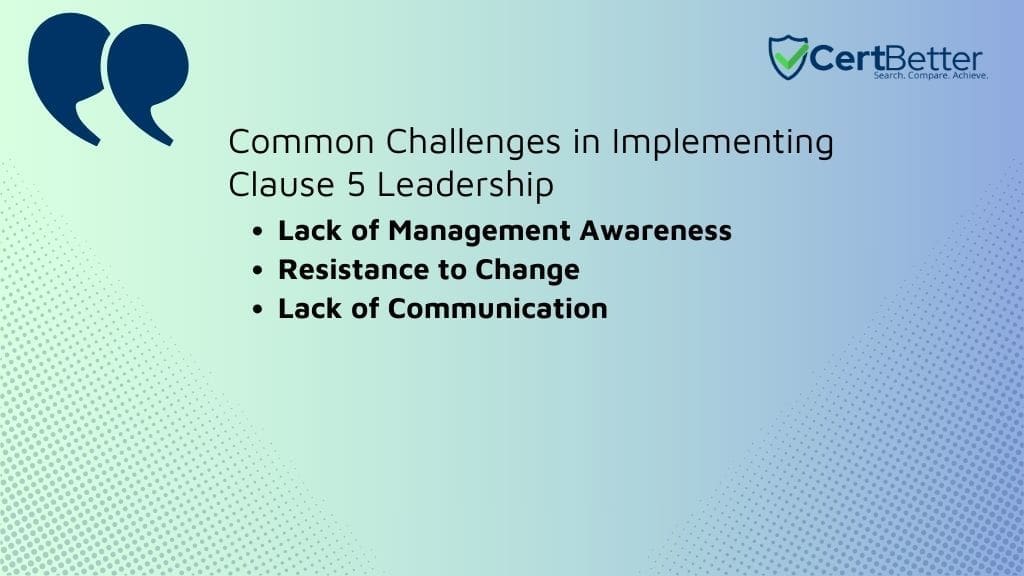
Most companies face challenges, especially when the leadership team is not fully committed or when there is a lack of understanding about what Clause 5 really requires. I'll list some of my favourite ones which I see almost every time during my ISO audits.
Lack of Management Awareness — In some companies, leadership often delegates the QMS responsibilities to lower-level managers or staff while having no idea about Quality at all. This can lead to a disconnect between the company’s strategic goals and the QMS, making it difficult to achieve the desired results.
If you're a quality manager, I suggest sitting down with your top management and help them understand why it's important to have their leadership involvement. May be explore a few course on Leadership on Linkedin.
Resistance to Change — Implementing a QMS requires changes in the way things are done, and not everyone is comfortable with change. I have seen cases where employees resist new processes or where leaders are reluctant to change their management style to meet the requirements of Clause 5.
Lack of Communication — If leaders do not communicate the importance of the QMS and their commitment to it, employees may not take the system seriously. This can lead to a lack of buy-in from the team, which makes it difficult to fully implement the QMS.
Overcoming these challenges requires a strong commitment from the leadership team. One of the first steps is to make sure that top management is fully aware and involved in the QMS. They need to understand that their role is not just to oversee the system but to actively participate in it. This can be achieved by regular involvement in quality meetings, setting clear quality objectives, and leading by example.
Final Thoughts
In conclusion, Clause 5 of ISO 9001:2015 Quality Management System emphasises the critical role of leadership in the success of their business and customer satisfaction . This helps fostering a culture of continuoual improvement and customer focus within the organisation. By understanding and fulfilling the responsibilities outlined in Clause 5, including leadership commitment, customer focus, establishing a clear quality policy, and defining organizational roles, top management can drive their organisation toward greater quality and customer satisfaction.