When steel structures or machinery parts don’t fit together as planned, the results can be costly, delays on construction sites, expensive rework in factories, and sometimes even safety risks. Too often, the root cause comes down to unclear expectations around welding tolerances.
On this page
One fabricator might claim their work is “within limits,” while the client insists it isn’t good enough. Without a shared reference, these disputes can spiral into lost time, wasted money, and strained partnerships.
That’s why the welding industry turns to ISO 13920 (Welding – General Tolerances). This international standard defines acceptable dimensional variations in welded constructions from length and angles to flatness, straightness, and alignment.
“By creating a common language between designers, fabricators, inspectors, and clients, ISO 13920 helps projects run smoother, safer, and more efficiently.”
In this guide, we’ll break down what ISO 13920 covers, why it matters for your business, and how to put it into practice in plain, practical terms.
1. Why ISO 13920 Matters?
Welding isn’t just about joining metal. It’s about creating structures that are safe, reliable, and cost-effective. Even the smallest dimensional error in a welded component can ripple into major issues once the parts are assembled. That’s why ISO 13920 provides a business advantage, not just a technical guideline.
1.1 Fit-Up and Safety Depend on Accuracy
If welded beams, frames, or machine parts don’t line up as expected, the integrity of the whole structure is at risk. A bridge girder that sits out of alignment or a pressure vessel flange that doesn’t seal properly can compromise safety. ISO 13920 ensures that deviations stay within acceptable limits so the final product performs as intended.
1.2 Lowering Costs Through Fewer Disputes and Less Rework
Every time a client rejects a delivery or installers have to modify components on-site, costs pile up. By agreeing upfront on ISO 13920 tolerances, both fabricator and customer share the same reference point. That reduces arguments, limits rework, and keeps projects on schedule.
1.3 A Neutral Standard for Global Supply Chains
In today’s market, welded components often travel across borders before reaching their final destination. ISO 13920 acts as a neutral benchmark in contracts, removing ambiguity between international partners. For example, a manufacturer in Europe and a contractor in the Middle East can work seamlessly when both sides use the same tolerance language.
1.4 Meeting Modern Expectations of Precision
Clients and regulators now demand higher standards of accuracy and accountability. Using ISO 13920 signals professionalism, it shows that your shop or company operates to internationally recognised best practices. That credibility is invaluable when bidding for contracts or working with high-profile clients.
1.5 Building Trust With Stakeholders
Trust is the foundation of long-term business relationships. When clients know your tolerances are measured against ISO 13920, they see more than welded steel, they see reliability, safety, and quality assurance. That builds confidence not only with customers but also with contractors, inspectors, and regulators.





2. Do You Need ISO 13920? A Practical Self-Test
Not every welded structure needs aerospace-level precision but many projects suffer because there’s no clear agreement on what’s “good enough”. ISO 13920 helps you set that baseline. If you’re unsure whether it applies to your business, walk through this short self-test.
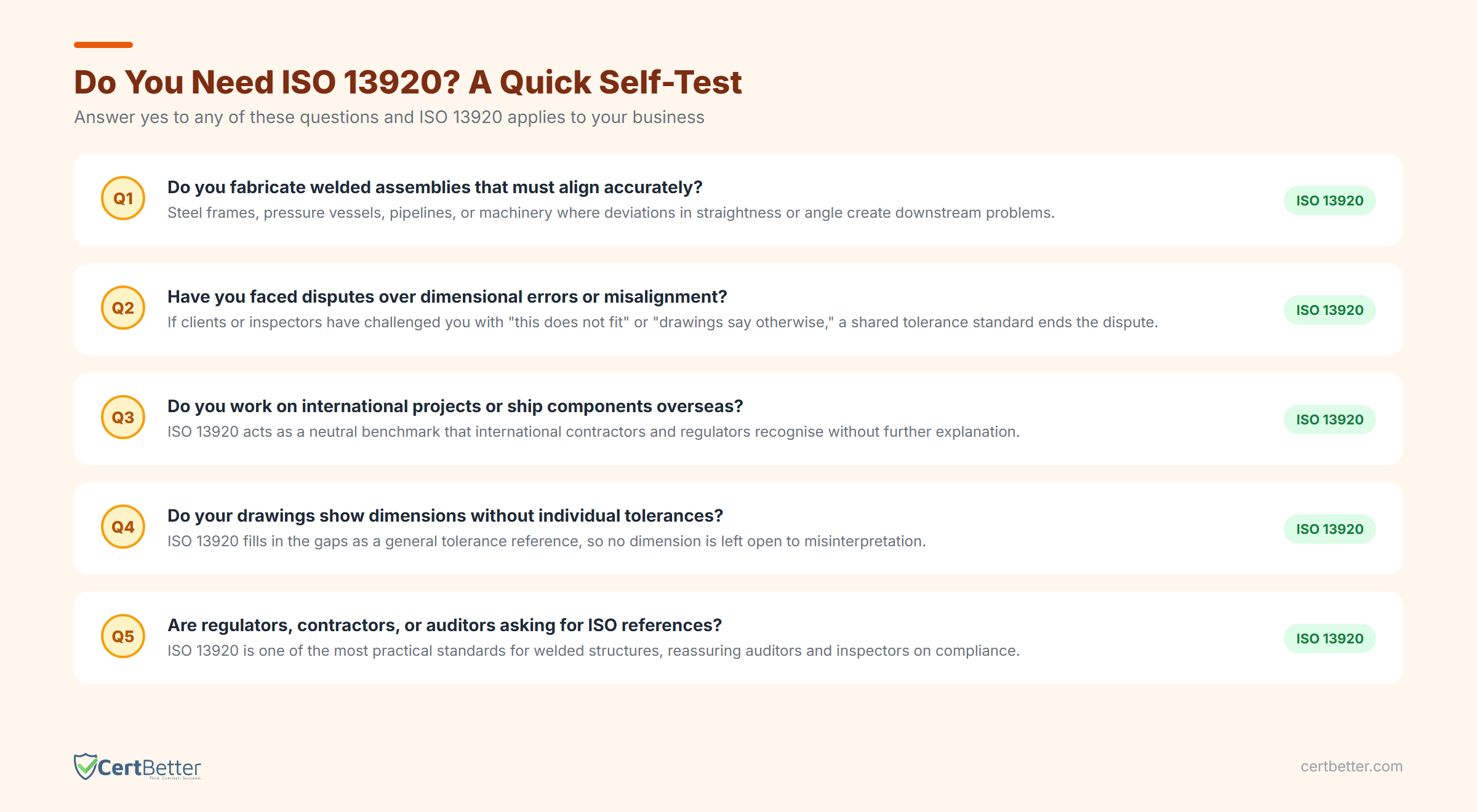
2.1 Do you fabricate welded assemblies that must align accurately?
If you build steel frames, pressure vessels, pipelines, or machinery parts, even small deviations in straightness or angle can cause big problems later. ISO 13920 ensures your work meets predictable limits.
2.2 Have you faced disputes over dimensional errors or misalignment?
If clients or inspectors have ever challenged you with statements like “this doesn’t fit” or “the drawings say otherwise,” then adopting ISO 13920 gives you a clear reference point to avoid conflict.
2.3 Do you work on international projects?
When your parts are shipped overseas, contractors and regulators need proof of compliance. Referencing ISO 13920 in your contracts and drawings shows you’re aligned with globally recognised tolerances.
2.4 Do your drawings show many dimensions without individual tolerances?
If your engineering drawings don’t specify tolerances for every single dimension, you risk misinterpretation. ISO 13920 fills in the gaps by providing general tolerances. So no dimension is left in doubt.
2.5 Are regulators, contractors, or auditors asking for ISO references?
If you’re being asked to show compliance with ISO standards, ISO 13920 is one of the most practical for welded structures. It reassures auditors and inspectors that your process is built on recognised international criteria.
3. Key Components of ISO 13920: Breaking It Down in Plain English
ISO 13920 can look intimidating when you first open it, full of tables, tolerance classes, and technical definitions. But at its core, it’s simply a guide to how much variation is acceptable in welded parts. Here’s what you need to know.
3.1 Tolerance Classes (A–D)
The standard defines four classes, from very precise to very approximate.
- Class A (Fine) – For high-precision work like aerospace, medical devices, or specialised machinery.
- Class B (Medium) – Used in general engineering and construction — the most common class.
- Class C (Coarse) – Suitable for heavy steel structures where some variation is acceptable.
- Class D (Very Coarse) – For very large, heavy-duty projects like shipbuilding, where exact fit is less critical.
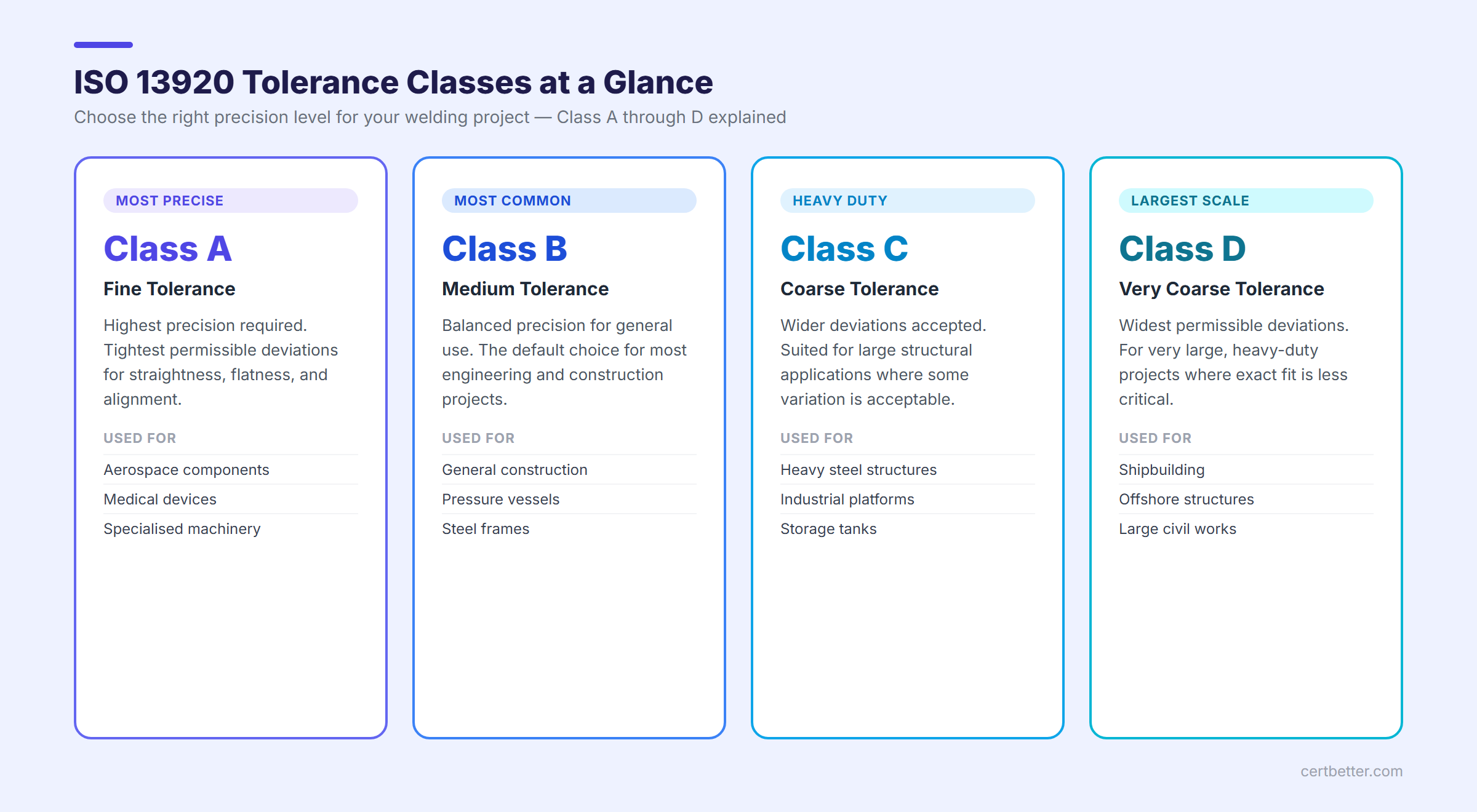
Choosing the right class is about balancing cost with function. Too fine, and fabrication costs rise sharply; too coarse, and you risk safety or assembly issues.
3.2 Dimensions Covered
ISO 13920 focuses on four types of dimensions:
- Linear – Length, width, and height of welded parts.
- Angular – Deviations in angles and slopes.
- Shape – Straightness and flatness of components.
- Position – Alignment and parallelism between parts.
Together, these tolerances ensure that welded components fit properly during assembly.
3.3 Tables of Tolerances
The heart of the standard is its tolerance tables. These tables show the permissible variation in millimeters or degrees based on:
- The size of the component
- The chosen tolerance class (A–D).
For example, a 1,000 mm beam in Class B might allow a few millimeters of variation in straightness, while the same beam in Class A would allow much less.
3.4 What’s Not Included
It’s just as important to know what ISO 13920 does not cover:
- Weld quality levels (like cracks, porosity, or surface imperfections) → that’s handled by ISO 5817.
- Special geometric tolerances (like symmetry, coaxiality, or concentricity) → these must be specified separately if needed.
3.5 Inspection Methods
To check tolerances, you don’t always need expensive equipment. Common tools include:
- Straightedges, tape measures, and squares for simple checks.
- Calipers and gauges for finer measurements.
- Laser measurement systems or CMM (Coordinate Measuring Machines) for high-precision projects.
The method you use should match the tolerance class you’ve chosen.
4. Steps to Align with ISO 13920: A Clear Roadmap
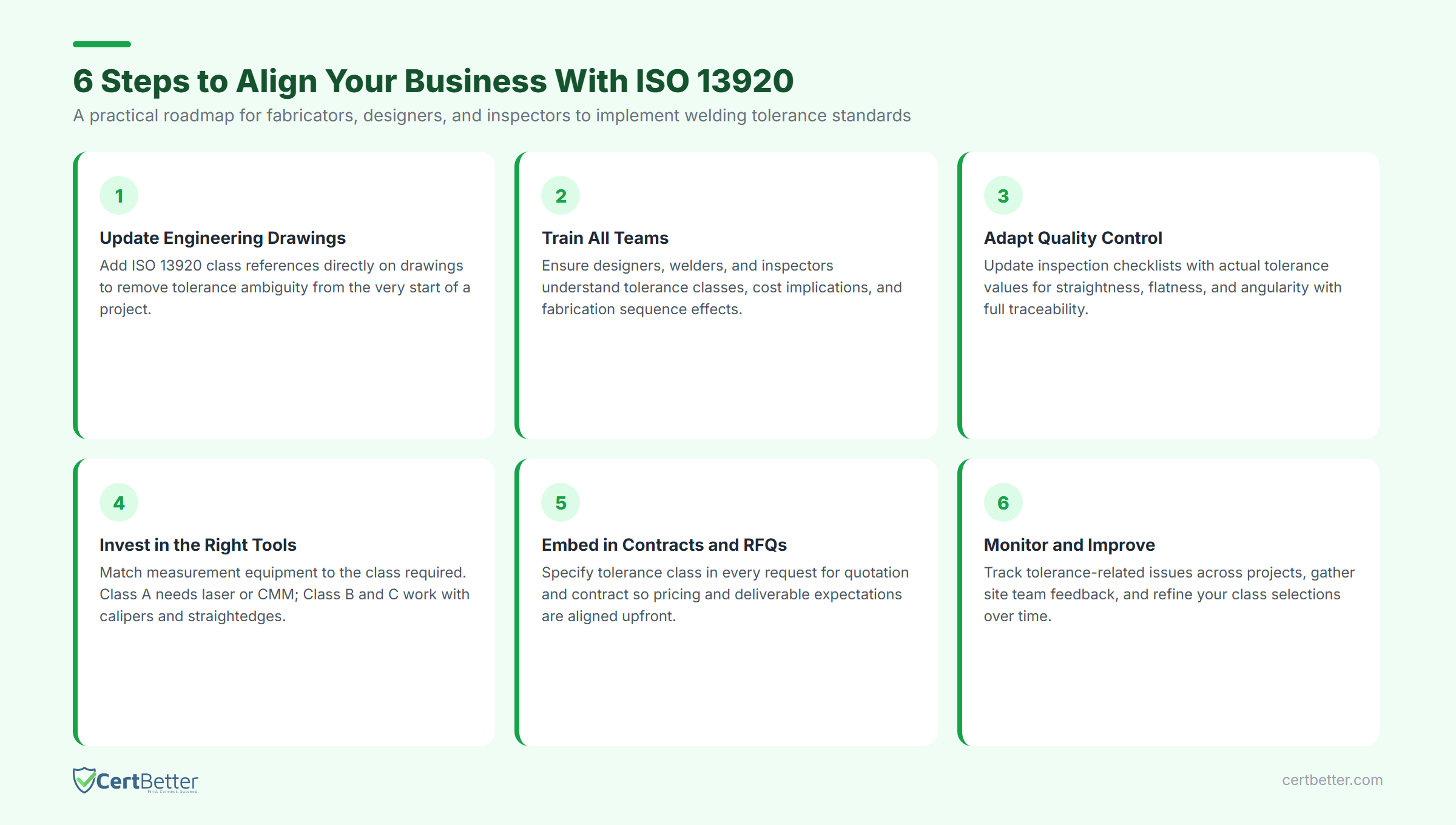
Adopting ISO 13920 requires more than just quoting it on drawings. To see real benefits, you need to integrate it into design, fabrication, inspection, and contracts. Here’s how to build that alignment in practice.
Step 1: Update Your Engineering Drawings
Every project starts with drawings, and this is where most disputes are born. If tolerances aren’t clearly specified, clients, fabricators, and inspectors all bring their own assumptions.
For example, noting “ISO 13920-B applies” on a frame beam to reference ISO 13920 directly, you remove ambiguity from the start. A 2,500 mm beam might look acceptable to a welder but be rejected by a client without that clear baseline. Standardising this practice across all design teams ensures consistency and prevents misunderstandings.
Step 2: Train Designers, Welders, and Inspectors
Tolerance classes can seem abstract until they’re connected to real-world work. Training sessions should show how Class A compares to Class D, how tighter tolerances impact welding sequences and distortion control, and how cost escalates when unnecessary precision is specified.
A useful way to drive the message home is to share examples from past projects, one where tight tolerances led to costly rework, and another where realistic tolerances allowed smooth assembly without compromising quality.
Step 3: Adapt Quality Control Procedures
Your quality system must reflect ISO 13920 requirements. Inspection checklists should be updated with the actual tolerances for straightness, angularity, and flatness instead of vague statements like “checked for alignment.” Inspectors need to be trained not just in using tools but also in documenting results clearly.
A report that says “Flatness measured at 2.5 mm across 1,000 mm span, within Class B tolerance” builds confidence far more than generic notes. This level of traceability becomes critical in both audits and client reviews.
Step 4: Invest in the Right Tools
Inspection accuracy is only as good as the tools you use. Class A tolerances may require vernier calipers, dial gauges, laser systems, or even CMMs, while Class B tolerances can be handled with reliable squares and calipers. Coarser classes often require nothing more than straightedges and tapes.
The key is not to overspend on equipment you’ll rarely use. Instead, invest wisely in the tools that match the tolerance classes you most frequently apply, ensuring both accuracy and cost control.
Step 5: Embed ISO 13920 in Contracts and RFQs
Many costly disputes arise not in the workshop but in contracts. If a client expects Class B precision but a fabricator delivers Class C, both may feel justified in their position. The solution is to make ISO 13920 part of the commercial conversation from the outset.
Clients should specify the tolerance class in requests for quotation, and fabricators should price their work accordingly. This not only sets expectations but also creates a fair link between cost and precision.
Step 6: Monitor, Review, and Improve
ISO 13920 isn’t a one-time decision. To make it effective, you need ongoing review and adjustment. Track how many tolerance-related issues arise on projects and whether they were preventable. Gather feedback from site teams about whether tolerances specified in drawings match the reality of assembly.
Over time, you’ll develop a sharper sense of when to apply fine tolerances for critical projects and when coarser tolerances are more than sufficient. Treating ISO 13920 as part of your overall quality management system ensures it becomes a tool for continuous improvement rather than just compliance.
5. Challenges in Implementing ISO 13920 (and How to Overcome Them)
5.1 Confusion with ISO 5817
A frequent issue is mixing up ISO 13920 with ISO 5817. The first deals with geometry tolerances like straightness and flatness, while the second covers weld quality levels such as cracks or porosity. Misunderstandings lead to disputes, so it’s important to make the difference clear to both teams and clients.
5.2 Choosing Tolerances That Are Too Tight
Specifying Class A tolerances when Class B would suffice often drives up costs without adding real value. Overly strict requirements mean longer inspections and higher production costs, which can make projects less competitive.
5.3 Choosing Tolerances That Are Too Loose
Going too far in the opposite direction is just as risky. Loose tolerances may speed up fabrication but can cause misaligned assemblies and safety concerns during installation. Finding the right balance is key.
5.4 Limited Access to Inspection Equipment
Small shops sometimes worry about not having advanced tools like laser systems. In reality, most ISO 13920 checks can be done with basic instruments such as calipers, tape measures, or straightedges.
5.5 International Misinterpretations
Even with ISO 13920 in place, different countries or contractors may interpret tables differently. To avoid confusion, tolerance classes should always be clearly stated in drawings and contracts.
6. Additional Considerations: Leadership, Training, and Integration
6.1 Leadership Commitment
ISO 13920 may be technical in nature, but it only works if leadership makes it a priority. When managers allocate resources for training, inspection tools, and process improvements, tolerances become part of company culture instead of an afterthought.
6.2 Training and Competency
Designers, welders, and inspectors need to understand the tolerance classes and how they affect both cost and quality. A workforce that shares the same tolerance language avoids disputes and works more efficiently across projects.
6.3 Digital Integration
Modern CAD, CAM, and BIM platforms allow ISO 13920 requirements to be embedded directly into models and workflows. This reduces mistakes, strengthens traceability, and makes compliance easier on complex projects.
6.4 Consistency Across Projects
Some companies only reference ISO 13920 when issues arise, which undermines its purpose. Applying it consistently across all work builds credibility and positions the organisation as professional and reliable in the eyes of clients and regulators.
7. FAQs: Common Questions About ISO 13920
Is ISO 13920 mandatory?
No, it’s not a legal requirement. However, it is often written into contracts and project specifications, which makes it effectively mandatory for many jobs.
How is ISO 13920 different from ISO 5817?
ISO 13920 sets tolerances for dimensions and geometry, like straightness, flatness, and angular deviation. ISO 5817 deals with weld quality levels, such as cracks, porosity, or surface imperfections. They complement each other but cover different aspects of welding.
Which tolerance class should I use?
That depends on the project. Class A is for precision applications like aerospace or specialised machinery, Class B is the most common in construction and engineering, while Classes C and D are used for heavy-duty structures where exact fit is less critical.
How do I check compliance with ISO 13920?
Compliance can be verified with simple tools like calipers, tape measures, and straightedges for most projects. More advanced methods, such as laser measurement or coordinate measuring machines (CMMs), are only needed for fine tolerances.
Does ISO 13920 apply to all materials?
The standard is primarily used for steel and aluminum welded assemblies, but its principles can be applied to other metals where similar fit-up and alignment issues exist.
Where can I find experts to help apply ISO 13920?
You can connect with qualified welding consultants, inspectors, and certification bodies through CertBetter.com. Verified providers on the platform specialise in applying standards like ISO 13920 to real-world projects.
8. Where to Download ISO 13920 PDF?
To make sure you are working with the most accurate and up-to-date version, always get ISO 13920 from official sources. The standard is available for purchase directly from the International Organization for Standardization (ISO) website. It can also be obtained through trusted national standards bodies such as BSI (UK), ANSI (US), or Standards Australia.
9. Conclusion: Why ISO 13920 Builds Clarity and Trust
Welding projects succeed when every part fits together the way it should. Yet without a clear tolerance standard, even skilled fabricators and careful inspectors can end up in disputes that cost time, money, and trust. ISO 13920 solves this by giving the industry a shared language — one that defines acceptable limits for length, angle, flatness, and alignment.
For fabricators, it means fewer arguments and more predictable outcomes. For clients, it means confidence that what’s delivered will fit as intended. And for inspectors, it provides an impartial reference point to judge compliance fairly.
At its heart, ISO 13920 isn’t just about numbers on a drawing. It’s about collaboration, professionalism, and credibility. By applying it consistently, businesses avoid costly misunderstandings, strengthen relationships, and show that they take quality seriously. In a world where trust is everything, that’s a competitive edge no company can afford to ignore.