In the global publishing world, millions of books are released, printed, downloaded, streamed, or archived every year. Without a universal system to tell them apart, even a simple task like ordering a title or tracking sales would become chaotic.
On this page
The International Standard Book Number (ISBN), defined by ISO 2108, solves that problem. It assigns a unique 13-digit identifier to every edition and format of a book, ensuring that publishers, bookstores, libraries, and online platforms can identify and manage publications accurately.
From a paperback in Melbourne to an audiobook released in New York, the ISBN keeps the publishing supply chain organised and efficient.
“ISBN is the digital DNA of the book world, enabling discoverability, accurate metadata, and global trade across every platform and market.”
In this guide, we’ll unpack ISO 2108, explain why it matters for publishers and content creators, and show how to align your publishing process with this essential global standard.
Why the Standard Matters
In publishing, clarity and consistency mean everything. Without ISBN, the book supply chain would collapse under the weight of duplication, lost royalties, and unreliable data. ISO 2108 ensures order in this fast-moving ecosystem.
A Universal Language for Books
ISO 2108 establishes one global system for identifying publications. No matter where a book is printed or sold, its ISBN speaks the same language to every database and retailer. It connects printing houses, distributors, and e-commerce platforms in a single digital network.
Preventing Duplication and Revenue Loss
Every unique edition or format carries its own ISBN. This prevents mix-ups between versions, protects author royalties, and keeps distributors from shipping the wrong product.
Reliable Cataloguing and Sales Tracking
Librarians and online platforms rely on ISBN to locate and track titles. For example, libraries use it to classify books correctly, while retailers use it to manage stock and automate sales reporting.
Powering Modern E-Commerce
From Amazon and Apple Books to Kobo and Google Play, ISBN enables automation. It helps digital storefronts sync book data instantly, display the right cover and metadata, and manage millions of listings without overlap.
Strengthening Small Publishers and Authors
For self-publishers, ISBN is a mark of professionalism. It ensures visibility across retail and library networks, making even a single author’s release discoverable on the same systems used by global publishers.
Connecting the Entire Publishing Chain
Publishers, distributors, and metadata registries all rely on ISBN to share information. ISO 2108 makes these systems interoperable, so updates in one database can be mirrored across others without confusion.
Building Trust and Traceability
Just like CertBetter’s Verified Provider program promotes trust in the ISO industry, ISO 2108 promotes trust in publishing. A properly assigned ISBN proves that a title is genuine, trackable, and ready for global trade.





Do You Need ISO 2108?
Not sure whether ISO 2108 applies to you? Use this quick self-test to find out. Each question points to a real-world publishing scenario.
Do you publish printed or digital books for public sale or distribution?
If yes, you need ISBNs for each title and edition. ISBN ensures your work can be found, listed, and sold through bookstores, libraries, and online platforms.
Do you manage multiple product formats such as hardcover, paperback, or e-book?
Each format must have its own ISBN. This avoids confusion and keeps royalties, sales data, and stock records accurate.
Do you run a publishing house, academic press, or self-publishing imprint?
ISBN simplifies cataloguing and rights management. It also gives your publications global visibility and professional credibility.
Do you distribute or sell books internationally?
Most distributors and retailers require an ISBN to add your titles to their systems. Without it, your book may be invisible in global databases.
Do you manage a national library, academic repository, or educational content platform?
Libraries and repositories rely on ISBN to index and share metadata. It ensures every book can be located quickly and referenced correctly.
Key Components of ISO 2108: Understanding How ISBN Works
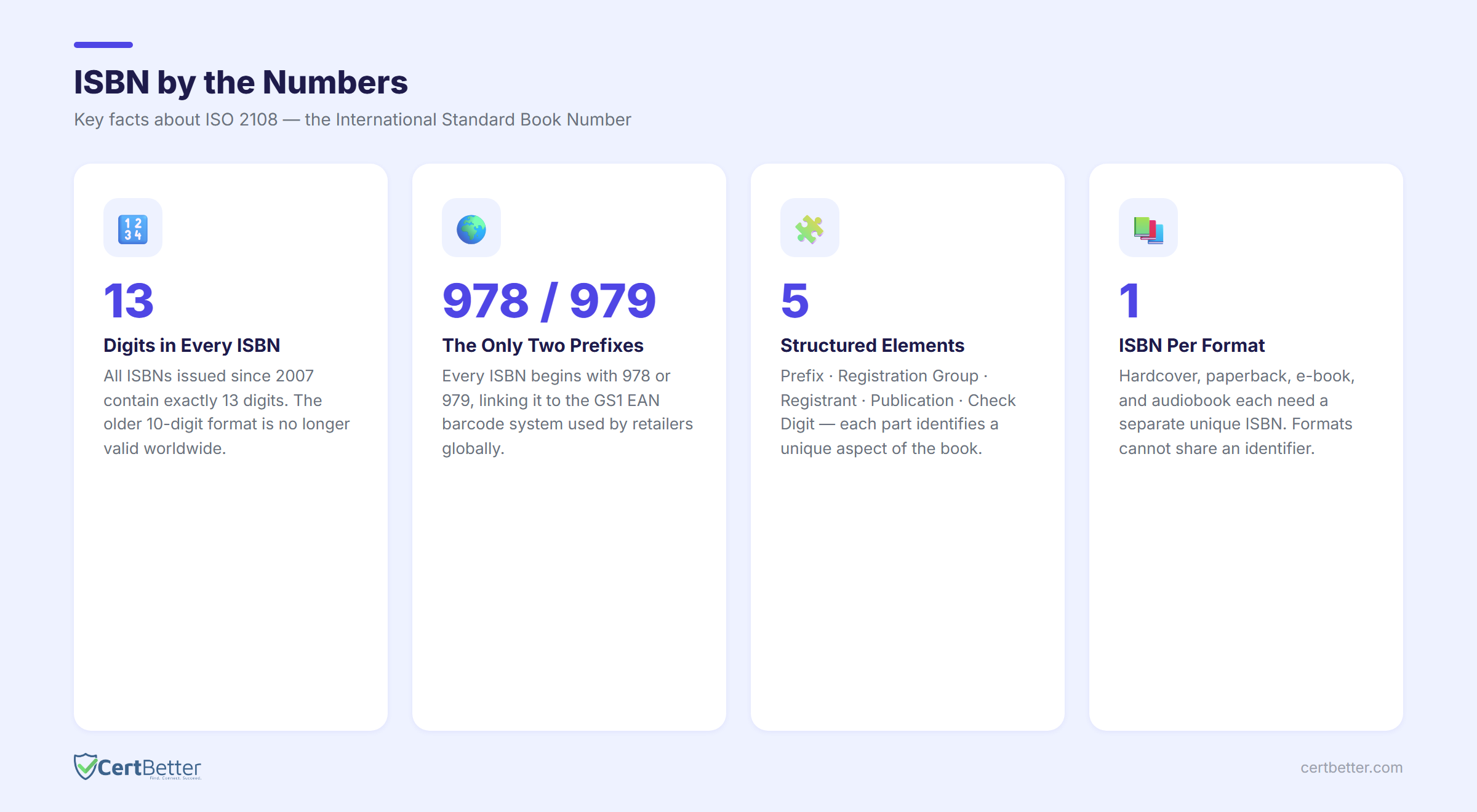
Before applying for or assigning ISBNs, it helps to understand how they’re built and managed. ISO 2108 defines a clear structure so every number tells a story — who published the book, where it came from, and which version it represents.
Total Length: 13 Digits
All ISBNs issued since 2007 contain 13 digits. The older 10-digit system is no longer valid. The 13-digit format aligns ISBNs with international barcoding standards for easy scanning and data sharing.
Prefix Element
The first three digits are always 978 or 979. This connects ISBN to the GS1 EAN system used by retailers and logistics networks worldwide, ensuring every book can also double as a scannable barcode.
Registration Group
This identifies the country, region, or language group.
For example:
- 0 or 1 = English-language regions
- 2 = French-language regions
- 3 = German-language regions
It tells you where the publisher or language group belongs, not where the book is printed.
Registrant Element
This part identifies the publisher or imprint. Larger publishers may have shorter numbers (because they publish many titles), while small or niche publishers receive longer ones. It’s how ISBN connects each title back to its issuing organisation.
Publication Element
This identifies the specific edition, volume, or format.
Every variation — hardcover, paperback, e-book, audiobook, or new edition — gets a unique publication element, guaranteeing that every version can be tracked independently.
Check Digit
The last digit is automatically calculated to validate the number’s accuracy. It’s a built-in safeguard that ensures data entry errors are caught before the ISBN is registered or printed.
Steps to Align with ISO 2108: A Practical Roadmap for Publishers
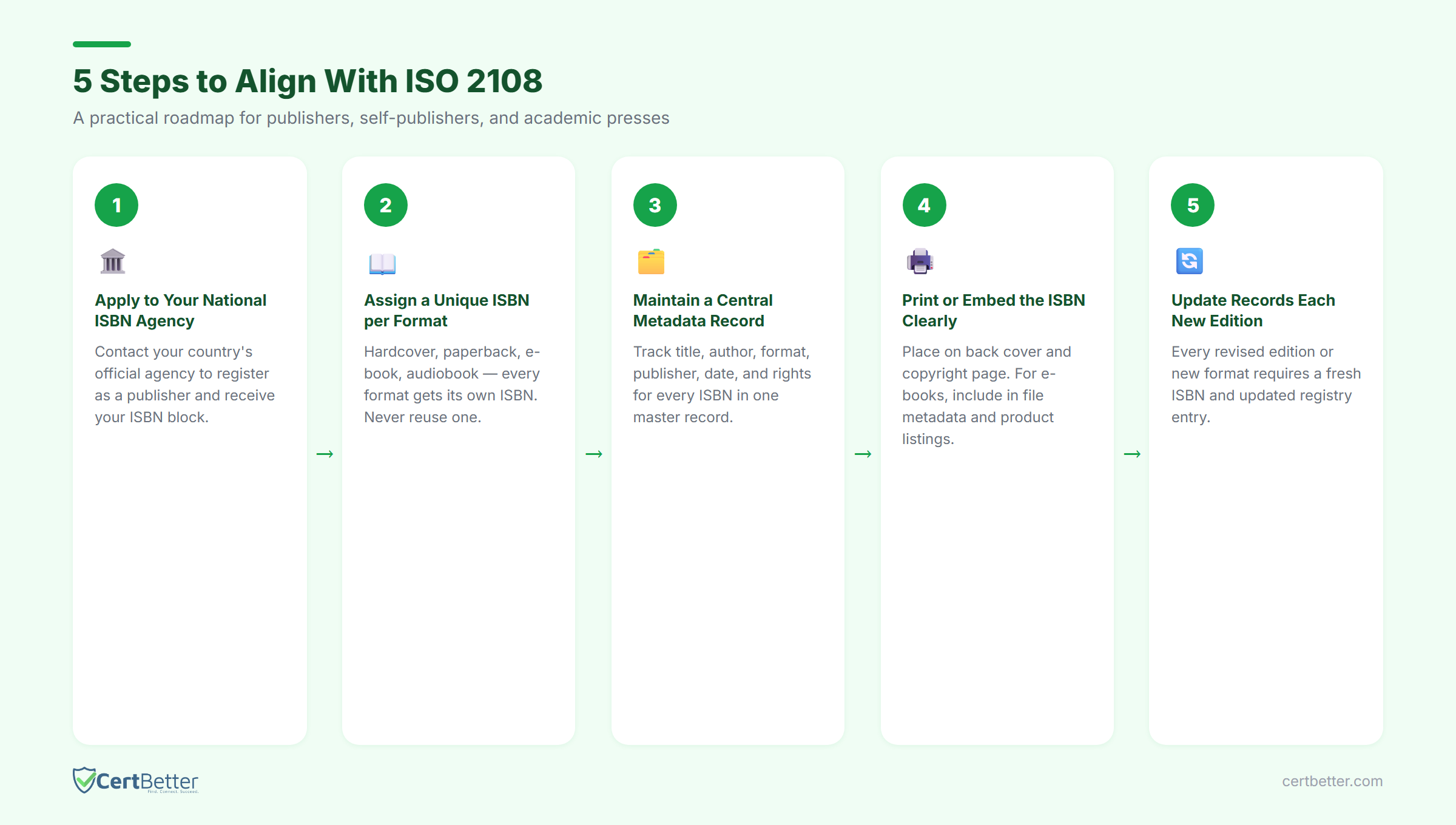
Whether you are a first-time author, a small independent press, or a large publishing house, aligning with ISO 2108 is a straightforward process. The key is to follow a structured approach that ensures every publication is correctly registered and traceable across global systems.
Step 1: Apply for ISBNs through Your National Agency
Start by contacting your country’s national ISBN agency. You can usually apply online to receive either individual ISBNs or a block of numbers (if you publish frequently).
This step officially registers you as a recognised publisher and gives you the authority to assign ISBNs to your works.
Step 2: Assign Unique ISBNs to Each Edition and Format
Each product version must have its own ISBN, hardcover, paperback, e-book, or audiobook.
If you publish a translated edition or an updated version, it also requires a new ISBN.
Never reuse an ISBN, even if a title is discontinued.
Step 3: Maintain a Central Metadata Record
Keep detailed records for every ISBN you assign, including:Title and subtitle
- Author(s) and contributors
- Publisher name and imprint
- Publication date and format
- Language, edition number, and rights information
Accurate metadata ensures your book is discoverable in global databases and prevents confusion when reissuing editions.
Step 4: Print or Embed the ISBN Clearly
In printed books, the ISBN should appear:
- On the verso (back) of the title page
- On the back cover near the barcode
- On the copyright page if applicable
For digital formats, include it in the file metadata, on the product listing page, and within digital rights management systems.
Step 5: Integrate ISBNs with Barcodes and Retail Systems
The ISBN can be easily converted into a GS1 EAN-13 barcode for scanning in bookstores and warehouses.
Most retailers and logistics systems require this barcode version to process sales, shipments, and returns efficiently.
Step 6: Keep Your ISBN Records Updated
Whenever a new edition, format, or partnership is created, update your ISBN registry and inform distributors and digital platforms.
Maintaining up-to-date records helps prevent errors, such as two books sharing the same identifier or incorrect listings on online marketplaces.
Step 7: Automate with Publishing Software
If you manage multiple titles, consider using publishing or metadata management software that supports ISBN and ONIX data exchange.
Automation helps eliminate manual mistakes and ensures your data stays consistent across distributors, printers, and online platforms.
Challenges in Implementing ISO 2108 (Pitfalls and Practical Advice)
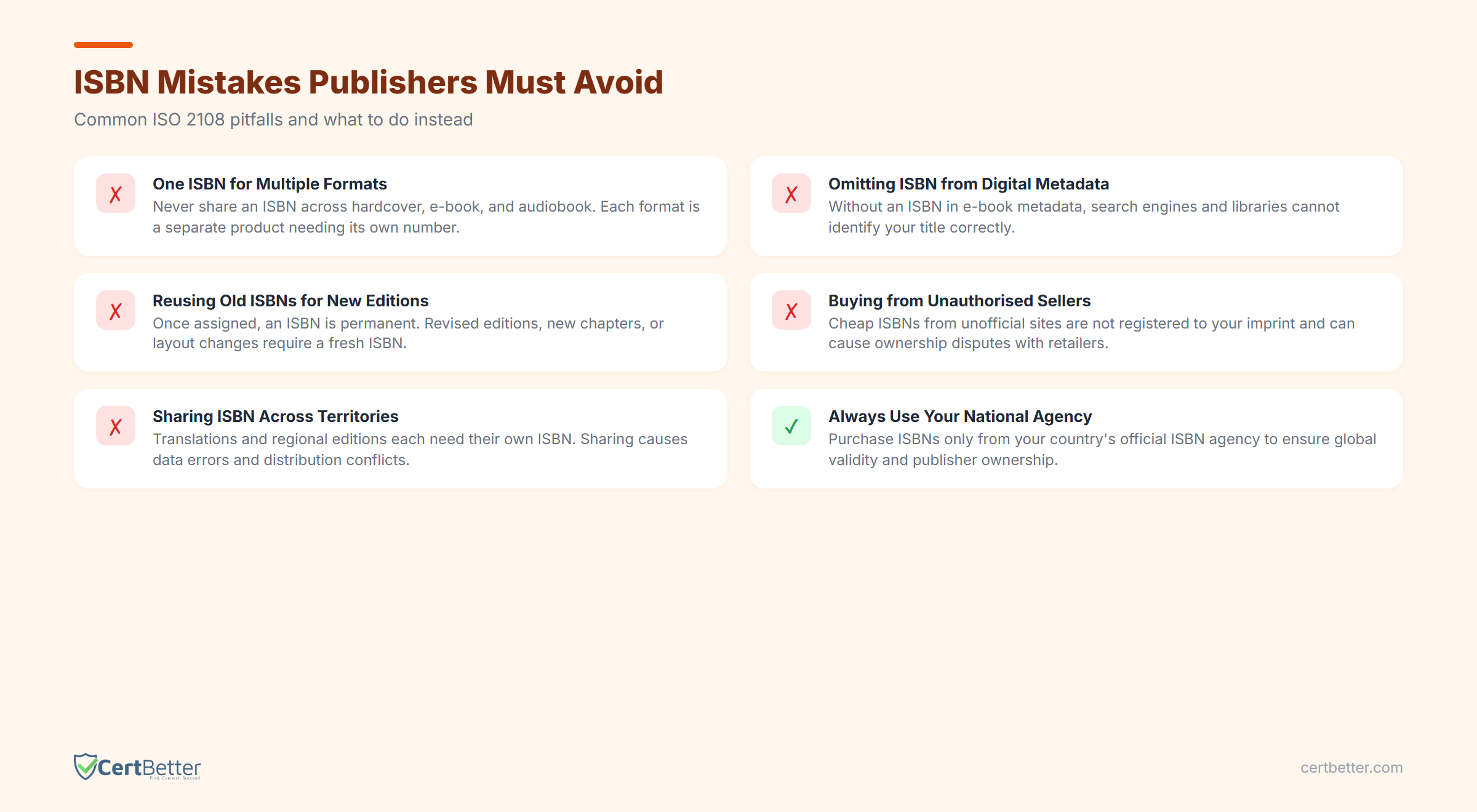
Assigning and managing ISBNs might look simple, but small mistakes can lead to major data problems, especially when your books are listed across multiple platforms. ISO 2108 provides a clear framework, but many publishers still face common pitfalls.
Here are the most frequent challenges and practical ways to avoid them.
Assigning One ISBN to Multiple Formats
This is one of the biggest errors publishers make. Each format, such as hardcover, paperback, e-book, or audiobook, needs its own ISBN.
If you use one ISBN for multiple formats, sales data and royalties can get mixed up, and retailers may display the wrong product image or description.
Tip: Treat every format as a separate product. Clear ISBN separation keeps your sales, royalties, and distribution data accurate.
Forgetting to Issue a New ISBN for Revised Editions
Even small content changes can require a new ISBN. For example, adding new chapters, changing illustrations, or adjusting layout creates a new edition. Using the old ISBN can confuse library catalogs and online stores.
Tip: Before every reprint or digital update, ask, “Would a reader see this as a new edition?” If yes, assign a new ISBN.
Using the Same ISBN Across Territories or Languages
Translations and regional editions must each have their own ISBN. A book sold in multiple countries or languages is considered a distinct product. Sharing one ISBN across versions can lead to data errors and distribution conflicts.
Tip: Coordinate early with your distributors and partners in each market. Assign region-specific ISBNs and keep a shared master record.
Omitting ISBNs from Digital Metadata
Many self-publishers forget to include ISBNs in e-book metadata or online listings. Without this, search engines and library systems cannot properly identify your title.
Tip: Always include the ISBN in the metadata of your e-book files and retailer upload forms. It improves discoverability and ensures the correct version appears in every platform.
Buying ISBNs from Unauthorised Sellers
Some websites offer “cheap ISBNs” that are not officially registered to your name or imprint. These fake numbers can lead to ownership disputes or rejection from major retailers.
Tip: Purchase ISBNs only from your national ISBN agency. This ensures you are the recognised publisher and your ISBNs are valid worldwide.
Treating ISBN as Just a Barcode
ISBN is not just a barcode or a visual tag. It is the key that connects your book to its entire publishing record. When used correctly, ISBN helps track royalties, rights, and sales analytics across all formats.
Tip: Manage ISBNs as part of your core publishing data. Keep them connected to your internal metadata, marketing systems, and rights management processes.
Poor Internal Record Keeping
Losing track of which ISBN belongs to which title leads to duplication and data conflicts.
Tip: Keep a central database or spreadsheet with every ISBN, title, edition, and publication date. Update it regularly to avoid confusion or missed updates.
Additional Considerations: Leadership, Training, and Integration
Publishing standards work best when they are supported by strong leadership, well-trained teams, and smart integration with other systems. ISO 2108 is not just about assigning numbers. It is about managing knowledge, consistency, and data quality across every book you release.
Here are the key areas to strengthen as you align your organisation with ISO 2108.
Leadership Commitment
Strong leadership ensures ISBN management becomes part of the publishing culture. When executives support structured metadata practices, teams are more consistent and careful in applying ISBN rules.
Leaders should make ISBN control part of the company’s publishing policy and link it to quality and compliance goals.
Staff Training and Awareness
Even the best system fails without trained people. Everyone involved in production, editing, marketing, or distribution should understand what an ISBN means, when to use it, and how to record it correctly.
Simple internal training or checklists can prevent mistakes that later cause cataloging errors or lost sales.
Integration with Quality and Data Systems
ISBN management works best when linked to broader information systems. For example, integrating ISBN records with a quality management system like ISO 9001 ensures traceable documentation.
Connecting ISBN to data security or information management systems, such as ISO 27001, can also protect digital publishing assets and metadata integrity.
Digital Future and ISBN-A
Publishing is no longer limited to printed books. ISO 2108 includes the concept of ISBN-A, or Actionable ISBN, which turns each ISBN into a digital link.
This helps connect e-books, online content, and databases through permanent web addresses, making tracking and citation easier in the digital age.
Consistency Across Repositories and Institutions
Academic and educational organisations benefit most from consistent metadata. Universities, libraries, and learning platforms that integrate ISBN management into their repositories improve discoverability and reduce cataloguing errors.
Frequently Asked Questions About ISO 2108
1. What does ISBN stand for?
ISBN stands for International Standard Book Number. It is a 13-digit identifier that uniquely represents each book edition or format. ISBN allows publishers, retailers, and libraries to track and manage titles accurately across the world.
2. Do I need a new ISBN for e-book and print versions?
Yes. Each version of a book, such as hardcover, paperback, e-book, or audiobook, must have its own ISBN. This keeps sales, royalties, and cataloguing data separate and accurate.
3. Who issues ISBNs?
ISBNs are issued by national ISBN agencies that operate under the International ISBN Agency based in London. Most countries have their own authorised agency where publishers or authors can apply directly.
4. Is ISBN mandatory for self-publishers?
ISBN is not legally required, but it is strongly recommended if you want your book to appear in bookstores, online retailers, or libraries. Without it, your title may not be discoverable in global catalogues.
5. Can I reuse an old ISBN for a new edition?
No. Once an ISBN has been assigned, it is permanently linked to that specific edition. Reusing it for a different version or revised publication can cause serious data conflicts and confusion in retailer and library systems.
6. What is the difference between ISBN and ISSN?
ISBN identifies books and other monographic works. ISSN, or International Standard Serial Number, identifies serial publications such as magazines, journals, and newspapers. Each system serves a different type of content.
Where to Download the Standard
To ensure accuracy and compliance, always obtain an ISO 2108:2017 International Standard Book Number (ISBN) from verified sources such as the ISO Store, BSI Group, ANSI or Standards Australia. Confirm that you are purchasing the 2017 edition (confirmed 2023), as this is the current and authoritative version defining the 13-digit ISBN structure and application for both printed and digital publications.
Conclusion: Why ISO 2108 Matters for Every Publisher
Behind every barcode and every “Buy Now” button on a bookstore shelf or digital platform is a quiet system that keeps the publishing world organised. That system is ISO 2108.
The ISBN gives every book its own global identity. It prevents mix-ups, supports accurate cataloging, and ensures that the right version reaches the right reader every time. Whether you publish novels, textbooks, or digital learning materials, ISBN keeps your data consistent and your titles visible worldwide.
For authors and publishers, adopting ISO 2108 is more than a technical requirement. It is a sign of professionalism, credibility, and respect for your readers. It also saves time for distributors, librarians, and educators who rely on accurate identifiers to do their work. Just as CertBetter verifies ISO consultants and organisations to build trust in the ISO industry, ISO 2108 verifies the integrity of every book in the publishing ecosystem. Both systems share the same goal: making information reliable, traceable, and universally trusted.