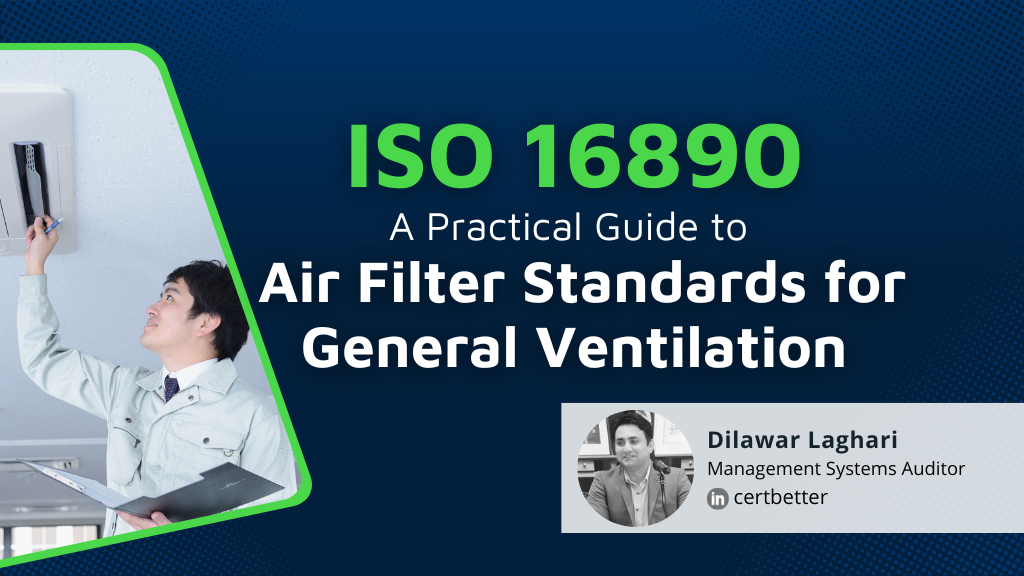
Not all air filters are created equal. Some catch only visible dust, but miss tiny harmful particles like those from car exhaust, wildfire smoke, or even bacteria. So, how can we identify the right one? That’s where ISO 16890 comes in.
On this page
“If you can’t see it, you might still be breathing it, and that’s exactly why filter standards matter.”
This international standard enables us to select air filters that effectively protect our lungs by focusing on particle sizes such as PM1 and PM2.5, which can penetrate deeply into our bodies.
Whether you’re managing an HVAC system in a shopping mall, improving air quality in a school, or simply making your office healthier, ISO 16890 provides a smarter way to choose the right filters.
In this guide, I’ll walk you through what ISO 16890 is, why it matters, and how you can use it to create cleaner, healthier indoor environments. Let’s get into it.
Recommended Read: ISO 45001 For Beginners: Easy Guide to Implementing Health and Safety Standard
Why ISO 16890 Is a Big Deal: Core Benefits for Your Building or Business
Here’s why this standard matters to you, whether you manage a school, hospital, office building, factory, or even your own home:
1. Real-World Particle Focus
Unlike older standards that used artificial dust for testing, ISO 16890 evaluates filters using real-world pollutants, the ones we breathe daily. These include particles from vehicle emissions, construction dust, allergens, and even fine particles from cooking.
ISO 16890 classifies filters based on their ability to remove particles with diameters of 1 μm (PM1), 2.5 μm (PM2.5), and 10 μm (PM10). This classification helps you select filters that offer protection from pollutants that affect respiratory health.
Example: If you're managing a building near busy roads or industrial areas, you can confidently choose a filter that targets PM1 particles.
2. Improved Health and Safety
Clean air impacts more than comfort; it affects health. Poor indoor air quality is associated with respiratory diseases, heart conditions, and fatigue.
ISO 16890 enables you to select filters that remove health-threatening particles, ensuring safe air for occupants, especially children, the elderly, and individuals with asthma or allergies.
Industries that benefit: healthcare, education, food production, pharmaceuticals, and residential living.
3. Transparent Filter Selection
Before ISO 16890, comparing filters was difficult due to inconsistent testing methods. Now, there is a clear and consistent evaluation method based on actual particle removal.
Filters are rated for their performance against specific particle sizes, helping you choose products suited to your building's specific needs.
4. Global Consistency
ISO 16890 is a globally accepted standard, providing uniformity across regions and industries. Whether sourcing filters locally or internationally, you can rely on consistent ratings and specifications.
This is especially helpful for multinational companies and large-scale construction or maintenance projects.
5. Better Communication with Clients and Contractors
Using ISO 16890 classifications makes it easier to explain filter choices. Whether talking to a client, project manager, or building owner, you can justify selections using measurable health-based data.
This improves decision-making, reduces misunderstandings, and strengthens trust.





Do You Need ISO 16890? A Simple Checklist
Here are a few quick questions. If you answer "yes" to any, ISO 16890 may be the right fit:
- Are you responsible for indoor air quality in buildings such as offices, schools, hospitals, or factories?
Yes? Then ISO 16890 helps ensure you’re providing cleaner air for the people inside those buildings. It allows you to select filters that target harmful pollutants based on the building’s function and occupants.
- Do you want to reduce harmful fine particles like PM2.5 or PM1 that affect human health?
If protecting the health of your employees, customers, or residents is a goal, then ISO 16890 gives you data-backed tools to choose the right filter based on particle size.
- Are you planning to upgrade your HVAC system or currently evaluating replacement filters?
Transitioning to ISO 16890-rated filters during upgrades is a smart move. You'll be future-proofing your system and ensuring real-world performance.
- Do you want a consistent, global standard that allows you to compare filter performance regardless of country or supplier?
ISO 16890 is internationally recognised. It brings everyone to the same page, making procurement and specification simpler.
- Are you preparing for indoor air quality audits, certifications, or sustainability goals?
Using ISO 16890-aligned filters can improve your compliance scores and align with WELL, LEED, or RESET building standards.
Key Components of ISO 16890: What You Need to Know
Understanding these technical components will make your decision-making more confident and informed.
1. Particle Size Relevance: PM1, PM2.5, PM10
Some particles are visible (like dust), but others are microscopic and harmful. ISO 16890 focuses on:
- PM10: Larger particles like dust and pollen
- PM2.5: Smaller particles such as smoke and fine dust
- PM1: Ultrafine particles that can enter the bloodstream
These categories ensure filters are rated for what truly matters.
2. Filter Group Classifications: ePM1, ePM2.5, ePM10, ISO Coarse
Once particle sizes are defined, filters need to be categorised based on their ability to capture those particles. That’s where these filter groups come in.
Filters are categorised based on their particle-capturing ability:
- ePM1: Targets ultrafine particles
- ePM2.5: Removes smoke and smaller dust
- ePM10: Filters larger dust and allergens
- ISO Coarse: Offers basic protection from large particles
3. Efficiency Testing With and Without Electrostatic Charge
To ensure filters perform reliably over time, ISO 16890 tests them with and without electrostatic charge. This gives a more realistic idea of long-term performance.
Some filters use static electricity to trap particles, but the charge may degrade over time. ISO 16890 tests filters both with and without this charge to give a more accurate long-term performance rating.
4. Minimum Efficiency Thresholds and Rounding Rules
The standard introduces thresholds that ensure only truly effective filters get classified. It also simplifies numbers for easier comparison and purchasing decisions.
A filter must achieve at least 50% efficiency for a particle size group to earn the respective ePM classification. Results are rounded to the nearest 5% for clarity and easier comparison.
5. Replacing EN 779: Why It Matters
ISO 16890 isn't just a minor update; it fully replaces the older EN 779 system. Here’s why that shift is important.
ISO 16890 replaces the outdated EN 779 system. Unlike EN 779, which used synthetic dust, ISO 16890 reflects real-world air quality and provides a globally consistent framework.
Must Read: A Beginner’s Guide to ISO 14001 Environmental Management Systems (EMS)
How to Implement ISO 16890: A Step-by-Step Framework
Ready to make the switch? This section gives you a practical, step-by-step process for adopting ISO 16890 in your facility. Whether you're retrofitting an old HVAC system or starting fresh, these steps will help you succeed.
Step 1: Understand the Standard and Its Scope
Learn the core principles of ISO 16890 and how it improves upon EN 779. Focus on real particle sizes (PM1, PM2.5, PM10) and their relevance to health and indoor air quality. Understand that the standard emphasises real-world efficiency over theoretical lab conditions, which makes it more practical for your building.
Step 2: Evaluate Your Current Filtration Setup
Inventory all existing HVAC filters and check if they are rated using older systems like MERV or EN 779 (e.g., F7). Determine if those filters actually provide adequate protection against PM1 and PM2.5. If you're unsure, consider using air quality sensors to detect pollutant levels and compare them to current filter specs. This step helps identify gaps between expected and actual air filtration performance.
Step 3: Identify Your Building's Filtration Requirements
Different areas in your facility might require different filtration levels. For instance, patient rooms in a hospital or infant classrooms in a daycare centre need finer filtration (ePM1), while utility corridors or mechanical rooms might get by with ePM10 or ISO Coarse filters. Also factor in external influences like proximity to highways, factories, or wildfire zones. Tailor your filter requirements to space usage, occupant health sensitivity, and local air pollution levels.
Step 4: Compare and Select Filters Using ISO 16890 Ratings
Once your needs are defined, compare filter options using their ISO 16890 labels. Evaluate discharged efficiency (not just initial performance) and look at lifecycle costs—including energy use and maintenance. A filter rated ePM1 65% will remove 65% of PM1-sized particles. Match these numbers to the zones identified in Step 3 to ensure correct placement and budget alignment.
Step 5: Partner with Verified Suppliers and Consultants
Not all filter vendors fully comply with ISO 16890. Ask your supplier to provide ISO-accredited lab test results, preferably with both charged and discharged efficiency data. Consultants or engineers familiar with ISO 16890 can help interpret the data and guide product selection. This partnership reduces the risk of purchasing mislabeled or underperforming filters.
Step 6: Install Filters and Monitor Their Performance
After installation, implement a basic performance tracking system. Use differential pressure sensors to measure when filters start to clog. Monitor indoor air quality using PM2.5/PM1 meters if possible. Keep logs of replacement dates, energy usage, and maintenance issues. Over time, this data can help you refine your filter choices and reduce waste.
Step 7: Educate Your Team and Stakeholders
Educating staff, tenants, and maintenance teams creates buy-in and accountability. Provide short training sessions or visual guides on what ePM1, ePM2.5, and ISO Coarse mean. Show how these filters improve air quality, save energy, and support health goals. Communicate benefits clearly—especially when filter upgrades come with higher upfront costs—to ensure long-term support and understanding.
Common Challenges When Transitioning to ISO 16890 (And How to Overcome Them)
Transitioning to a new standard isn’t always smooth. Here are some common roadblocks and how to overcome them using simple, actionable solutions.
1. Confusion Between Old and New Standards
EN 779 and ISO 16890 use different systems. Dual-labelled filters and team training can help ease the transition.
2. Over-Specification or Under-Specification
Choosing filters based solely on cost or top-end ratings can backfire. Solution: Base your selection on real-world building use and environmental conditions.
3. Misunderstanding Electrostatic vs. Discharged Efficiency
Some filters lose effectiveness over time. Solution: Check discharged efficiency for an accurate measure of long-term performance.
4. Resistance from Suppliers or Installers
Some providers may default to outdated standards. Solution: Share ISO 16890 documents and highlight health and performance benefits.
Key Considerations Before Fully Adopting ISO 16890
Before diving into full adoption, consider these practical factors that will impact performance, cost, and stakeholder support.
1. Check Compatibility with Your HVAC System
High-efficiency filters may increase airflow resistance. Ensure your system can accommodate them without strain.
2. Balance Clean Air with Energy Use
Better filtration may raise energy consumption. Find filters that balance protection with efficiency.
3. Match Filters to Health Needs
Consider who uses the space. Schools and hospitals need higher filtration levels than storage areas.
4. Keep Stakeholders in the Loop
Inform teams, tenants, or clients about upgrades and their benefits. Transparency improves support.
5. Think Beyond Just Filters
Use ISO 16890 as part of a broader indoor air quality strategy that includes regular maintenance and smart ventilation.
FAQs: Common Questions About ISO 16890 Answered
What’s the difference between ISO 16890 and EN 779? ISO 16890 measures real-world particles like PM1. EN 779 used artificial dust, offering less accurate health protection data.
What do ePM1, ePM2.5, and ePM10 mean?These indicate a filter’s efficiency against specific particle sizes. PM1 is the smallest and most hazardous.
How do I choose the right filter class? Match the filter to your building’s function and air quality requirements. Hospitals need ePM1, and offices may require ePM2.5.
Do ISO 16890 filters need more frequent replacement? Not necessarily. Performance depends on usage and environment.
What does “discharged efficiency” mean?It refers to filter performance without static charge, showing real-life filtration levels.
Can I still use EN 779 filters? Yes, but ISO 16890 is becoming the standard. Use dual-labelled filters for smoother transitions.
Where to Download ISO 16890 PDF
To download the ISO 16890 PDF, visit the official ISO website or licensed national distributors like ANSI or BSI. This is the best way to access the latest version of the ISO 16890 PDF download for air filter classification and testing.
Final Word: Why ISO 16890 Should Guide Your Air Filter Decisions
ISO 16890 is more than a labelling system. It prioritises health, efficiency, and clarity. By focusing on PM1, PM2.5, and PM10, it helps you can make informed decisions that protect building occupants.
Whether you're upgrading a hospital, school, office, or home system, ISO 16890 provides a reliable, transparent framework that takes the guesswork out of air filtration.
If clean air and long-term value matter to you, ISO 16890 is the standard to trust.