Imagine a global e-commerce company expanding into 12 new countries. To move fast, they rely heavily on machine translation (MT) for product descriptions, contracts, and customer support messages. At first, it seems like a smart move, translations appear instantly, costs are lower, and products go live quickly.
On this page
But soon, cracks appear. Product descriptions read awkwardly, customers misunderstand instructions, and some translations even introduce legal risks by altering meaning. Regulators begin asking questions, complaints rise, and the brand’s reputation takes a hit.
The problem? MT alone is fast but unreliable. Without human oversight, businesses risk compliance gaps, customer mistrust, and expensive errors.
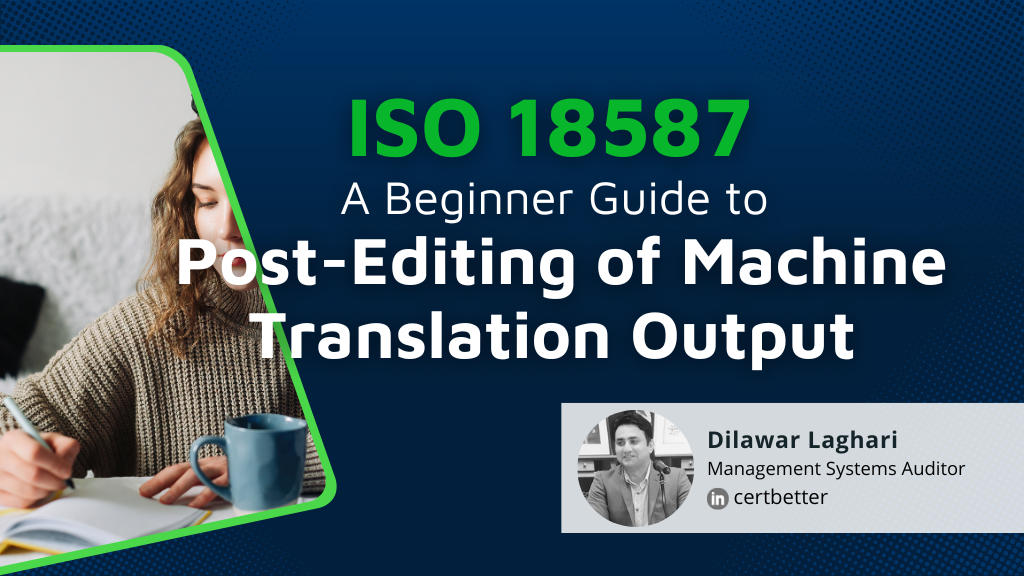
That’s where ISO 18587 steps in. This internationally recognised standard provides a structured framework for human post-editing of machine translation output, ensuring that the final text combines the speed of technology with the accuracy and trustworthiness of professional translation.
“Machine translation gets you speed, but ISO 18587 ensures you don’t sacrifice quality, compliance, and credibility along the way.”
Helpful Read: Beginner’s Guide to ISO 17100: What It Means for Translation Quality
1. Why ISO 18587 Matters for Your Business
Translation isn’t just about words. It's about meaning, trust, and compliance. As businesses expand globally, the demand for faster, cheaper translation grows. Machine translation (MT) tools like Google Translate or DeepL make it easy to scale, but without a structured review process, the risks far outweigh the savings.
ISO 18587 provides a business case for organisations that want both speed and accuracy. Here’s why it matters:
1.1 Rising Reliance on Machine Translation
From e-commerce platforms to legal firms and healthcare providers, MT has become part of daily operations. The challenge is that while MT delivers speed, it doesn’t guarantee accuracy.
ISO 18587 introduces the human post-editing step to bring translations up to professional standards.
1.2 Regulatory and Reputational Risks
Inaccurate translations can lead to legal disputes, compliance violations, or even patient harm in industries like healthcare.
ISO 18587 helps mitigate these risks by requiring human post-editors to check accuracy, style, and terminology, ensuring the final output is reliable and compliant.
1.3 Meeting Client Demands for Quality
Many clients now expect their translation providers to demonstrate adherence to recognised standards. ISO 18587 certification signals to customers that your workflows are audited, structured, and consistently deliver quality.
1.4 Competitive Advantage for Translation Service Providers (TSPs)
In a crowded translation market, ISO 18587 acts as a trust badge. It shows that your organisation doesn’t just use MT but has the systems and expertise to deliver accurate, human-quality translations, faster and at scale.
1.5 Alignment with ISO 17100
ISO 17100 already sets the global benchmark for human translation services. ISO 18587 builds on that foundation, addressing the unique challenges of MT output. Together, they provide a complete quality framework for modern translation workflows.





2. Do You Need ISO 18587? A Practical Checklist
Machine translation (MT) is no longer just an optional tool, it’s everywhere. From e-commerce descriptions to patient instructions, organisations use MT to save time and costs.
But not every use case is safe to rely on without proper human post-editing. That’s where ISO 18587 helps you decide if formal compliance is necessary. Here’s a practical self-test:
2.1 Do you use machine translation for contracts, manuals, product information, or customer-facing text?
These are high-visibility, high-risk documents. If a contract clause is mistranslated, it could lead to legal disputes. If a user manual is inaccurate, it could cause product misuse. ISO 18587 ensures that human post-editors catch these issues before they reach your customers.
2.2 Are your translations going into regulated industries (healthcare, pharma, legal, finance)?
In these sectors, mistranslations aren’t just embarrassing, they can be dangerous or illegal. Imagine dosage instructions translated incorrectly, or financial disclosures losing accuracy in another language. ISO 18587 provides a framework where qualified professionals validate every word against industry requirements.
2.3 Do you have in-house translators or outsource to agencies but need a consistent quality benchmark?
Without a standard, every translator or agency might handle MT output differently. ISO 18587 gives you a clear, measurable benchmark. Whether your work is done in-house or outsourced, you’ll know the post-editing process meets internationally recognised requirements.
2.4 Are clients asking about ISO 17100 or ISO 18587 certification?
In global tenders, especially government and corporate contracts, certification often decides who wins the deal. Having ISO 18587 on your profile signals that your organisation has reliable processes and trained post-editors, a big advantage in competitive bidding.
2.5 Have you experienced issues with readability, accuracy, or style in MT output?
If your customers ever said, “This translation doesn’t make sense,” that’s a warning sign. Awkward translations not only frustrate users but also damage trust in your brand. ISO 18587 fixes this by requiring full post-editing to human-quality standards, so translations are clear, accurate, and professional.
If you answered yes to even two of these questions, ISO 18587 is not just relevant. I’s a smart investment in risk reduction, customer satisfaction, and market credibility.
3. Key Components of ISO 18587: How It Works in Practice
At its heart, ISO 18587 is about transforming raw machine translation into human-quality text. It doesn’t leave accuracy to chance; instead, it introduces a structured process where trained post-editors refine the output until it meets professional standards.
Here’s how the main elements of the standard come together in practice.
3.1 Full vs. Light Post-Editing
The standard makes a clear distinction between full and light post-editing. Full post-editing aims to produce a translation that reads as if it were done by a professional human translator. It covers grammar, style, terminology, and accuracy with no loss or addition of meaning.
Light post-editing, on the other hand, only ensures basic comprehensibility. It may leave awkward phrasing or stylistic inconsistencies untouched. Since light editing doesn’t guarantee professional quality, ISO 18587 only applies to full post-editing.
3.2 Pre-Production: Setting the Stage
Before editing begins, organisations need to check whether machine translation plus post-editing is even appropriate for the text in question. Technical manuals or product documentation may be good candidates, while highly creative marketing copy often is not.
In some cases, teams pre-edit the source text to simplify long sentences, remove ambiguities, or harmonise terminology. This step improves the machine output and makes the post-editing process faster and more effective.
3.3 Production: The Post-Editing Process
This is the core of ISO 18587. Human post-editors take the machine output and refine it into a final text that is accurate, fluent, and reliable. They correct grammar, spelling, punctuation, and formatting, ensure that no information is added or missing, and polish the text so it reads naturally in the target language.
They also apply any client-specific style guides or glossaries to ensure consistency. The end goal is a piece of content that is indistinguishable from a translation done entirely by a professional human translator.
3.4 Post-Production: Quality Verification
Once the editing is complete, the standard requires a final round of checks. This includes verifying formatting and layout, confirming that the client’s requirements have been met, and reviewing the work against project specifications. An often overlooked but valuable aspect of this stage is the feedback loop.
Post-editors are encouraged to document recurring machine translation errors so that the MT engine can be retrained and improved over time. In this way, ISO 18587 not only ensures quality in the present but also drives continuous improvement for the future.
3.5 Competence of Post-Editors
ISO 18587 places strong emphasis on the qualifications of the people doing the post-editing. Editors must meet the same competence levels as professional translators under ISO 17100. This means they should hold a relevant degree in translation or linguistics, or alternatively, have a degree in another field with at least two years of full-time experience, or five years of practical translation or post-editing experience.
Beyond education, they need mastery of CAT tools, familiarity with machine translation systems, strong research skills, and a deep understanding of the client’s industry. In short, ISO 18587 recognises that technology alone cannot guarantee quality. It must be paired with skilled human expertise.
Recommended Read: ISO 20252 A Practical Guide to Market, Opinion and Social Research
4. Steps to Align with ISO 18587: A Clear Roadmap
Adopting ISO 18587 isn’t about replacing your translation process overnight. It's about gradually building a structured system that balances the speed of machine translation with the reliability of human expertise.
If you’re considering certification, here’s a practical roadmap to guide the journey.
Step 1: Assess Demand
The first step is to evaluate whether machine translation plus post-editing makes sense for your business. Some organisations benefit immediately, especially those managing large volumes of technical documents, legal contracts, or user manuals.
Others may find that certain types of content, like creative marketing copy, are better left to human translators. Understanding where ISO 18587 fits into your workflow helps avoid wasted effort and ensures the standard delivers value.
Step 2: Train Post-Editors
ISO 18587 requires post-editors to meet strict competence criteria. This means investing in training so that your team can work confidently with CAT tools, recognise common machine translation errors, and apply client-specific style guides.
Some companies choose to certify their in-house team, while others rely on external translation partners who are already trained to the standard. Either way, skilled editors are the backbone of successful implementation.
Step 3: Develop Workflows
Once your team is trained, the next step is to design structured workflows that cover pre-production, production, and post-production. This includes deciding how source texts are prepared, how post-editors will handle output, and how quality will be verified before delivery.
A well-defined workflow not only supports certification but also creates consistency across projects, no matter which editor or client is involved.
Step 4: Set Client Expectations
Clients often assume that machine translation plus post-editing is always faster and cheaper. While it can save time, the reality is that full post-editing still requires significant human input. Being transparent about what ISO 18587 covers and clarifying the difference between light and full post-editing, helps avoid misunderstandings.
By setting clear expectations, you ensure that clients appreciate both the efficiency and the quality guarantees that come with certification.
Step 5: Audit and Certify
The final stage is to formalise your efforts by working with an accredited certification body. The audit process will review your workflows, staff qualifications, and quality controls against the ISO 18587 requirements.
For many organisations, this step not only results in certification but also highlights opportunities to refine processes even further. Certification then becomes more than a badge, it’s a trust signal to clients and a foundation for long-term credibility in global markets.
5. Challenges in Implementing ISO 18587
Like any quality standard, ISO 18587 brings both opportunities and challenges. While it creates a clear path for delivering reliable post-edited translations, organisations often face hurdles when putting the requirements into practice.
Understanding these pitfalls early can save time, money, and frustration.
5.1 Over-Reliance on Raw Machine Translation
One of the most common mistakes is assuming that machine translation alone is “good enough.” Even the best engines make errors, especially with technical terms, idiomatic expressions, or context-sensitive phrases.
Companies that skip or reduce the human post-editing step risk delivering content that confuses readers, fails audits, or damages credibility. ISO 18587 reminds us that the machine is a tool, not a replacement for human judgment.
5.2 Assuming Light Post-Editing Is Acceptable for Regulated Industries
Some organisations try to cut corners by using light post-editing for highly sensitive documents such as medical instructions or legal contracts. This approach can be dangerous.
Light editing only ensures basic comprehensibility and may leave serious errors uncorrected. ISO 18587 is clear: only full post-editing produces text that can be trusted in regulated environments.
5.3 Using Unqualified Editors
Another pitfall is assigning MT post-editing to staff who lack the necessary training or experience. Just being bilingual does not make someone a qualified post-editor.
ISO 18587 requires professional-level competence, often with formal qualifications or years of practice. Without this, errors slip through, and the quality assurance promise of the standard is undermined.
5.4 Lack of Client Education About Effort vs. Cost
Clients sometimes expect post-editing to be as quick and cheap as running text through a translation app. When they don’t understand the human effort required to polish the output to professional standards, they may push for unrealistic deadlines or pricing.
Providers implementing ISO 18587 need to invest time in client education, explaining the difference between raw MT, light editing, and full post-editing. Clear communication avoids disappointment and builds trust.
5.5 Failure to Keep Workflows Updated as Technology Evolves
Machine translation systems are constantly improving, and so are the tools used by post-editors. What worked last year may not be the most efficient or accurate approach today.
Organisations that treat ISO 18587 as a one-time setup risk falling behind. To get the full benefit, workflows should be regularly reviewed and adapted to take advantage of new CAT tools, MT engine updates, and client needs.
6. Additional Considerations for Long-Term Success
Achieving ISO 18587 certification is not just about meeting technical requirements. Long-term success depends on leadership, culture, and integration with broader quality systems.
These softer but critical elements often determine whether the standard truly strengthens an organisation or becomes just another box to tick.
6.1 Leadership Commitment
A strong commitment from leadership is essential. When executives prioritise post-editing as part of the company’s quality strategy, it sets the tone for the entire organisation.
Budget, staffing, and technology decisions reflect that priority. Without leadership buy-in, post-editing risks being treated as an afterthought rather than a strategic advantage.
6.2 Training and Staff Competency
The best workflows mean little if post-editors aren’t equipped with the right skills. Regular training is vital, not only on CAT tools and machine translation engines but also on recognising error patterns and applying client-specific terminology.
Companies that invest in continuous training build a workforce that can adapt to new technologies and changing client demands.
6.3 Integration with Broader Quality Systems
ISO 18587 does not stand alone. It aligns closely with ISO 17100 for translation services and can be integrated into wider frameworks like ISO 9001 for quality management.
For organisations in regulated industries, linking ISO 18587 with standards such as ISO 13485 (medical devices) or ISO 14971 (risk management) creates a unified system that covers both translation and compliance.
6.4 Future Outlook
ISO 18587 was first published in 2017 and is currently under review, with a revised version expected by 2026. The update is likely to place more emphasis on client risk assessment and align even more closely with ISO 17100.
Forward-looking organisations should treat this not as a disruption but as an opportunity to refine their processes and stay ahead of client expectations.
7. FAQs: Common Questions About ISO 18587
What’s the difference between ISO 17100 and ISO 18587?ISO 17100 covers all human translation services, while ISO 18587 is specific to post-editing of machine translation output. In practice, many organisations use them together for a complete quality framework.
Can freelancers get certified to ISO 18587?Certification is issued to organisations, not individuals. However, freelancers can align their practices with the standard, which makes them more attractive to agencies and clients seeking ISO-compliant services.
What’s the difference between light and full post-editing?Light post-editing aims only for basic readability. Full post-editing ensures the text reads like a professional human translation. ISO 18587 applies only to full post-editing.
Does ISO 18587 guarantee perfect translations?No standard can guarantee perfection. What ISO 18587 ensures is a structured process, qualified editors, and consistent quality that clients can trust.
How long does certification take?Timelines vary depending on the size of the organisation and how mature its workflows are. Most translation service providers take between three and six months to prepare, implement, and complete the certification audit.
Will the 2026 revision replace the 2017 version?Yes, once the new edition is published. However, current certifications remain valid until transition deadlines are set, giving organisations time to adapt.
8. Where to Download ISO 18587 PDF?
To make sure you’re working with the most accurate and up-to-date version of ISO 18587, always obtain the standard from official sources. The safest options are the ISO Store itself or your national standards body, such as BSI in the UK, ANSI in the US, or Standards Australia.
Avoid free or unofficial PDFs you might find online. They are often outdated, incomplete, or unreliable and regulators or clients may reject them.
9. Conclusion: Why ISO 18587 Is Essential for Modern Translation
In today’s global marketplace, speed and efficiency often tempt businesses to lean heavily on machine translation. While MT has its place, relying on it alone can create serious risks from compliance failures to damaged customer trust. ISO 18587 bridges this gap by ensuring that every machine-translated text is reviewed, refined, and polished by qualified human editors.
For businesses, the standard means reduced risks, smoother regulatory compliance, and greater confidence when entering new markets. For translation providers, it’s a powerful way to demonstrate professionalism, stand out in a crowded industry, and deliver consistent quality at scale.
By adopting ISO 18587, you’re not just editing words, you’re safeguarding meaning, protecting your reputation, and building trust across every market you serve. In a world where language is the link between business and people, that trust is invaluable.