In 14 years working in HSEQ, I've seen hundreds of workplaces and personally managed a few for physical safety such as slips, trips, chemical hazards, machinery guards. But the injury nobody saw coming? That supervisor who had a breakdown after 18 months of impossible deadlines. That amazing customer service officer taking more leave because of stress-related concerns. That young apprentice who wants to quit after relentless bullying at the workplace.
On this page
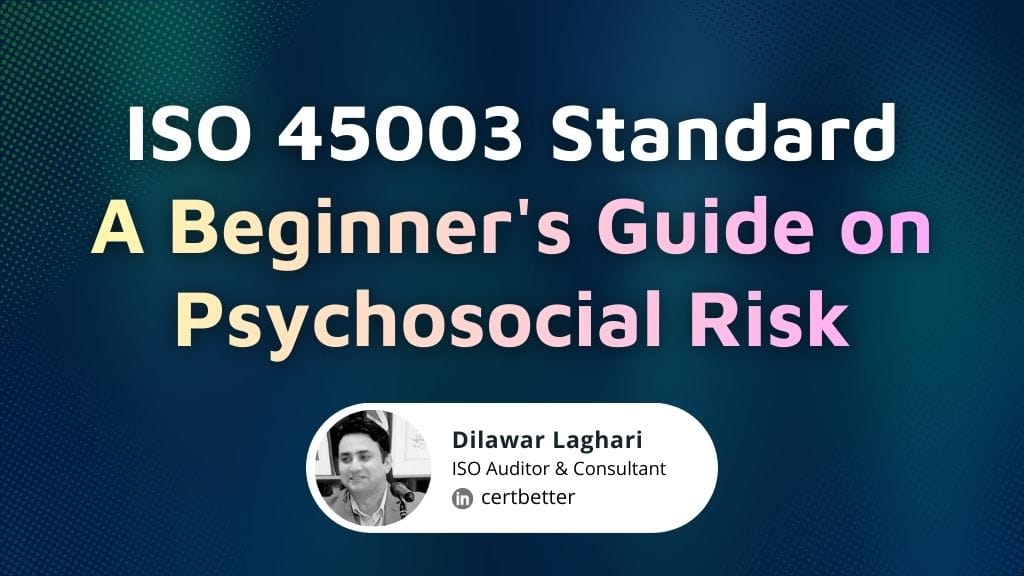
ISO 45003, published June 2021, is the world's first global standard specifically for managing mental health and psychological safety at work. Here's what it actually means in plain language.
What Is ISO 45003?
ISO 45003 is a guidance standard for managing psychosocial risks in the workplace.
Full name: ISO 45003:2021 Occupational health and safety management — Psychological health and safety at work — Guidelines for managing psychosocial risks.
Three critical things to understand:
1. It's guidance, not certifiable You can't get ISO 45003 certified like you can with ISO 45001 or ISO 9001. It's a guidebook showing how to manage psychological safety, not a certification standard with pass/fail audits.
2. Works with ISO 45001 ISO 45003 is designed to slot into ISO 45001 (the OHS management system standard). If you already have 45001, ISO 45003 shows you how to properly address the mental health part. If you don't have 45001, you can still use ISO 45003 principles.
3. Applicable to every workplace Doesn't matter if you're 5 staff or 5,000, office or factory, profit or non-profit. Psychosocial risks exist everywhere.





What Are Psychosocial Hazards? (Simple Explanation)
Psychosocial hazard = anything at work that could harm someone's mental health.
Not the physical stuff like forklifts or chemicals. The work design, workload, relationships, and environment factors that create psychological stress.
Quick examples:
High job demands: Accountant expected to process 50 invoices per day when realistic capacity is 30. Constant rushing, no lunch breaks, taking work home every night.
Low job control: Call centre worker must follow exact script, can't adapt to customer needs, manager monitors every call. No autonomy, feels like robot.
Poor support: New nurse on night shift, no senior nurse available, expected to manage emergency situations alone with inadequate training.
Bullying: Apprentice electrician subjected to daily verbal abuse from supervisor, excluded from team meetings, given impossible tasks then ridiculed for failing.
Role ambiguity: Marketing coordinator unsure whether they report to sales manager or marketing director, receives conflicting instructions, unclear job expectations.
Traumatic events: Paramedic repeatedly exposed to fatal accidents, no debriefing support, expected to "toughen up."
Isolation: Remote farm worker alone for weeks, no contact with supervisor or colleagues, radio contact only.
See the pattern? These aren't about personal weakness. They're work design issues that create psychological harm.
The 14 Main Psychosocial Hazards
ISO 45003 groups psychosocial hazards into categories. Australian regulators SafeWork identify 14-17 common ones:
1. Job demands - Workload too high or too low, time pressure, emotional demands Example: Aged care nurse responsible for 30 residents when safe ratio is 15
2. Low job control - No say in how/when work is done Example: Factory worker can't adjust production line speed even when equipment malfunctioning
3. Poor support - Inadequate help from supervisors or colleagues Example: Junior lawyer working on complex case, senior partner unavailable, no guidance
4. Lack of role clarity - Unclear responsibilities or conflicting expectations Example: Project manager told to deliver fast, cheap, and high-quality—pick all three
5. Poor change management - Restructures, technology changes poorly communicated Example: Staff learn from news article that office closing, no prior consultation
6. Inadequate reward/recognition - Effort not acknowledged Example: Sales rep exceeds targets 3 years running, no pay rise, no recognition
7. Poor organisational justice - Unfair treatment, favouritism, unclear processes Example: Promotion given to manager's friend despite better-qualified internal candidates
8. Traumatic events - Exposure to violence, death, distressing material Example: Police officer attends multiple child fatality scenes without psychological support
9. Remote/isolated work - Working alone, difficult to get help Example: Security guard overnight shift in empty building, nearest colleague 20km away
10. Poor physical environment - Noise, temperature, overcrowding Example: Open-plan office with 80 people, constant noise, no quiet spaces
11. Violence and aggression - Physical or verbal attacks Example: Hospital emergency department nurse threatened by intoxicated patient
12. Bullying - Repeated unreasonable behaviour Example: Team leader publicly humiliates worker for mistakes in front of colleagues
13. Harassment - Sexual, racial, or other discriminatory behaviour Example: Female apprentice subjected to sexual comments from tradies daily
14. Conflict - Poor workplace relationships Example: Two department managers in constant dispute, staff caught in middle
Australian workplaces must manage all these under WHS laws since 2022.
Why ISO 45003 Matters
Legal obligation (Australia): All Australian states including Victoria adopted model WHS regulations in 2022-2024 requiring employers to identify and control psychosocial risks. Victoria introduced Psychological Health Regulations effective 1 December 2025.
Managing psychosocial risks isn't optional—it's law.
Business impact:
- Mental health claims now 12% of all serious WorkCover claims (Safe Work Australia 2025)
- Median time off work for psychological injury: 5 times longer than physical injuries
- Mental health claims among costliest workplace injuries
- Work-related mental injuries represent 18% of new claims in Victoria 2023-24
Real costs: When I audit businesses with poor psychosocial risk management, I see:
- High staff turnover (recruitment costs $15K-$40K per position)
- Increased absenteeism (average 9.5 days lost per psychological claim)
- Reduced productivity (stressed workers make more errors)
- WorkCover premiums increase
- Potential prosecution (Victorian employer fined $380K in 2023 for failing to manage psychosocial risks)
How ISO 45003 Helps
ISO 45003 provides structured approach to managing psychological safety using same risk management process as physical safety:
1. Identify psychosocial hazards Survey staff, review incidents, analyse work design, consult workers about what causes stress.
Example: Retail manager surveys team, discovers top stressors are unpredictable rosters (issued 2 days before) and inadequate staff during peak times.
2. Assess risks Determine likelihood and severity of harm from identified hazards.
Example: Unpredictable rosters—high likelihood (affects all 15 staff), moderate severity (causes stress, impacts family life, some staff considering quitting). High risk.
3. Control risks Eliminate hazard where possible. Where not possible, minimise risk through controls.
Example: Implement 2-week advance roster, minimum 3 staff during peak hours, option to swap shifts via app. Eliminates unpredictability hazard.
4. Monitor and review Check controls are working, gather feedback, adjust as needed.
Example: After 3 months, survey shows roster stress reduced from 8/10 to 3/10. Staff turnover decreased. Control effective.
Practical Examples from Real Audits
Example 1: Construction company - High job demands
Hazard: Site supervisors managing 3 projects simultaneously, working 60-hour weeks, stressed and exhausted.
Control: Hired additional supervisor, redistributed projects so each supervisor manages 1-2 sites maximum. Overtime monitored, no supervisor works more than 48 hours.
Result: Supervisor stress reduced, quality improved, safety incidents decreased.
Example 2: Accounting firm - Poor support
Hazard: Graduate accountants left alone with complex tax returns, senior accountants too busy to help.
Control: Allocated each graduate a mentor (15-minute daily check-in), weekly technical training sessions, simplified work allocation system.
Result: Graduates report feeling supported, fewer errors, retention improved.
Example 3: Healthcare facility - Traumatic events
Hazard: Nurses exposed to patient deaths, family distress, no psychological support.
Control: Implemented Critical Incident Stress Management program, peer support network, access to confidential counselling, mandatory debriefing after traumatic events.
Result: Staff feel supported, psychological injury claims reduced.
Example 4: Call centre - Low job control
Hazard: Agents must follow rigid script, can't use judgement, manager monitors every conversation.
Control: Provided agents flexibility to adapt script to customer needs, reduced monitoring to quality sampling (10% of calls), trusted agents' judgement.
Result: Job satisfaction increased, customer satisfaction improved, turnover reduced.
Getting Started with ISO 45003 (Beginner Steps)
Step 1: Get management commitment CEO/directors must visibly support psychological safety. Not just words—actual resources and priority.
Step 2: Consult workers Anonymous surveys, focus groups, suggestion boxes. Ask "What causes you stress at work?"
Step 3: Identify your top 3-5 psychosocial hazards Don't try to fix everything at once. What are the biggest issues affecting most workers?
Step 4: Assess the risks For each hazard: How many workers affected? How severe? How often?
Step 5: Implement controls using hierarchy
- Eliminate hazard (best): Remove the source. Example: Stop understaffing—hire more people.
- Redesign work: Change how work is done. Example: Rotate high-stress tasks among team.
- Administrative controls: Policies, training, procedures. Example: Bullying policy with clear reporting process.
- Support services: Counselling, EAP, peer support (least effective on its own).
Step 6: Monitor Re-survey in 6 months. Are controls working? What needs adjusting?
Australian Legal Requirements
Commonwealth + most states (NSW, QLD, WA, SA, TAS, NT, ACT): Work Health and Safety Regulation requires employers to:
- Identify psychosocial hazards
- Assess risks
- Implement controls using hierarchy of controls
- Review controls regularly
Victoria (from 1 December 2025): Occupational Health and Safety (Psychological Health) Regulations 2025 require:
- Identify and control psychosocial hazards
- Review and revise controls in certain circumstances
Penalties for non-compliance:
- Category 1 offence (death/serious injury): Up to $3.85M (company) or $765K + 5 years jail (individual)
- Category 2 offence (exposure to risk): Up to $770K (company)
- Category 3 offence (failure to comply): Up to $385K (company)
Common Mistakes I See
Mistake 1: Treating as individual problem "Sarah is stressed.. she should use EAP counselling." Reality: If 10 Sarahs are stressed, it's work design problem, not individual weakness.
Mistake 2: Survey without action Conduct staff survey, identify issues, then do nothing. This makes it worse—workers feel unheard.
Mistake 3: Focusing only on individual resilience "Let's run a mindfulness workshop!" Resilience training doesn't fix impossible workloads, bullying supervisors, or unclear roles.
Mistake 4: Treating as HR issue, not safety issue Psychosocial risk is WHS compliance matter. HSE manager should be involved, not just HR.
Mistake 5: One-size-fits-all approach Office workers and field workers have different psychosocial hazards. Tailor controls to actual risks.
Who Can Help
Internal resources:
- WHS/HSE manager (should lead psychosocial risk management)
- HR team (support with policies, training)
- Health and safety representatives (worker consultation)
- Senior management (commitment and resources)
External help:
- ISO 45003 consultants - Help implement psychosocial risk management framework
- Organisational psychologists - Specialist expertise in workplace mental health
- WHS consultants - Integrate psychosocial risk into existing OHS system
- EAP providers - Counselling support services
How Psychosocial Risk Consultants Can Help
If you need consultant to help implement ISO 45003 psychosocial risk management, CertBetter can help you find and compare.
CertBetter is a global directory of ISO 45003 consultants where you can:
Search consultants with ISO 45003 and psychosocial risk management expertise. Filter by location, experience, industry specialisation.
View verified credentials - Background-checked consultants with confirmed qualifications (organisational psychology, WHS, ISO 45001 Lead Implementer), insurance verified, client references validated.
Compare experience - See consultant specialisations (healthcare, construction, manufacturing), number of psychosocial risk projects completed, client reviews.
Request quotes - Send RFQ to multiple consultants, receive proposals directly, compare approaches and costs.
Read verified reviews - Feedback from businesses who've used these consultants for psychosocial risk management.
Visit certbetter.com, search ISO 45003 or psychosocial risk consultants, compare qualified professionals, request quotes from those matching your needs.
Platform saves you the background-checking work—consultants are pre-verified so you compare qualified specialists only.
Bottom Line
ISO 45003 isn't complicated. It's applying same risk management thinking to psychological safety that we've used for physical safety for decades.
The basic principle: Work shouldn't make people sick—physically or mentally.
Identify what's causing psychological harm in your workplace (workload, bullying, unclear roles, poor support, isolation, whatever it is), assess the risk, implement controls to eliminate or minimise it, monitor whether controls are working.
Start simple:
- Ask workers what causes them stress
- Pick your top 3 issues
- Fix the work design problems creating those issues
- Check it's working
You don't need to be psychologist. You need to be willing to listen to workers and change how work is organised when it's harming people.
That's ISO 45003 in practice.