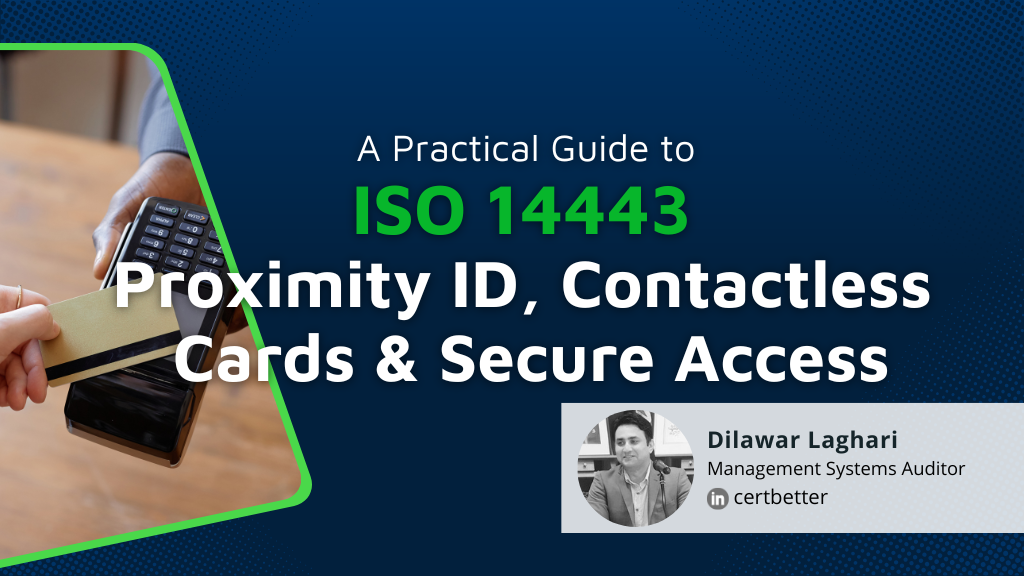
You’re at an airport, rushing to catch your flight. Instead of fumbling with papers or waiting in long queues, you simply tap your passport at a gate and walk through. Or maybe it’s your morning commute, you breeze past the metro turnstile with a quick tap of your card. Even at work, a single badge gives you access to secure areas without delays.
On this page
Now imagine if those systems weren’t connected by a universal standard. One company’s card wouldn’t work in another’s reader. Fraudulent copies could easily sneak into circulation. Banks, governments, and transport systems would all be vulnerable to chaos.
That’s where ISO 14443 comes in. It’s the internationally recognised framework for contactless integrated circuit cards (proximity cards). By setting clear rules on how these cards communicate, authenticate, and transfer data, ISO 14443 makes tap-and-go technology secure, fast, and reliable. No matter where in the world you are.
“From your daily commute to your passport check, ISO 14443 is the invisible standard making modern life possible.”
In this guide, we’ll break down why ISO 14443 matters, who needs it, what it covers, and how you can align with it to strengthen security and trust in your organisation.
Recommended Read: The Essential Guide to ISO 27018 Protecting Personally Identifiable Information in the Cloud
1. Why Does ISO 14443 Matter?
Contactless cards aren’t just about convenience; they’re about trust and security. Behind every quick tap at a turnstile, payment terminal, or passport gate, there’s a system that needs to be fast, reliable, and nearly impossible to trick. ISO 14443 provides that backbone.
1.1 Global Compatibility
Without ISO 14443, every card manufacturer and reader vendor would create their own system and they wouldn’t talk to each other. By setting global rules, the standard ensures your card works seamlessly across industries and countries. For example, a bank card issued in France can still be read securely by an ATM or payment terminal in Australia.
1.2 Data Security for Sensitive Transactions
Whether it’s your salary being spent through a contactless debit card or biometric data stored on your e-passport, ISO 14443 provides the protocols that keep information safe. It defines authentication processes, encryption methods, and data transfer requirements so that hackers and counterfeiters face strong barriers.
1.3 Fraud Prevention
Counterfeit access badges or cloned MetroCards are a real threat. By enforcing strong communication protocols, ISO 14443 reduces the risk of fraud. That’s why it’s widely adopted in industries where unauthorised access could lead to financial loss or safety hazards.
1.4 Regulatory Recognition
Governments and financial regulators worldwide reference ISO 14443 when setting compliance requirements. For example, ICAO (International Civil Aviation Organization) mandates it in e-passport systems, while banking systems use it as the base for EMV payment cards.
1.5 Building Trust with Users and Partners
Every tap is a trust transaction. Businesses, governments, and service providers that follow ISO 14443 send a strong message: “Your data and identity are secure with us.” That credibility isn’t just good for compliance — it’s good for business reputation.





2. Do You Need ISO 14443? (A Practical Checklist)
Not every organisation needs to implement ISO 14443 directly, but if you’re handling identity, payments, or secure access, chances are it already affects you. Here’s a simple self-test:
2.1 Do you issue or manage employee ID badges or access systems?
If your staff use proximity cards to enter buildings, ISO 14443 helps ensure those cards can’t be easily cloned or bypassed.
2.2 Are you in transport, banking, or e-passport programs?
Public transport operators, financial institutions, and governments rely heavily on this standard. If you operate in these sectors, compliance is not optional, it’s essential.
2.3 Do your partners or regulators require ISO-compliant proximity cards?
Many supply chain contracts, government tenders, and financial agreements explicitly require ISO 14443-based systems.
2.4 Have you faced compatibility problems with card readers from different vendors?
This is a classic pain point. ISO 14443 eliminates the guesswork by ensuring interoperability across different devices and manufacturers.
2.5 Are you worried about fraud, cloning, or weak security protocols?
If counterfeit cards or unauthorised access have ever been a concern, this standard is the proven way to strengthen your defences.
3. Key Components of ISO 14443: Making Proximity Cards Work
ISO 14443 might sound technical, but at its heart it’s about making sure cards and readers can “speak the same language” safely and reliably. The standard is broken into four main parts, each covering a different piece of the puzzle.
3.1 Physical Characteristics
Defines the card’s size, thickness, and durability. Most cards follow the familiar credit card format (ID-1), but this part ensures that no matter where you get your card, it fits into existing systems and lasts through daily use.
3.2 Radio Frequency Power & Signal Interface
Explains how the card and reader communicate wirelessly at 13.56 MHz. This section ensures that when you tap your card, the reader sends just the right amount of power and interprets the signals correctly.
3.3 Initialization & Anticollision
What happens if multiple cards are near the reader at the same time like when you have a bank card and metro card in the same wallet? This part ensures the system can “pick” the right card without errors, avoiding clashes and false readings.
3.4 Transmission Protocol
Outlines how secure, reliable data transfer happens between the card and the reader. This includes encryption, authentication steps, and error handling, the invisible security layer that protects your personal or financial data.
3.5 Card Types: A vs B
- Type A → Used widely in systems like MIFARE (transport cards, access badges) and EMV payment cards.
- Type B → Preferred in government-issued IDs and e-passports, where higher security and interoperability are critical.
Together, these components form the blueprint for tap-and-go technology, ensuring it works the same way as security, anywhere in the world.
4. Steps to Align with ISO 14443: A Practical Roadmap
Knowing what ISO 14443 covers is one thing. Putting it into practice is another. Here’s a simple roadmap you can follow whether you’re launching a new system or upgrading an existing one.
Step 1: Identify Your Application
Start by clarifying how you’ll use proximity cards. Are they for public transport, banking transactions, employee access, or government IDs? Each application has different risk levels and performance requirements.
Step 2: Choose Type A or Type B
- Type A → Often chosen for commercial uses like metro cards, workplace access, or retail payments.
- Type B → More common in high-security environments like passports and national identity systems.
Your choice will depend on your security priorities and the systems you need to integrate with.
Step 3: Partner with ISO-Compliant Vendors
Not all providers follow the standard strictly. Work only with manufacturers and system integrators who can demonstrate compliance. Ask for documentation and references — cutting corners here could expose you to fraud or system breakdowns.
Step 4: Test Cards with Readers and Backend Systems
Before rolling out at scale, run pilot tests. Make sure your cards can communicate reliably with your readers and that data flows correctly into your backend systems (HR software, payment platforms, transport ticketing).
Step 5: Train Staff and Users
Technology only works if people use it properly. Provide training for staff who manage the systems, and create simple guidance for end-users on how to handle cards safely (e.g., avoiding physical damage, reporting lost cards quickly).
Step 6: Review and Update Regularly
Cybersecurity threats evolve. Schedule periodic reviews of your card systems, update reader firmware, and refresh security protocols. Treat ISO 14443 compliance as an ongoing commitment, not a one-time project.
Helpful Read: ISO 14721 A Comprehensive Guide to Digital Preservation and Long-Term Archiving
5. Challenges in Implementing ISO 14443 (and How to Overcome Them)
Like any technology standard, ISO 14443 comes with real-world hurdles. Understanding these challenges upfront will save time, money, and frustration.
5.1 Fraud and Cloning Risks
Older generations of contactless cards are vulnerable to cloning or unauthorised duplication. If your organisation is still using outdated card technology, you may be at risk.
Tip: Always source cards from trusted ISO-compliant vendors, and update systems to use the latest security protocols.
5.2 Type A vs Type B Compatibility
Not all systems support both card types. Choosing one without checking your long-term requirements could cause integration headaches.
Tip: Map out all the environments where your cards will be used, from office doors to international airports before committing to a single type.
5.3 Outdated Reader Firmware
Card readers are only as secure as their software. If the firmware isn’t updated regularly, even the best cards can fail or become vulnerable to attacks.
Tip: Establish a schedule for updates and security patches, and work with suppliers who provide long-term support.
5.4 User Awareness
Many security breaches happen because users don’t understand how to protect their cards. For example, employees may carry multiple proximity cards in the same wallet, causing reader confusion.
Tip: Provide clear user training and guidelines. Small habits, like storing cards separately or reporting lost cards quickly, go a long way.
5.5 Cost Considerations
High-security cards and systems can be expensive, especially at the start. Some organisations delay upgrades, exposing themselves to higher risks.
Tip: Think of ISO 14443 as an investment in trust. A single security incident could cost far more than a compliant system.
6. Additional Considerations for ISO 14443 Success
Getting the technical side right is only half the journey. To truly benefit from ISO 14443, organisations need to focus on leadership, culture, and integration with broader security practices.
6.1 Leadership Commitment
When executives see card security as part of the organisation’s overall risk management strategy, it receives the attention and resources it deserves. A board-level commitment ensures budgets are approved, updates are prioritised, and compliance stays on track.
6.2 Training and Competency
Your system is only as strong as the people who manage and use it. Staff must know how to configure, monitor, and troubleshoot readers. End-users (like employees or commuters) need clear guidance on how to use and safeguard their cards. Consistent training reduces human error, the biggest vulnerability in most systems.
6.3 Integration with Cybersecurity Policies
Contactless cards are part of a bigger security picture. Integrating ISO 14443 into your cybersecurity strategy, including encryption, firewalls, and monitoring, helps protect against both physical and digital threats.
6.4 Environmental and Safety Considerations
In high-traffic areas like airports or metro stations, card readers must withstand heavy use and environmental stress. Factoring in durability and safety compliance ensures systems remain reliable long-term.
6.5 Future-Proofing Your Systems
Technology is evolving quickly. Many organisations are already moving toward mobile NFC solutions and biometric-linked IDs. By aligning with ISO 14443 today, you create a strong foundation for adopting these technologies tomorrow without major redesigns.
7. FAQs: Common Questions About ISO 14443
1. What is the difference between ISO 14443 Type A and Type B?Both are defined under the standard but differ in how they communicate with readers. Type A is widely used in transport cards and EMV payment systems (like contactless credit cards), while Type B is often chosen for government IDs and e-passports due to its higher interoperability in global systems.
2. Is ISO 14443 mandatory for e-passports?Yes. The International Civil Aviation Organization (ICAO) requires e-passports to use ISO 14443 for secure contactless data exchange.
3. What’s the maximum range of ISO 14443 cards?The cards are designed to work within about 10 cm of the reader. Actual range may vary depending on the card antenna, reader power, and environment.
4. How does ISO 14443 protect against fraud?The standard defines authentication steps, encryption protocols, and anticollision measures that make it much harder to clone or counterfeit cards. Combined with updated firmware and trusted suppliers, it significantly reduces fraud risks.
5. Can ISO 14443 cards work internationally?Yes. One of the main benefits of ISO 14443 is global interoperability. A compliant card can be used across systems worldwide, provided the application (e.g., transport, payment, ID) is supported.
6. How is ISO 14443 different from ISO 15693?ISO 14443 defines proximity cards with short range (up to 10 cm), designed for secure transactions like payments and IDs. ISO 15693 defines vicinity cards, which work at longer ranges (up to 1 metre) but typically offer lower security, useful for applications like libraries or asset tracking.
Where to Download ISO 14443 PDF?
To ensure you’re using the most accurate and current version of ISO 14443, always purchase it from official sources such as the ISO Store or your national standards body (e.g., BSI in the UK, ANSI in the US, Standards Australia). Avoid free or unofficial PDFs circulating online, as they are often outdated, incomplete, or unreliable and may not be accepted by regulators or auditors.
Conclusion: Why ISO 14443 Matters in Everyday Life
Every time you tap a card at a train gate, buy coffee with a contactless payment, or present your passport at an airport, you’re relying on a system built on trust. That trust doesn’t happen by accident; it’s powered by international standards like ISO 14443.
This standard ensures proximity cards work safely, quickly, and consistently across industries and borders. For businesses and governments, it means reduced fraud, smoother operations, and global interoperability. For end-users, it means confidence that their identity, data, and transactions are protected.
In short, ISO 14443 is more than a technical specification. It’s a quiet enabler of modern life, making tap-and-go technology reliable and secure worldwide. By aligning with it, organisations show a clear commitment to security, compliance, and trust values that matter now more than ever.