In 14 years working in HSEQ, including 7 years as a third-party auditor with major certification bodies like Intertek SAI Global and DNV, I've audited over 400 first-time certifications. I've also consulted on ISO implementations, so I've seen this process from both sides.
On this page
Most businesses make ISO certification harder than it needs to be. They overthink the standard requirements, over-document their processes, and treat it as a compliance exercise rather than building a functional management system.
Here's what actually happens during first-time ISO certification in Australia, based on what I see work (and fail) repeatedly.
Why Australian Businesses Actually Get Certified
Government tenders are the primary driver.
About 70% of first-time ISO certifications I audit are driven by tender requirements. Federal and state government tenders increasingly mandate ISO 9001 as minimum requirement. Construction tenders require ISO 45001. Some environmental contracts require ISO 14001.
Without ISO certification, you can't submit. With certification, you're competitive. That's the business reality.
Tier-1 suppliers demanding tier-2 certification.
Major contractors and corporate buyers require their suppliers to be ISO certified. If you supply to construction, manufacturing, or government sectors, your customers eventually require certification.
I've audited dozens of businesses that resisted certification for years until their largest customer made it mandatory. Then they scrambled to certify in 3-4 months to keep the contract.
Insurance premium reductions.
Some insurers offer 5-15% premium reductions for ISO 45001 certification. For businesses with $20K-$50K annual premiums, that's $1K-$7.5K annual saving.
ISO Certification pays for itself in 2-3 years through insurance alone.
Export market access.
European and Asian buyers expect ISO certification. It signals you operate to international standards. For manufacturers and exporters, certification opens markets that won't engage with non-certified suppliers.





Which ISO Standard to Start With (And Why)
ISO 9001 is the default first certification for 80% of businesses.
Quality management applies to everyone. Government tenders typically specify ISO 9001. It's the foundation... easier to add other standards later once you understand how ISO systems work.
ISO 45001 for construction, trades, and manufacturing.
If workplace safety is a significant business risk, start with ISO 45001. Construction businesses often certify to 45001 first because tender requirements and insurance reductions make it higher priority than quality.
I've audited construction companies that implemented ISO 45001 first, then added ISO 9001 later. Both approaches work... depends on your business drivers.
ISO 14001 when environmental impact is material.
Waste management, recycling, manufacturing with environmental permits, civil construction... these sectors increasingly need ISO 14001 for tenders and regulatory compliance.
ISO 27001 for IT, data, and professional services.
Information security certification is growing fast. If you handle sensitive data, government information, or provide IT services, ISO 27001 is becoming mandatory.
Integrated systems vs single standard.
Many businesses eventually certify to multiple standards. You can implement them separately or integrate from the start.
Integrated systems share documentation—one manual covers 9001, 14001, and 45001 requirements. Reduces duplication and audit costs. But adds complexity to first-time implementation.
Expert advice: Start with single most important standard. Add others later once you understand how ISO systems work.
Trying to implement three standards simultaneously as first-time certification usually fails.
The Actual ISO Certification Process (What Really Happens)
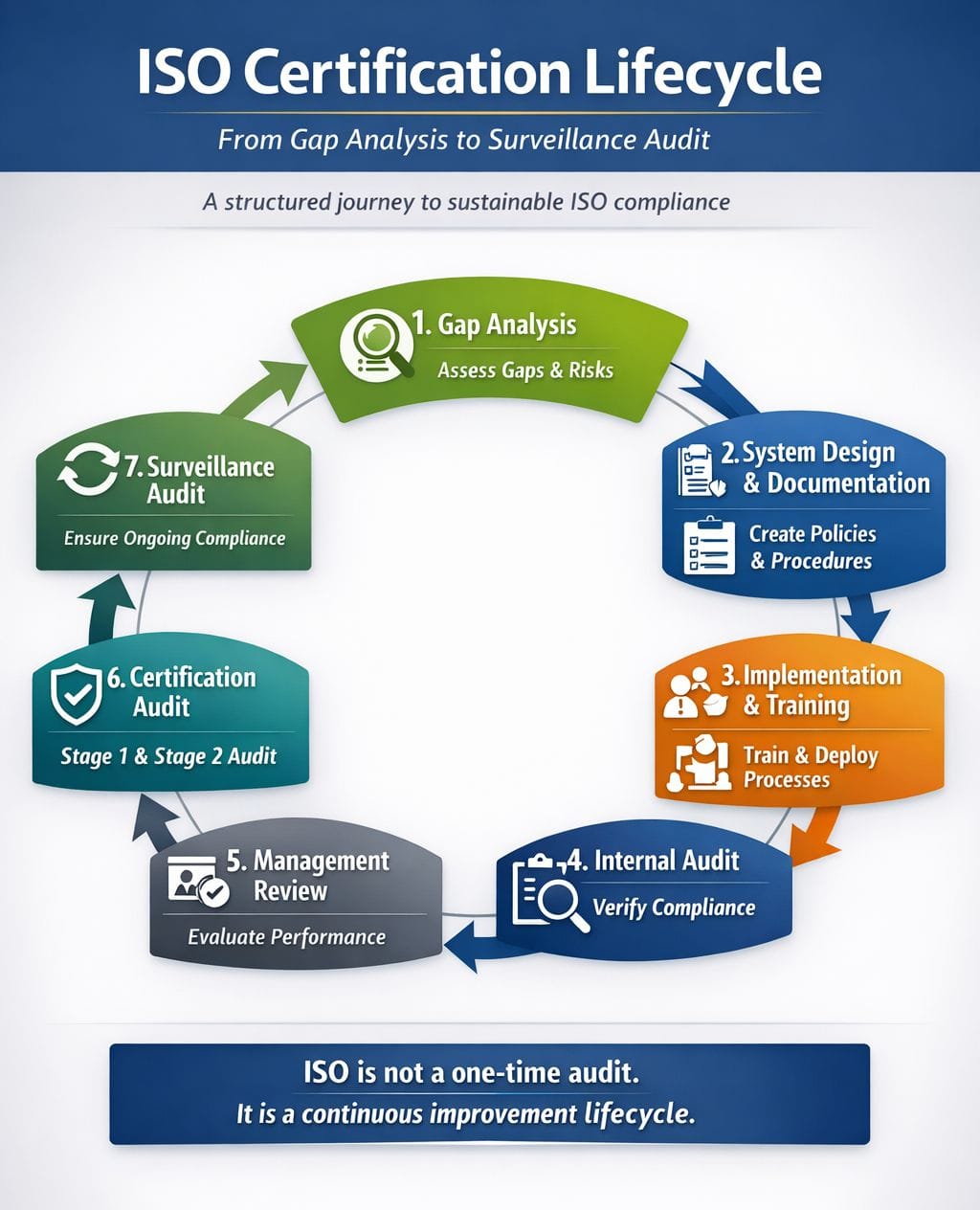
Step 1: Gap Analysis (Week 1-2)
You need to understand what you have versus what ISO requires. This is gap analysis.
Read Also: 5 Common ISO Certification Myths Debunked: Expert Insights From an Auditor
Good consultants spend time observing your operations, interviewing staff, reviewing existing documentation. They identify what's missing, what needs formalising, what you're already doing that just needs documenting.
DIY gap analysis is possible if someone internal understands ISO requirements. Most businesses need consultant help here because they don't know what they're looking for.
Step 2: System Development (Month 2-4)
Creating documented procedures, work instructions, forms, and records that meet ISO requirements while reflecting how you actually work.
This is where most first-timers struggle. They either create bureaucratic systems nobody will use, or oversimplified systems that won't pass audit.
The goal is documenting what you do, not creating theoretical processes. If your procedures don't match reality, you'll fail Stage 2 audit when auditor sees the disconnect.
Step 3: Implementation Period (Month 2-4)
ISO requires evidence your system is implemented and operating. You need 3-4 months of records showing you're following documented procedures.
This isn't optional. Certification bodies following IAF MD5 requirements check implementation evidence. If you developed system last month and booked certification audit this month, you'll fail.
During implementation, staff use new procedures, complete forms, generate records. Issues emerge—procedures need adjustment, forms don't capture right data, processes need refinement.
This is normal. The point is finding and fixing issues before external audit.
Step 4: Internal Audit (Month 4-6)
Before external audit, conduct internal audit checking your system meets ISO requirements and is effectively implemented.
Internal auditor checks all clauses, reviews records, interviews staff, identifies non-conformances. You fix issues before certification body arrives.
Many Australian businesses skip internal audit or do superficial job. Then they're surprised when certification auditor finds problems. Internal audit is your practice run—use it properly.
Step 5: Management Review (Month 6-8)
Top management reviews system performance, internal audit results, customer feedback, and decides on improvements.
This demonstrates leadership engagement—required by all ISO standards. Can't be delegated. CEO or managing director must participate.
I've failed Stage 1 audits where management review was clearly done by quality manager with CEO signature added later. Leadership involvement must be genuine.
Step 6: Stage 1 Audit (Month 8-10)
Certification body reviews your documentation, checks system readiness, identifies any major gaps before Stage 2.
I'm checking: Are all required procedures documented? Does documentation address all standard clauses? Is there evidence of implementation? Any major non-conformances that need fixing before Stage 2?
Stage 1 typically takes 1 day for small business, longer for complex operations. Conducted at your site or sometimes remotely by reviewing documents.
Outcome is either "ready to proceed to Stage 2" or "issues to address first." If major gaps exist, Stage 2 gets postponed until you fix them.
Step 7: Stage 2 Audit (Month 10-12)
This is the main audit. I'm verifying your system is implemented as documented and meets standard requirements.
Site walkthrough observing operations. Staff interviews checking they understand procedures. Records review verifying processes are followed. Evidence gathering confirming effectiveness.
Stage 2 duration depends on business size and complexity. Small service business might be 2-3 days. Medium manufacturer could be 5-7 days. IAF MD5 specifies minimum audit days—certification bodies can't shortcut this.
Most Australian businesses get minor non-conformances during Stage 2. That's normal. Major non-conformances delay certification until addressed. Zero non-conformances is rare but happens with well-prepared businesses.
Step 8: Certification Decision (1-2 weeks after Stage 2)
After Stage 2, I write audit report and submit to certification body's technical committee. They review the report and make certification decision.
If you had minor non-conformances, you submit evidence of corrections. Once accepted, ISO certificate is issued.
If you had major non-conformances, additional audit or verification is required before certification.
Step 9: Surveillance Audits (Every 12 months)
Certification is valid 3 years but requires annual surveillance audits. These are shorter audits checking you're maintaining the system.
I sample different areas each surveillance audit over the 3-year cycle, ensuring full system coverage. Duration is typically 30-40% of initial Stage 2 audit.
Step 10: Recertification (Every 3 years)
At end of 3-year cycle, recertification audit occurs. Similar to Stage 2 but considers 3 years of performance data, trends, and system maturity.
Successfully pass recertification and you get another 3-year certificate. Cycle repeats.
Realistic Timelines for Australian Businesses
Small service business (under 20 staff, single location, straightforward operations):
Gap analysis: 1 week. System development: 4-6 weeks. Implementation: 8-12 weeks. Internal audit and management review: 2 weeks. Stage 1: scheduled. Stage 2: 4-6 weeks after Stage 1.
Total timeline: 6-12 months from project start to certification.
This assumes dedicated internal resource, consultant support, and no major operational issues.
Small manufacturing (20-50 staff, single site, moderate complexity):
Gap analysis: 2 weeks. System development: 6-8 weeks. Implementation: 12-16 weeks. Internal audit and management review: 2-3 weeks. Stage 1: scheduled. Stage 2: 4-6 weeks after Stage 1.
Total timeline: 4-6 months.
Manufacturing adds complexity—production processes, quality control, equipment calibration, supplier management. All need proper documentation and implementation evidence.
Medium business (50-150 staff, possibly multi-site, complex operations):
Gap analysis: 3-4 weeks. System development: 8-12 weeks. Implementation: 16-20 weeks. Internal audit and management review: 3-4 weeks. Stage 1: scheduled. Stage 2: 4-8 weeks after Stage 1.
Total timeline: 6-12 months.
Multi-site operations require site sampling per IAF MD1 requirements. Multiple shifts, complex supply chains, various operational risks all extend timeline.
What influences timeline:
Existing system maturity. If you already have documented procedures and operational discipline, development phase is faster. Starting from scratch takes longer.
Internal resource availability. Dedicated project manager working 6-8 hours weekly moves faster than part-time effort squeezed between other priorities.
Management commitment. When leadership actively supports implementation, staff engagement is higher and timeline shortens. When it's treated as quality manager's problem, delays multiply.
Operational complexity. Simple service business is faster than complex manufacturing with regulatory compliance, hazardous materials, and multiple customer specifications.
Real Cost Breakdown (Australian Market 2026)
Consultant fees:
Small business (under 50 staff): $8,000-$15,000. Medium business (50-150 staff): $15,000-$30,000. Large or complex business: $30,000-$60,000+.
This covers gap analysis, system development, documentation, training, internal audit support, and Stage 1/2 preparation.
Certification body fees:
Small business: $3,000-$7,000 for Stage 1 + Stage 2. Medium business: $7,000-$15,000. Large business: $15,000-$30,000+.
Annual surveillance audits cost roughly 30-40% of initial certification audit. Recertification (year 3) costs roughly 60-80% of initial.
Internal time investment (the hidden cost):
This is what businesses underestimate. Internal staff time has opportunity cost even if you're not paying external fees.
Project manager role: 100-200 hours over 4-6 months. Department heads providing input: 20-40 hours each. Frontline staff in training and interviews: 2-5 hours per person. Management in reviews and decisions: 10-20 hours.
For 30-person business, total internal time might be 150-250 hours. At $75/hour average internal cost, that's $11,250-$18,750 in opportunity cost.
Total 3-year cycle costs:
Small business example: Consultant $12,000 + Initial certification $5,000 + Surveillance year 1 $2,000 + Surveillance year 2 $2,000 + Recertification year 3 $3,000 = $24,000 over 3 years.
Averages $8,000 per year. Plus internal time opportunity cost.
Government grants available:
Several states offer business improvement grants covering 30-50% of ISO certification costs.
Victoria: Various Business Grants can cover consulting fees. NSW: Various regional business support programs. Queensland: Business growth grants through DESBT. South Australia: Industry support programs.
Check your state's business development agency. Many businesses miss available funding because they don't investigate before starting certification.
DIY vs Consultant (The Honest Assessment)
When DIY works:
You have someone internal who has implemented ISO systems before. Not just worked in certified company—actually led implementation or has auditor training.
Your operations are relatively straightforward—professional services, consulting, simple manufacturing, trades without complex supply chains.
You have documented processes already—even if not ISO-formatted, you have procedure manuals, work instructions, quality controls written down.
Someone can dedicate 6-8 hours weekly for 4-6 months to project manage implementation.
When consultant is essential:
Nobody internal has ISO implementation experience. You're learning requirements while trying to implement them—recipe for mistakes.
Complex operations with multiple sites, shift work, hazardous processes, regulatory compliance beyond ISO, significant supply chain management.
Tight timeline driven by tender deadline or customer requirement. Consultant expertise accelerates process and reduces failure risk.
Previous DIY attempt failed. I've audited businesses on second attempt after initial DIY failure. Consultant costs less than wasted internal time from failed attempt.
Hybrid approach (what I recommend most):
Buy quality template toolkit with training ($1,500-$3,000). Use internal resources for gap analysis, initial documentation, and implementation. Hire consultant for 3-5 days of review, correction, and audit preparation ($3,000-$7,500).
Total investment: $6,000-$12,000 versus $15,000-$25,000 for full consulting.
You retain internal knowledge while getting expert guidance at critical decision points. This approach succeeds for capable businesses that lack specific ISO expertise.
Common First-Timer Mistakes I See Repeatedly
Treating certification as documentation exercise.
They create beautiful procedures nobody reads. When I interview staff during Stage 2, they've never seen the procedures. They're doing their jobs differently from documented processes.
This fails audit. ISO requires documented procedures match actual operations. If there's disconnect, you're either documenting incorrectly or not implementing properly.
Over-complicating procedures.
First-timers often create complex, bureaucratic procedures trying to cover every possible scenario.
I see 15-page procedures for simple processes that should be 2 pages. Forms requiring data nobody collects. Approval processes with 5 signatures when 1 is sufficient.
Complexity kills adoption. Staff ignore overly complex procedures and work around them. Then system fails during implementation.
Underestimating internal time required.
"The consultant will do everything" is common misconception. Consultant provides templates and guidance, but your internal team must customise documentation, implement processes, and operate the system.
Businesses allocate consultant budget but not internal resource time. Project stalls when internal staff can't dedicate required hours.
Choosing certification body based only on price.
Cheapest certification body often provides poorest service. Inexperienced auditors, rushed audits, poor communication, difficult surveillance audits.
I've worked for several certification bodies. Quality varies significantly. Cheap audits often mean offshore auditors with no Australian industry knowledge or inexperienced auditors building hours.
Check certification body's JASANZ accreditation, auditor experience in your industry, and client references before booking based on price.
Not involving frontline staff.
Management and quality manager develop entire system in isolation. Frontline staff first see procedures during implementation rollout.
Result: procedures don't match how work actually happens. Staff resist "head office" procedures that don't fit operational reality.
Involve frontline workers in procedure development. They know where processes break down and what documentation needs to capture. Their input creates usable procedures.
Rushing implementation before system is embedded.
Business develops system in 6 weeks then books certification audit immediately. No implementation period. No time to generate evidence. No opportunity to identify and fix issues.
I arrive for Stage 2 and there's 2 weeks of records. Procedures were finalised last month. Staff barely know the system exists.
This fails. ISO certification requires demonstrated implementation over time. You need 3-4 months of evidence showing the system works.
What Actually Happens During Audits
Stage 1 audit:
I'm reviewing documentation before site visit. Quality manual, procedures, forms, records samples. Checking all ISO clauses are addressed. Looking for obvious gaps or misunderstandings of requirements.
During site visit (if Stage 1 is on-site), I tour facilities, meet key staff, discuss system implementation progress.
I'm asking: Is documentation complete? Does it reflect actual operations? Is there evidence of implementation? Are staff aware of the system?
Stage 1 isn't pass/fail but readiness check. If major gaps exist, I recommend postponing Stage 2 until addressed. Minor issues can be fixed before Stage 2 proceeds.
Stage 2 audit:
Opening meeting: I explain audit scope, schedule, and process. Typically 15-30 minutes with management and key staff.
Site walkthrough: I observe operations, check how work actually happens, compare reality to documented procedures. Looking for obvious non-conformances or safety issues.
Department interviews: I talk with managers and staff about their processes. Can they explain procedures? Show me where documents are stored? Demonstrate how they handle non-conforming products or customer complaints?
Records review: I sample records across the audit period. Checking completeness, accuracy, evidence procedures are followed. Looking for patterns of compliance or non-compliance.
Evidence gathering: I collect objective evidence through observation, interviews, and records. This supports audit findings—both conformances and non-conformances.
Closing meeting: I present findings, explain any non-conformances, discuss next steps. Typically 30-60 minutes with management.
What I'm really assessing:
Does documentation match reality? If procedure says production checks happen hourly but records show daily checks, that's non-conformance.
Do staff understand their responsibilities? If quality procedure requires calibration checks but operator doesn't know what calibration means, that's implementation failure.
Is ISO system effective? Are you achieving intended outcomes? Reducing defects, improving safety, meeting customer requirements?
Is leadership engaged? Does management review show genuine analysis and decision-making, or is it paperwork exercise?
Minor vs major non-conformances:
Minor non-conformance: Isolated lapse, minor deviation, or documentation inconsistency. Doesn't prevent system from achieving objectives. Can be corrected quickly.
Example: One internal audit checklist missing signature. Training record filed incorrectly. Single procedure with outdated reference.
Major non-conformance: Systematic failure, complete absence of required process, or serious deviation affecting system effectiveness. Prevents certification until corrected.
Example: No internal audit conducted. Management review missing leadership involvement. Documented procedure completely different from actual practice.
Most first-time certifications get 2-5 minor non-conformances during Stage 2. That's normal. Major non-conformances occur in maybe 20% of first-time audits and usually indicate rushed implementation.
Maintaining Certification (The Post-Certification Reality)
Annual surveillance audits are mandatory.
Can't skip them. If you miss surveillance audit window, certification gets suspended. You'll need full recertification audit to reinstate.
Surveillance audits are shorter—typically 1-2 days for small business versus 3-4 days for initial Stage 2. I'm checking different system elements each year, ensuring full coverage over 3-year cycle.
Keeping system alive not just certified.
Biggest post-certification challenge is maintaining system momentum. Initial implementation had project energy, consultant support, certification deadline driving action.
After certification, it's easy to let system become stagnant. Procedures gather dust. Records become check-box exercise. Management review becomes annual paperwork.
Businesses that treat ISO as ongoing management tool see continued value. Those treating it as certificate to win tenders see diminishing returns and difficult surveillance audits.
Common reasons certificates get suspended:
Missed surveillance audit deadline. Failed surveillance audit with major non-conformances not corrected. Change in business scope without updating certification. Significant compliance failures or legal issues.
I've seen certificates suspended because businesses relocated without notifying certification body. Scope changed but certificate still showed old scope. Surveillance audit overdue by 18 months.
Suspension means certificate is invalid for tenders until reinstated. Reinstatement often requires additional audit and fees.
Recertification every 3 years:
Recertification audit is more comprehensive than surveillance. I'm reviewing 3 years of performance data, trends, improvements, system maturity.
Businesses with mature systems find recertification straightforward. Those barely maintaining compliance struggle because 3 years of weak performance is evident in records.
Australian-Specific Considerations
JASANZ accreditation is non-negotiable.
For Australian government tenders and major corporate contracts, certification body must be JASANZ accredited. International accreditation bodies (UKAS, ANAB, etc.) are recognised through IAF mutual recognition, but JASANZ is Australian and New Zealand standard.
Read: What's difference between Accreditation vs Certification
Always verify certification body's JASANZ accreditation status before engaging. Check JASANZ.org register. If they're not listed, their certificates won't be accepted in most Australian tenders.
Industry association support.
Some industry bodies provide ISO support to members. Master Builders, HIA, ACA, various professional associations offer guidance, templates, or member discounts on certification.
Worth checking your industry association membership benefits. Some provide significant value for first-time certifications.
AS/NZS standards integration.
Australia has joint standards with New Zealand (AS/NZS) in some areas. If you're operating in both countries or exporting to NZ, check whether AS/NZS standards apply alongside ISO.
Construction, electrical, and some manufacturing sectors have Australian-specific standards that integrate with ISO requirements.
My Final Advice After 7 Years of Auditing First-Timers
Start with business objectives, not certification.
Best certifications occur when business genuinely wants to improve operations and sees ISO as framework for doing so. Certificate becomes byproduct of building better management system.
Worst certifications are pure compliance exercises—get certificate to win tenders but zero interest in system effectiveness. These businesses maintain minimum compliance, struggle through surveillance audits, and get little value from certification.
Budget realistically including internal time.
$15,000-$20,000 total investment for small business including consulting, certification, and internal opportunity cost is realistic. Trying to do it for half that usually means cutting corners that create problems later.
Choose certification body based on value not just price.
I've worked for premium certification bodies and budget ones. Quality varies enormously. Experienced auditors provide insights that improve your business. Poor auditors just check boxes.
Ask for auditor qualifications, industry experience, and client references. Cheaper audit that provides no value costs more than premium audit that identifies improvement opportunities.
Implementation timeline matters more than certification deadline.
Don't rush implementation to meet tender deadline. Better to miss one tender with properly implemented system than rush certification with poor system that barely passes and struggles in surveillance.
Rushed implementations create ongoing pain. Proper implementations create lasting value.
Involve your people, not just your quality manager.
Systems succeed when staff at all levels understand and support them. Involve frontline workers in procedure development. Get management genuinely engaged in reviews and decisions. Make it organisation-wide effort, not quality department project.
Certification is beginning, not end.
Certificate opens tender opportunities. Real value comes from operating an effective management system that reduces errors, improves efficiency, and manages risks.
Businesses viewing certification as finish line miss the point. Those viewing it as starting point for continuous improvement get ongoing returns on their investment.
At CertBetter, our mission is to simplify the ISO certification process so Australian businesses can quickly discover, compare, and request quotes from verified providers.
We've verified over 50 consultants and certification bodies across Australia. Every provider on our platform is background-checked, insurance-verified, and JASANZ accreditation confirmed.
You can compare ISO quotes from multiple providers for free. No obligation. No sales pressure. Just transparent comparison of verified providers' pricing, services, and client reviews.
Whether you need consulting support, certification body selection, or both—compare your options before committing. See what different approaches cost. Read verified reviews from businesses like yours.
First-time certification doesn't have to be complicated. It just needs to be done properly.