In 14 years working in HSEQ, including 7 years as third-party auditor, I've seen hundreds of Australian businesses get blindsided by certification costs they never saw coming.
On this page
Most ISO certification bodies quote Stage 1, Stage 2, and surveillance audits. Businesses budget accordingly. Then invoices arrive with charges they didn't expect—GST, annual registration fees, certificate updates, travel costs, additional audit days. The quoted $15,000 becomes $22,000 once everything's included.
This isn't deliberate deception by most certification bodies. It's lack of transparent quoting.
Here's every cost you'll actually pay over a 3-year certification cycle, including the ones nobody mentions upfront.
The Quoted ISO Costs (What Everyone Knows About)
Every certification body quotes these in their proposals:
Initial certification (Year 1):
- Stage 1 audit (documentation review): Typically 1-2 days, $1,500-$4,000
- Stage 2 audit (on-site certification): 2-8+ days depending on size, $3,000-$16,000+
- Total Year 1 quoted: $5,000-$20,000 depending on business size and standard
Surveillance audits (Years 2 and 3):
- Annual audits: 30-40% of Stage 2 duration, $2,000-$8,000 per year
- Total Years 2-3 quoted: $4,000-$16,000
Recertification (End of Year 3):
- Full renewal audit: 60-80% of Stage 2 duration, $3,000-$14,000
Example quote for medium-sized business: Stage 1+2 $19,073, Surveillance 1 $7,660, Surveillance 2 $7,660, Recertification $13,875 = $48,268 total over 3-year cycle.
This is what certification bodies quote. But this is rarely what you actually pay.





The Hidden Cost Most Businesses Miss: GST
10% GST applies to all certification body fees in Australia.
Some ISO certification bodies quote GST-inclusive. Most quote GST-exclusive. That $48,268 quote becomes $53,095 with GST. Extra $4,827 you need to budget.
When comparing ISO quotes, verify whether prices include or exclude GST. I've seen businesses select "cheaper" quote only to discover it excluded GST whilst competitors included it.
Always ask: "Is this quote GST-inclusive or exclusive?"
If you're registered for GST, you claim it back. If you're not GST-registered (under $75K annual turnover), you pay it as additional cost.
Annual Registration Charges (The Stealth Fee)
Many ISO certification bodies charge annual registration or maintenance fees separate from audit costs.
Typical range: $350-$600 AUD per year.
This isn't audit time. It's administrative fee for:
- Maintaining your certificate in their database
- Providing access to online certificate verification system
- Annual certificate renewal documentation
- Keeping accreditation records updated
Over 3-year cycle, that's $1,050-$1,800 on top of audit fees. Some certification bodies include this in quoted prices. Many don't.
I've audited for bodies that charge separately and bodies that bundle it. Separate charging creates surprise invoices each anniversary. Bundled pricing is cleaner but sometimes makes headline quote appear higher when comparing.
Question to ask: "Do charge any annual registration charges, if yes, are these billed separately?"
ISO Certificate Administration Costs
Physical certificates and administrative changes cost extra with most certification bodies.
Hardcopy certificates: $100-$200 each Most certification bodies provide one complimentary certificate with initial certification. Additional copies cost money. If you need certificates for:
- Multiple office locations to display
- Framing in reception area plus one for quality manager's office
- Copies for key clients or tender submissions
You're paying $100-$200 per copy. Some businesses order 3-5 certificates, adding $300-$1,000 to costs.
Digital certificates are usually free and unlimited. Physical certificates are revenue generators for certification bodies.
Certificate updates: $200-$400 per change If your business:
- Changes legal name
- Changes registered address
- Adds or removes certified sites
- Updates scope of certification
Most ISO certification bodies charge $200-$400 administrative fee to reissue certificate with updated details. This isn't audit time—just admin processing and certificate reprinting.
I've seen businesses relocate offices mid-cycle and face $350 fee to update certificate address. Others undergo name changes following acquisitions and pay $400 for certificate reissue.
Logo usage fees: $0-$500 annually Some certification bodies charge annual logo licensing fees if you want to use their accreditation mark (UKAS, JASANZ logos) in your marketing. Not all bodies charge this, but international certification bodies sometimes do.
Check whether logo usage is included or requires separate licensing agreement.
Travel and Accommodation (The Geographic Penalty)
If ISO certification body isn't local, you pay auditor travel costs.
Melbourne business using Sydney-based ISO certification body pays:
- Return flights: $400-$800 per audit
- Accommodation: $200-$300 per night × audit days
- Hire car or taxi: $100-$200 per audit
- Meals allowance: $80-$120 per day
For 4-day Stage 2 audit: $800 (flights) + $1,200 (3 nights accommodation) + $150 (transport) + $360 (meals) = $2,510 extra not in original quote.
Over 3-year cycle with Stage 2, two surveillances, and recertification, travel costs add $6,000-$10,000.
Regional or remote Australian businesses pay more. Perth business using eastern states certification body faces $1,200+ return flights. Far North Queensland or Northern Territory locations add significant accommodation and travel costs.
Some certification bodies include travel in quoted prices. Others charge actual costs incurred. Always clarify:
"Are auditor travel and accommodation costs included in your quote, or charged separately at actual cost?"
If charged separately, request estimate based on your location. Don't assume travel is included unless explicitly stated.
Regional loading: Some certification bodies charge regional premium (15-25% higher audit day rates) for locations requiring significant travel. This partially covers their costs whilst remaining more transparent than surprise invoices post-audit.
Additional Audit Days (When Scope Grows)
IAF MD5 specifies minimum audit days based on employee count and complexity. But circumstances change. Common reasons additional audit days get added:
Multi-site expansion: You quoted certification for single site. During Year 1, you open second location and want it included in certificate scope. Certification body adds audit days for additional site sampling. Extra cost: $1,500-$4,000 per additional location depending on size.
Employee growth: You certified with 30 staff. By surveillance audit, you've grown to 45 staff. Employee count affects IAF MD5 audit duration calculations. Certification body recalculates and adds 0.5-1 day to surveillance audit. Extra cost: $800-$1,500 per audit going forward.
Scope expansion: Initial certification covered design and manufacturing. You add installation services mid-cycle. New scope element requires additional audit time to verify competency. Extra cost: $1,000-$3,000.
Increased complexity: Your risk category was initially assessed as "medium." Major contract win brings hazardous material handling, raising complexity to "high." Certification body increases audit duration per IAF MD5 requirements. Extra cost: $1,500-$5,000 for remaining cycle.
Major non-conformances requiring follow-up: If Stage 2 identifies major non-conformances, I issue conditional certification pending verification of corrections. Follow-up verification visit costs extra: $1,000-$2,500 depending on extent of verification needed.
Most certification bodies state in contracts that audit duration is indicative and subject to revision based on scope changes, employee growth, or complexity increases. This protects them legally but creates budget uncertainty for you.
Question to ask: "Under what circumstances might additional audit days be required, and what's your process for notifying us and agreeing revised fees?"
Cancellation and Rescheduling Fees
Life happens. Audits need rescheduling. This costs money. Typical ISO certification body cancellation/rescheduling policies fall under 14 days period.
More than 30 days notice: Usually no fee, or minimal admin charge ($100-$200)
14-30 days notice: 25-50% of audit fee charged even if audit doesn't proceed. Certification body has allocated auditor time and turned away other work.
Less than 14 days notice: 50-100% of audit fee charged. Auditor and travel are booked, cancellation costs the certification body significantly.
Example: Your 3-day surveillance audit quoted at $4,500. Key staff member has family emergency, you need to reschedule with 10 days notice. ISO Certification body charges 75% cancellation fee = $3,375, plus you still need to pay for rescheduled audit when it occurs.
Over 3-year cycle, one or two rescheduling situations can add $2,000-$5,000 in unnecessary costs.
I've seen businesses reschedule multiple times due to operational issues, paying thousands in rescheduling fees on top of actual audit costs.
This is preventable through better planning, but sometimes unavoidable due to emergencies.
How to minimise risk: Schedule audits during operationally stable periods. Avoid peak production periods, planned shutdowns, or key staff holiday periods. Confirm availability of all critical personnel before committing to audit dates.
The Biggest Hidden Cost: Internal Time
This isn't paid to ISO certification body, but it's real opportunity cost. Time your staff invest during certification cycle:
Initial implementation (Year 1):
- Quality manager project managing: 150-300 hours
- Department heads providing input: 20-50 hours each
- Frontline staff in training and interviews: 2-5 hours per person
- Management in reviews and approvals: 15-30 hours
For 40-person business, total internal time might be 400-600 hours. At $80/hour average internal cost (salary + on-costs), that's $32,000-$48,000 in opportunity cost during Year 1 alone.
Ongoing maintenance (Years 2-3):
- Internal audits: 40-80 hours annually
- Management reviews: 8-15 hours annually
- Procedure updates and document control: 30-60 hours annually
- Surveillance audit participation: 20-40 hours per audit
- Corrective action management: 20-50 hours annually
Annually adds 120-250 hours = $9,600-$20,000 per year in internal opportunity cost.
This is why DIY certification (no consultant) doesn't save as much money as expected. You're not paying consultant, but internal time investment increases dramatically. Internal staff working on ISO aren't working on revenue-generating activities.
Most businesses don't account for this when budgeting certification. They see consultant fee of $15,000 and think "We'll save that by doing it ourselves." Reality: internal time opportunity cost is $40,000-$60,000 versus consultant fee + reduced internal time of $20,000-$30,000.
ISO Consultant actually saves money when opportunity cost is considered properly.
Payment Structure Variations Between Certification Bodies
Different certification bodies have different payment terms. This affects cash flow significantly.
Payment model 1: Pay-as-you-go (Most common)
Stage 1 invoiced 2-4 weeks before Stage 1 audit. Stage 2 invoiced 2-4 weeks before Stage 2 audit. Each surveillance invoiced before respective audit. Recertification invoiced before recertification audit.
Advantages: Only pay for audits as they occur. If you terminate certification, you're not locked into prepaid fees.
Disadvantages: Invoice timing might not align with your budget cycles.
Payment model 2: Annual subscription
Certification body invoices entire year's costs upfront or in quarterly instalments. Year 1 covers Stage 1+2, Year 2 covers surveillance, Year 3 covers surveillance + portion of recertification.
Advantages: Predictable annual costs. Easy to budget. Some certification bodies offer 5-10% discount for annual payment.
Disadvantages: You pay upfront for audits that haven't occurred yet. If you cancel mid-year, getting refund can be complex.
Payment model 3: Full 3-year upfront
Some certification bodies offer discounted rate (10-20% off) if you commit to full 3-year cycle and pay upfront or in agreed instalments.
Advantages: Locked-in pricing protects against future rate increases. Largest discount available.
Disadvantages: Major upfront capital commitment. If business closes or changes direction, you've prepaid for audits you won't use. Some certification bodies offer partial refunds; others don't.
What I recommend: Pay-as-you-go for first cycle. You don't know this certification body yet. After successful first cycle, consider annual or 3-year commitment if you're confident in their service quality and your business stability.
Question to ask: "What payment terms do you offer? Can we pay per audit, annually, or is there discount for multi-year commitment? What's your refund policy if we need to cancel?"
Cost Transparency: What Good Certification Bodies Do
Reputable certification bodies provide itemised quotes showing:
- Stage 1 audit: X days @ $Y per day = $Z
- Stage 2 audit: X days @ $Y per day = $Z
- Surveillance 1: X days @ $Y per day = $Z
- Surveillance 2: X days @ $Y per day = $Z
- Recertification: X days @ $Y per day = $Z
- Annual registration fee: $X per year × 3 years = $Z
- Estimated travel costs (if applicable): $Z per audit
- GST: 10% of above = $Z
- Total 3-year cycle cost: $Z
Clear breakdown lets you compare apples-to-apples with other certification bodies.
Bad certification bodies provide vague quotes:
"ISO 9001 certification: $18,000"
What does this include? Stage 1+2 only? Full 3-year cycle? GST inclusive or exclusive? Travel included or extra? Maintenance fees included?
Vague quotes hide costs that emerge later via surprise invoices.
Red flags indicating poor cost transparency:
- Refusing to provide written quote
- Quote doesn't specify audit days allocated
- No mention of GST treatment
- Travel costs described as "actual costs" with no estimate provided
- Annual fees not mentioned
- No breakdown between Stage 1, Stage 2, surveillance, recertification
- Verbal quotes that differ from written contracts
If certification body won't provide transparent itemised quote, don't engage them. Cost surprises will follow.
How to Get True Total ISO Cost
When requesting certification body quotes, ask these specific questions:
- "Please provide itemised quote showing Stage 1, Stage 2, both surveillance audits, and recertification separately with audit days and rates specified."
- "Is this quote GST-inclusive or exclusive? If exclusive, please add GST line item."
- "Are annual registration or maintenance fees included in these prices, or charged separately? If separate, what's the annual fee?"
- "How many hardcopy certificates are included? What's the cost for additional copies?"
- "What's your fee for updating certificates if our address or name changes?"
- "Are auditor travel and accommodation costs included or charged at actual cost? If charged separately, please provide estimate based on our location."
- "Under what circumstances might additional audit days be required beyond this quote?"
- "What's your cancellation and rescheduling fee policy?"
- "What payment terms do you offer—per audit, annual, or multi-year? Any discounts for prepayment?"
- "What's your total 3-year cycle cost including all fees, GST, and estimated travel?"
Answers to these questions give you true total cost for comparison purposes.
Create comparison spreadsheet:
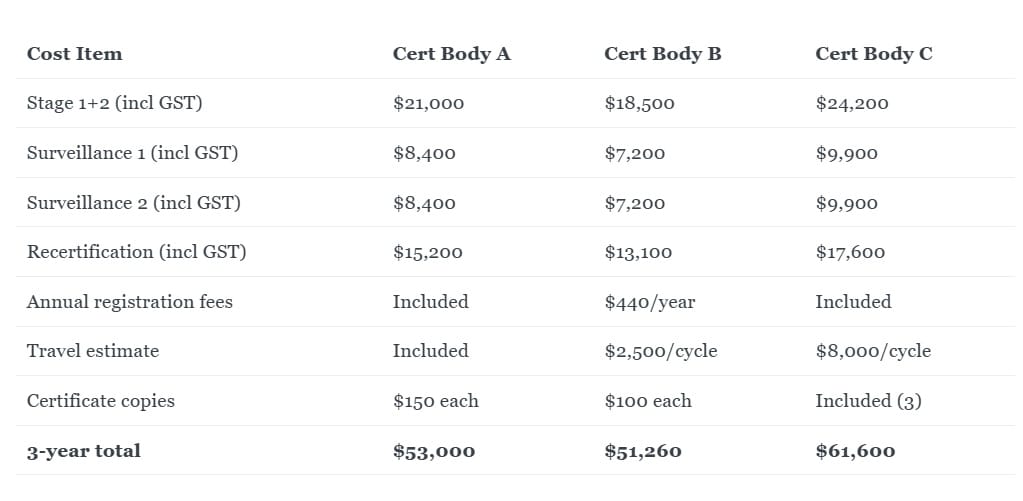
Now you're comparing accurately. Cert Body B looked cheapest initially ($46,000 quoted) but becomes $51,260 once travel and annual fees included. Cert Body A quoted higher ($48,000) but included everything, totalling $53,000.
Without itemisation, you'd have selected Cert Body B thinking you saved $2,000, only to discover actual cost was $1,740 less with Cert Body A after hidden costs emerged.
Real-World Example
45-person manufacturing business, ISO 9001:2015 certification, Sydney location, 2024-2026 cycle:
Original quote from certification body: $42,000 (GST-exclusive, 3-year cycle)
What they actually paid:
- Stage 1+2: $19,073 + $1,907 GST = $20,980
- Surveillance Year 2: $7,660 + $766 GST = $8,426
- Surveillance Year 3: $7,660 + $766 GST = $8,426
- Recertification: $13,875 + $1,388 GST = $15,263
- Annual registration: $400 × 3 years = $1,200
- Hardcopy certificates: $150 × 3 copies = $450
- Address update (relocation Year 2): $300
- Additional 0.5 days surveillance Year 3 (staff growth): $1,100
- Rescheduling fee Year 2: $2,000
Total actually paid: $58,145
Original quote: $42,000
Difference: $16,145 (38% more than quoted)
GST alone added $4,827. The rest was hidden costs they didn't anticipate. Not fraudulent—just lack of transparent quoting and unexpected circumstances.
Business was frustrated because they'd budgeted $45,000 (adding buffer to $42,000 quote). Actual cost $58,145 blew budget by $13,145.
How to Minimise Hidden ISO Costs
Strategies to control certification costs:
1. Get itemised quotes with all fees disclosed upfront No surprises if everything's in writing with clear breakdown.
2. Use local certification body to avoid travel costs Sydney business using Sydney certification body eliminates $5,000-$8,000 in travel over 3-year cycle.
3. Bundle multi-standard certification ISO 9001 + 14001 integrated costs less than separate certifications. Integration factor saves 15-30% versus separate audits.
4. Schedule audits carefully to avoid rescheduling fees Plan around operational stability. Confirm key personnel availability before locking dates.
5. Manage scope carefully—don't expand mid-cycle If opening new sites or significantly growing staff, wait until after surveillance audit to notify certification body. Expansion just before audit triggers immediate recalculation and additional costs.
6. Negotiate payment terms Ask for annual or 3-year discount if cash flow permits upfront payment.
7. Use digital certificates only Physical certificates are nice for wall display but $150-$200 each adds up. One physical for reception, rest digital for tender submissions.
8. Account for internal time in budget Most businesses underestimate internal opportunity cost. Budget $30,000-$60,000 (depending on size) for internal time during Year 1, $10,000-$20,000 ongoing annually.
9. Prepare thoroughly to avoid additional verification visits Major non-conformances requiring follow-up visits cost extra. Strong internal audit and management review before Stage 2 identifies issues you can fix before certification body arrives.
10. Read contract terms carefully Payment terms, cancellation policies, scope change provisions, and price escalation clauses are in contracts. Read them. Negotiate unfavourable terms before signing.
CertBetter: Transparent Pricing from Verified Certification Bodies
At CertBetter, you can request quotes from multiple certification bodies in seconds (always contact us for any support - auditor/consultant writing this). You compare true total costs, not misleading headline prices.
No hidden surprises. No wondering why invoice doesn't match quote. Just transparent pricing from JASANZ accredited certification bodies who've proven their pricing transparency.
Visit certbetter.com to compare certification body quotes with full cost transparency. See exactly what you'll pay over 3-year cycle before committing.
Certification costs enough without hidden surprises. Get transparency before signing.
Our ISO cost calculator factors in these hidden costs, not just the audit fee, so your estimate reflects what you will actually spend. Run the numbers before signing anything.